
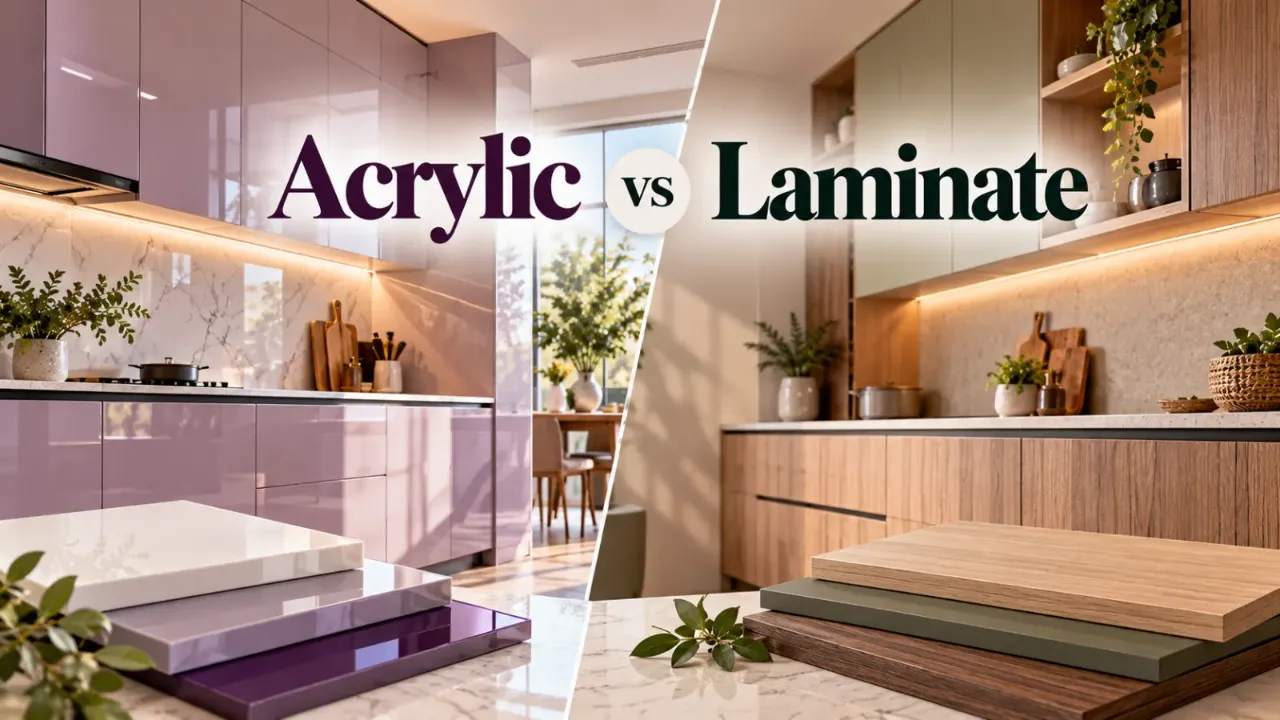
Acrylic vs Laminate
For Indian homeowners comparing kitchen shutters, wardrobes or a TV unit, the acrylic vs laminate decision usually comes down to a balance between visual finish, everyday wear, cleaning habits and the quotation—not simply which surface looks more premium. Both are decorative finishes applied over a board substrate, and either can work well when the underlying carcass, edge treatment and installation are specified properly.
Before you compare samples, it helps to see how locality listings and design professionals serving your area present these materials in completed homes. A sample can look excellent in a showroom and behave differently beside a sunny window, a hob or a frequently used wardrobe handle.
Acrylic and laminate: what are you actually comparing?
Acrylic is a high-gloss decorative surface, commonly supplied as a sheet or panel and bonded to a board such as MDF, plywood or another engineered substrate. Its appeal is the reflective, glass-like appearance and the depth it can give to a colour. Acrylic is often selected for contemporary kitchens, wardrobes and feature shutters.
Laminate is a layered decorative material pressed under heat and pressure. It is available in matt, textured, woodgrain, stone-look and glossy variants. The word “laminate” therefore covers a much wider visual range than the familiar brown woodgrain sheet. A good comparison must identify the laminate’s finish, thickness, texture and intended application.
Neither finish automatically makes a cabinet waterproof. Water resistance depends on the board, joints, edge sealing, hardware, installation and how spills are handled. This is one of the most important points to clarify before paying an advance.
Choose acrylic when appearance leads
Acrylic suits a clean, reflective look and can make a compact kitchen or wardrobe wall feel visually lighter. It is worth considering when you are comfortable wiping fingerprints and want a strong colour statement on selected shutters.
Choose laminate when practicality leads
Laminate is the more adaptable choice for many Indian homes. Matt textures are forgiving of smudges, woodgrains add warmth, and replacement or addition of a matching panel is often easier when the specification is recorded clearly.
Acrylic vs laminate: the detailed comparison
The table below is a starting point, not a substitute for a written material specification. Product quality varies within both categories. Ask to see the exact finish and edge detail proposed for your project.
| Factor | Acrylic | Laminate | What to check in the quotation |
|---|---|---|---|
| Visual character | Reflective, glossy and colour-forward; can resemble a polished glass surface. | Available in matt, gloss, woodgrain, stone-look and textured finishes. | Exact product range, colour code, finish and whether the sample is a true production sample. |
| Fingerprints and cleaning | Smudges and fine marks are generally more visible on dark or high-gloss colours. | Matt and textured options usually disguise everyday marks better. | Recommended cleaning method and whether abrasive cleaners are excluded. |
| Scratch visibility | Fine scratches can stand out on a reflective surface, especially in direct light. | Texture and pattern can make minor marks less obvious, but laminate is not scratch-proof. | Warranty exclusions, care instructions and the process for replacing a damaged shutter. |
| Colour and light | Reflection can brighten a room, but dark colours may show dust and handling. | Offers broad control over contrast, warmth and visual softness. | View the colour near your flooring, wall paint and daylight source. |
| Maintenance | Needs regular wiping if you want the glossy surface to remain visibly clean. | Usually straightforward; textured surfaces may need a soft brush or careful cloth cleaning. | Cleaning products to use, products to avoid and responsibility for installation defects. |
| Typical applications | Kitchen shutters, wardrobes, bar units and selected feature panels. | Kitchen and utility cabinets, wardrobes, study units, doors and full-home cabinetry. | Where each finish is being used and whether internal surfaces are included. |
| Cost position | Often positioned as a higher-finish option, but the final amount depends on brand, board, edge work and design. | Spans a wide range, from simple decorative sheets to specialised textures and premium finishes. | Rate basis, quantity, wastage, GST if applicable, hardware, transport and installation. |
Where each finish makes sense at home
Kitchen shutters
Acrylic can look striking on upper shutters or a tall pantry wall, particularly when paired with a quieter matt finish below. Laminate is often easier to live with across a busy kitchen because it offers texture and does not make every fingerprint part of the visual composition.
For either material, inspect the area around the sink, dishwasher and hob. Ask how exposed edges are sealed and whether the design keeps splash-prone joints away from standing water.
Wardrobes and dressing areas
Acrylic wardrobe shutters can give a narrow bedroom a brighter, more continuous plane, although adjacent windows may create glare. Laminate offers more flexibility for handles, finger grooves, woodgrain combinations and a warmer bedroom palette.
Do not judge only the shutter. Check the inside finish, shelf thickness, hinge quality, drawer movement and how the wardrobe meets skirting, ceiling and uneven walls.
TV units, studies and living spaces
Glossy acrylic can provide a clean accent on a TV unit, but a large reflective panel may catch ceiling lights and become visually busy. Laminate is useful for open shelving, wood-toned backing panels and study cabinets where a softer surface is easier to work beside.
Utility rooms and high-use zones
Utility areas reward sensible detailing over showroom shine. A textured or matt laminate can conceal dust and minor handling marks. If acrylic is used, reserve it for areas away from buckets, wet cloths and repeated impact.
What changes the price?
There is no responsible single price for acrylic or laminate cabinetry without a scope. Two quotations may use the same word—“laminate kitchen”—while allowing for very different boards, hardware, internal finishes and installation work.
- Board and construction: Plywood, MDF, particle board and other engineered boards have different specifications and uses. Ask for the board type and thickness for carcass, shutters, shelves and backs.
- Finish grade and brand: A basic laminate and a specialised anti-fingerprint, textured or high-pressure product should not be treated as equivalent. Acrylic sheets also differ in colour consistency, surface quality and edge treatment.
- Shutter profile: Plain shutters, routed designs, fluted details, cut-outs and integrated handles require different labour and may affect wastage.
- Edges and corners: Ask whether edge banding, acrylic edging, corner joins and exposed backs are included. A beautiful front with poorly finished edges will age badly.
- Hardware: Hinges, drawer channels, lift-up fittings, baskets, pull-outs and soft-close mechanisms can materially change the quotation.
- Site conditions: Wall deviations, service shafts, floor levels, lift access, dismantling, electrical changes and plumbing adjustments may add work beyond the cabinet finish.
- Quantity and design efficiency: A compact, well-planned layout can cost less than a larger installation with many narrow shutters, corner mechanisms or special features.
Use WallsToWonder tools before you approve the quote
A designer’s estimate is useful, but you should still understand what you are being charged for. Keep the scope, room measurements, finish samples and quotation together while comparing options. WallsToWonder’s tools can help you organise that first review.
Cost planning
Use the AI cost estimator as an early planning aid to think through rooms, scope and finish choices. Treat its output as an estimate, not a final contractor commitment. Confirm quantities and specifications with the designer or company serving your project.

Quotation review
Use the quotation checker to identify items that may need clarification, such as internal finishes, hardware counts, edge work, installation and exclusions. It cannot replace a site measurement or a careful conversation about the contract.
You can also browse design ideas to compare how matt, textured and glossy finishes behave in real room compositions. Save references by room rather than collecting isolated cabinet photographs; the surrounding light, flooring and wall colour affect the result.
How to compare designers and companies fairly
If you are speaking to more than one designer or company serving your area, give each of them the same brief. Include room dimensions, expected storage, preferred finish, board requirements, hardware preferences and a realistic move-in timeline. Otherwise, the lowest quotation may simply be the least complete one.
- Compare scope first. Check whether demolition, civil work, electrical changes, false ceiling, painting, delivery and installation are included or excluded.
- Compare the material schedule. The document should identify board type, thickness, exterior and interior finish, edge treatment, hardware make or specification, and locations of use.
- Compare drawings and measurement responsibility. A designer should explain what has been measured, what remains provisional and how changes will be approved.
- Compare service involvement. Ask who handles design revisions, site coordination, factory production, installation, snag correction and post-installation support.
- Compare payment stages. Payments should correspond to clearly described milestones. Do not rely on a verbal promise that an unspecified finish will be “upgraded later”.
Questions to ask before paying an advance
Take these questions to the meeting and record the answers in the quotation or scope document:
- What exact acrylic or laminate product, finish and colour code is included?
- Which board is used for each part: carcass, shutters, shelves, backs and lofts?
- How are exposed edges, sink units, corner joints and cut-outs sealed?
- Are internal cabinet surfaces included, and are they the same finish as the exterior?
- Which handles, hinges, channels, baskets and lift-up fittings are included by quantity?
- What happens if the approved colour is unavailable or the sample differs from the supplied batch?
- Who will take final site measurements, and what changes can trigger a revised quotation?
- What is excluded from the amount, including electrical, plumbing, civil and appliance-related work?
- How are damage, manufacturing defects, installation defects and replacement parts handled?
- When does production begin, and what payment is due at each agreed stage?
Red flags in an acrylic or laminate quotation
Material vagueness
“Premium acrylic”, “best laminate” or “waterproof board” without a product reference is not a sufficient specification. Ask for a written schedule and a sample linked to the room or cabinet location.
Unclear measurement basis
A rate per running foot can hide differences in height, depth, lofts, fillers, corner units and accessories. Confirm what one running foot includes before comparing totals.
Large advance, small paper trail
Be cautious when a substantial payment is requested before drawings, finish approval, scope and milestone terms are documented. A verbal assurance is difficult to use when the specification changes.
Pressure to decide from one sample
One glossy swatch cannot show edge quality, glare, cleaning effort or how a finish works across an entire room. Request a larger sample or visit a completed project where possible.
A simple decision framework
Use this sequence instead of beginning with the question, “Which one is better?”
- Identify the room’s pressure points. Is it exposed to cooking residue, wet hands, direct sunlight, children, pets or heavy daily use?
- Choose the visual behaviour. Decide whether you want reflection and colour depth, or a quieter surface that works with several materials.
- Set your maintenance tolerance. If frequent wiping will irritate you, be careful with dark, high-gloss acrylic on touch-heavy shutters.
- Specify construction before decoration. A dependable board, accurate installation, good hardware and sealed edges matter more than a fashionable surface alone.
- Compare complete quotations. Look at the total scope, not just the finish rate.
Many well-resolved homes use both. For example, a designer might pair glossy acrylic on a limited kitchen feature with laminate on lower cabinets, wardrobes and study storage. The mix works when the colours, handle language and edge details are coordinated.
Plan the next comparison with WallsToWonder
Use Design my room to organise a room brief, explore Find my style for finish direction, and browse Projects and Posts for reference ideas. When you are ready to speak with professionals, review designers and companies serving your area and use the AI interior assistant to structure questions for your consultation.
Frequently asked questions
- 1. Is acrylic better than laminate for an Indian kitchen?
- Not universally. Acrylic offers a glossy, reflective look, while laminate gives more choice in matt and textured finishes and can be easier to live with in high-use areas. The board, edge sealing, hardware and installation are equally important.
- 2. Which is easier to maintain, acrylic or laminate?
- Both can be cleaned with a soft, slightly damp cloth and the care method recommended for the product. Acrylic usually shows fingerprints and fine marks more clearly, while textured laminate may need careful cleaning in its grain.
- 3. Is acrylic waterproof?
- The finish alone does not make a cabinet waterproof. Moisture performance depends on the substrate, joints, edge sealing, plumbing conditions and installation. Ask for the complete construction specification, especially around sinks and wet zones.
- 4. Can acrylic and laminate be used together?
- Yes. Using one as an accent and the other for larger storage areas can balance reflection, warmth and maintenance. Match undertones and confirm the samples under the lighting in your home.
- 5. What should I check before choosing a designer for this work?
- Compare the same scope across proposals, including boards, finish codes, internal surfaces, edge treatment, hardware, installation, exclusions, payment stages and defect handling. Ask who takes final measurements and records approvals.
For another review of your material choices or to browse locality listings and relevant interior projects, keep the approved samples and final quotation together. That simple record will make later decisions—and any corrections—much easier.
Turn this idea into a plan for your home
Visualise your space, understand the likely budget, or find a professional who can bring the idea to life.