

Storage Ottoman or Coffee Table for a Worli Living Room? Compare Everyday Use
Choose between a storage ottoman and a coffee table by testing serving, storage, seating and movement in the actual room. In a Worli home, an upholstered top and a rigid table solve different tasks. Check the selected product’s intended use, opening method and footprint before deciding which belongs at the centre of the seating.
Start with your Worli property
For a Worli living room, start with the sofa, household routes and what normally lands on the central surface. A compact apartment, a separate sitting room and an open living-dining area create different briefs. Do not assume a locality implies a luxury layout or a particular floor area. Decide whether the priority is a serving surface, occasional seating, a footrest or accessible storage.
Define the primary job
List the ordinary activities: drinks, reading, games, remote controls, blankets or occasional guests. An ottoman intended for storage or a footrest is not automatically suitable for seating; check the actual product information. A coffee table usually offers a rigid surface but may add hard corners and less concealed storage. Compare the task that happens every day rather than buying a hybrid product on the promise that it performs every function equally well.
Test the complete open arrangement
Mark the footprint in front of the retained sofa. Sit, stand and walk to the usual doors and storage. For an opening ottoman, include its lid or moving parts and the user’s retrieval position. Do not treat the closed dimensions as the complete working envelope. A table with drawers also needs room for those fronts. Compare a side-table arrangement if the central piece makes movement awkward, rather than assuming every seating group requires a large object in the middle.
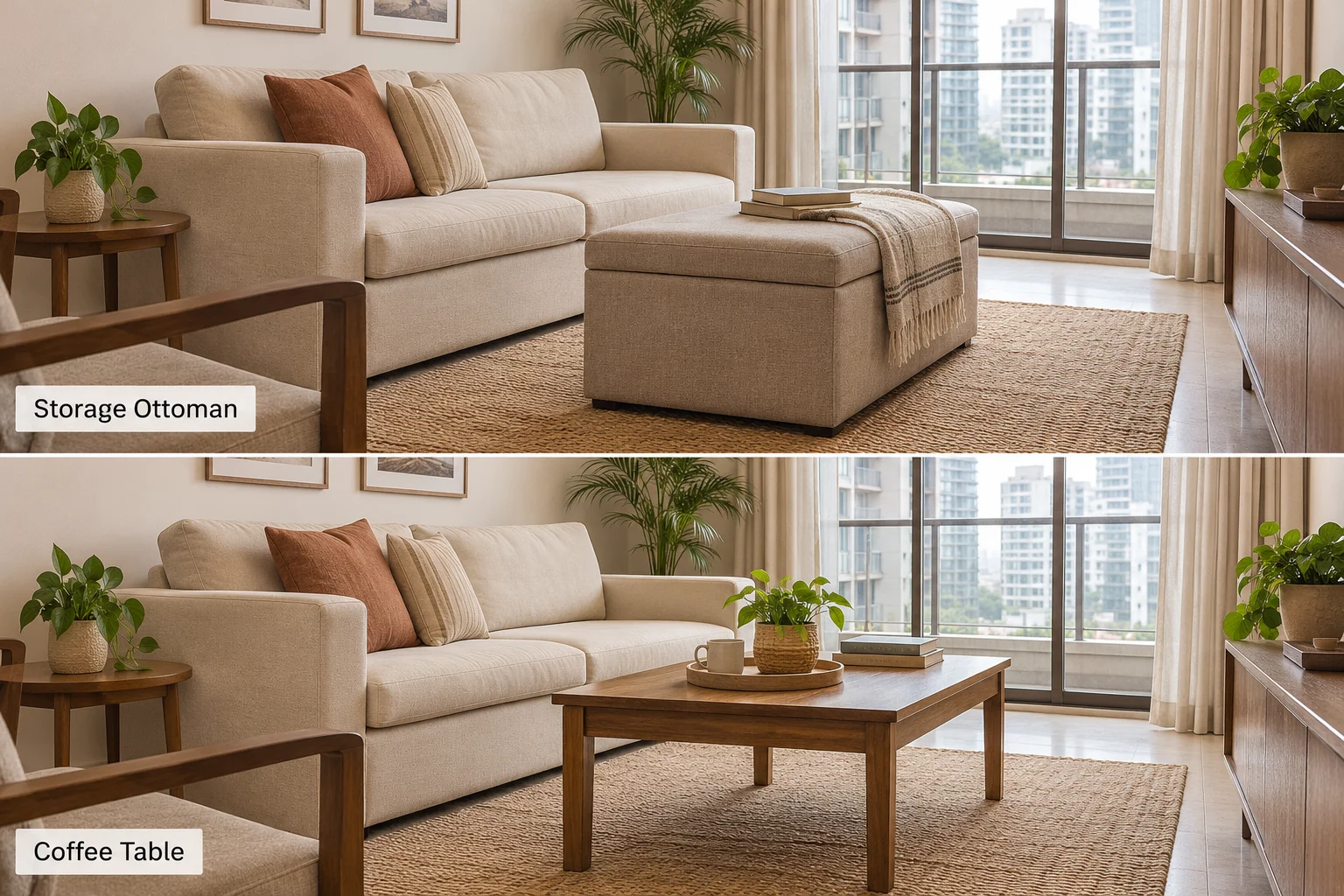
Match storage to the product
Choose contents suitable for the selected assembly and follow its operating and care instructions. Avoid using storage as a play area or assuming a lid is designed for unsupervised access by children. Decide how often items need to be retrieved and whether the top must be cleared first. A compartment holding rarely used objects may be convenient; one containing daily essentials can be frustrating if every opening requires moving a tray, books and decorative items elsewhere.
Consider surfaces and upkeep
Ask how upholstery, timber or other finishes are maintained and whether removable components or replacement parts are available. A tray does not make every upholstered surface a stable or heat-resistant serving area. Review the intended use with the supplier and choose a suitable surface for the household’s actual habits. At delivery, check the product and its mechanism as instructed, including what is needed to clean around and below it. The preferred option should work in an ordinary untidy moment as well as a styled photograph.
A practical example to test the decision
A household wants an ottoman to hide blankets and serve tea. A trial reveals that their usual serving arrangement needs a more suitable rigid surface and the blankets are used daily. They compare a small coffee table with storage elsewhere against an appropriate ottoman and separate side table. The choice follows tasks and operation instead of a promise that one product does everything.
Step-by-step planning checklist
- List the daily jobs of the central furniture.
- Check the exact product’s intended uses and care information.
- Trial the closed and open footprint with the sofa.
- Decide which items belong in any storage compartment.
- Test ordinary serving, retrieval and cleaning before accepting a custom solution.
What to put in the quotation
- Product model, intended use and usable dimensions.
- Opening mechanism and suitable storage access.
- Finish, care and replacement information.
- Delivery, assembly and any required product-specific installation.
Planning budget and scope
| Scope | Planning allowance or pricing method |
|---|---|
| Reorganise retained furniture | ₹0–₹3,000 initial allowance |
| Loose ottoman or coffee table | ₹6,000–₹25,000 initial allowance |
| Bespoke storage furniture | Measured product-specific quotation |
These are editorial starting allowances, not live Worli retail prices. Upholstery, construction, dimensions and hardware affect cost. Compare a whole arrangement, including any necessary serving surface or alternative storage, rather than the central piece alone.
Preparation and project timing
Complete a floor trial before ordering. Ready-made products follow stock and delivery; bespoke work needs measurements and sample approval. Keep the arrangement reversible until the household has checked how the top and storage are actually used.
Before you approve the proposal
Ask the household to use the proposed arrangement through a normal evening. Note where cups, devices and blankets go and what must be moved to open storage. This reveals whether a simple side table or a smaller central piece would work better. A useful comparison keeps the same sofa and room outline so one option does not win merely because the illustration silently removed furniture or enlarged the available space.
Prepare a clearer brief with WallsToWonder
Collect photographs, measurements and the choices you want to compare. Use Design My Room to explore a visual direction, then have the relevant professional check the measured layout, product requirements and work scope. Account access and current tool allowances apply; a visual concept is not a costed construction drawing.
Organise the scope with the interior cost planning tool and explore interior companies serving Mumbai. Confirm service availability for Worli directly and ask the firm to explain deliverables, site involvement and exclusions.
For related planning, read Coffee Table Decor Ideas: Three Layouts for Round and Rectangular Tables.
Frequently asked questions
Can every ottoman be used as a seat?
No. Confirm the selected product’s intended use and instructions.
Does a tray make fabric suitable for hot items?
Do not assume that. Choose surfaces and serving methods appropriate to the actual product.
Will storage reduce clutter?
Only when contents and retrieval fit the routine. A compartment that is awkward to open can shift clutter elsewhere.
Should the piece match the sofa exactly?
Physical fit and daily use matter first; visual coordination can follow.
What is the best first check?
Trial the footprint, including opening and retrieval, with the retained seating.
Turn this idea into a plan for your home
Visualise your space, understand the likely budget, or find a professional who can bring the idea to life.