
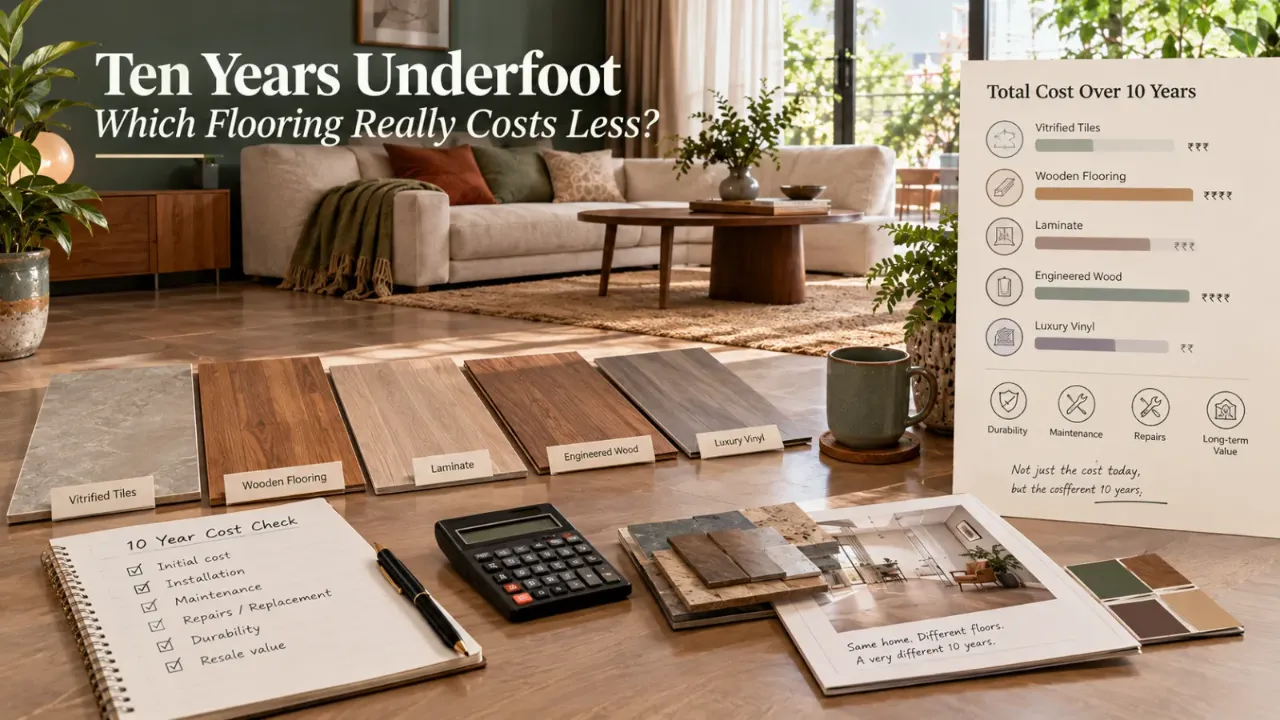
Ten Years Underfoot: Which Flooring Really Costs Less?
Flooring is one of those decisions that feels like a one-time purchase. You choose the material, pay for it, install it and move on. Except it isn't. A floor lives with you for years, and its maintenance, repairs, restoration and replacement can change the true cost significantly.
The Quick Answer
For a typical Indian home, vitrified tiles usually have the lowest long-term maintenance burden.
Marble can cost substantially more over time because it may require periodic polishing and more careful maintenance.
Engineered wood generally has the highest maintenance sensitivity of the three, especially where moisture, scratches or unsuitable use are involved.
Vitrified
Best for: practical, low-maintenance whole-home flooring.
Main strength: relatively low ongoing maintenance.
Marble
Best for: homeowners who value natural stone, unique veining and a finish that can be restored.
Main trade-off: polishing and greater care over time.
Engineered Wood
Best for: bedrooms, studies and spaces where warmth and underfoot feel matter.
Main trade-off: more sensitivity to moisture, surface damage and refinishing needs.
The interesting part begins when you put actual 10-year numbers against them.
Don't Compare Only the Purchase Price
The first mistake is treating the flooring material as the entire cost.
Depending on the material, some categories may be small while others become significant.
Vitrified may mainly involve installation and occasional repairs. Marble can add polishing and stone-care costs. Engineered wood can add refinishing, repair and moisture-related risks.
This is why the “₹X per sq ft” figure is only the beginning.
A 1,000 Sq Ft Example
To make the comparison easier, imagine you are flooring 1,000 sq ft.
These are deliberately illustrative mid-range planning assumptions—not quotations for a specific city or product.
Vitrified: ₹110/sq ft → ₹1.10 lakh
Marble: ₹180/sq ft → ₹1.80 lakh
Engineered wood: ₹250/sq ft → ₹2.50 lakh
The initial winner is obvious. But now add ten years of ownership.
Vitrified Tiles: The Low-Maintenance Option
Vitrified tiles are often the practical benchmark for Indian homes.
The appeal is straightforward. They are available in a huge range of colours, patterns and finishes. They are relatively easy to clean. And unlike natural stone or wood, they don't normally require routine polishing to maintain their everyday appearance.
The main expenses after installation are more likely to come from:
- Broken tiles
- Chipped edges
- Grout repairs
- Local replacement
- Accidental damage
The big advantage is that ongoing restoration is usually limited.
What Could Vitrified Cost Over 10 Years?
Initial installation: ₹1.10 lakh
Minor repairs/replacements over 10 years: ₹10,000
Estimated 10-year total: ₹1.20 lakh
That does not mean every 1,000 sq ft floor will cost ₹1.20 lakh. It simply illustrates the cost structure.
The important feature is that ongoing restoration is relatively limited.
The Real Advantage of Vitrified: Predictability
The biggest financial benefit of vitrified flooring may not be that it is always the cheapest material. It is that its maintenance cost is relatively easy to understand.
There is no major polishing cycle built into the ownership plan.
You clean it. You repair damaged pieces when required. And if a particular tile is damaged, replacing the affected tile can be simpler than restoring an entire natural floor system.
The catch? Keep a few spare tiles. A discontinued pattern ten years later can be much harder to match.
Marble: More Than a Material Purchase
Marble changes the calculation.
Natural marble is not just a flooring material. It is a natural stone surface whose appearance can be renewed through grinding, polishing and related maintenance processes.
That is one of its great strengths. It is also one of its ongoing costs.
Marble can stain, scratch and etch, depending on the stone and how the floor is used and maintained.
So the floor may need professional attention periodically to bring back its original finish.
Why Marble Looks Expensive Even After It Is Installed
A polished marble floor can age beautifully. But part of that appearance comes from maintenance.
This is where homeowners sometimes compare a marble rate with a vitrified rate and stop there.
That is not a 10-year comparison.
The marble may later require:
- Polishing
- Stain treatment
- Sealing or resealing depending on the stone and system
- Scratch correction
- Repairs
- Local replacement work
Not every home will need every one of these. But they belong in the lifecycle conversation.
The 10-Year Marble Example
Initial installation: ₹1.80 lakh
Two professional polishing cycles: ₹60,000
Minor maintenance/spot repairs: ₹15,000
Estimated 10-year total: ₹2.55 lakh
Again, this is a planning illustration rather than a promised market rate.
The bigger lesson is that a marble floor can become significantly more expensive than its initial installation cost suggests.
But Marble Has an Advantage Tiles Cannot Fully Copy
Cost is only one part of the decision.
Marble has something many tile products are intentionally trying to imitate: natural variation.
No two stones have exactly the same veining and visual character.
For some homeowners, that is worth paying for.
And because marble can be professionally restored, a well-maintained floor can continue looking good for a very long time.
So the correct question isn't simply, “Is marble more expensive?” The better question is, “Is what marble gives me worth the extra lifecycle cost?”
Wooden Flooring Changes the Calculation Again
Wood brings an entirely different quality to a room.
It is warmer visually. It feels different underfoot. It can make a bedroom or study feel softer and more intimate.
But “wooden flooring” is not one product.
- Laminate
- Engineered wood
- Solid hardwood
These have different construction, maintenance requirements and expected service lives.
For this comparison, we are using engineered wood.
Why Wood Can Cost More Over Time
Engineered wood can look excellent for years when used in the right environment and maintained appropriately.
But unlike vitrified tile, you need to think more carefully about:
- Moisture
- Scratches
- Dents
- Furniture movement
- Cleaning method
- Refinishing
- Damaged boards
A water incident can be much more consequential for wood than for a typical vitrified floor.
And when the finish begins to show wear, restoration can require more specialised work.
The 10-Year Engineered Wood Example
Initial installation: ₹2.50 lakh
One major refinishing/recoating cycle: ₹1.00 lakh
Repairs and minor damaged-area work: ₹20,000
Estimated 10-year total: ₹3.70 lakh
The exact timing of refinishing depends on the product, finish, traffic and condition.
The point is that wood's lifecycle cost is much more sensitive to maintenance and restoration.
So Who Wins the 10-Year Cost Test?
1. Vitrified
₹1.20 lakh
Lowest illustrative 10-year cost and relatively predictable maintenance.
2. Marble
₹2.55 lakh
Higher initial and ongoing maintenance cost, but natural character and restorative potential.
3. Engineered Wood
₹3.70 lakh
Highest illustrative lifecycle cost in this example, with greater sensitivity to refinishing and damage.
But remember what this table does not measure.
It does not measure comfort. It does not measure visual character. It does not measure resale perception. And it does not measure whether the floor suits the room.
That's why lifecycle cost should guide the decision—not make it automatically.
The Cheapest Floor Can Still Be the Wrong Floor
Imagine saving money by choosing a cheaper material for the entire home.
But the bedrooms now feel cold and uninviting to you. Or the living room doesn't have the natural character you wanted. Or you selected a surface that needs more care than your lifestyle allows.
You may technically have spent less. You may also regret the decision every day.
Flooring is one of those decisions where the lowest number is not always the best answer.
Room-by-Room, the Winner Can Change
Living Room
Vitrified and marble can both work well. Marble may be attractive when you want a more natural, high-end visual language. Vitrified can deliver a similar visual direction with a wider range of patterns and a simpler maintenance profile.
Bedrooms
This is where engineered wood becomes much more interesting. The warmer feel can be a genuine benefit in a bedroom. Because bedrooms generally have different use patterns from kitchens and balconies, the material may be easier to protect.
Kitchen
Vitrified is usually the safer practical choice for the floor. Cooking brings spills, water, dropped objects and frequent cleaning. The flooring should make life easier, not more delicate.
Bathrooms
This is not where generic “wooden flooring” should automatically be placed. Wet-area flooring needs materials and finishes specifically suitable for repeated water exposure and slip considerations.
Study or Home Office
Engineered wood can make sense here, especially when visual warmth is a priority. But think about chair movement, protective pads and cleaning habits.
The Biggest Marble Cost Trap: Choosing It Everywhere
Marble can look spectacular across a large home. But do you actually need it everywhere?
You might prefer to concentrate it in:
- Entry
- Living
- Dining
- Feature areas
This approach can reduce both the initial cost and the future maintenance burden.
The same principle applies to wood. You don't need wooden flooring everywhere to get the feeling of warmth.
The Biggest Wood Cost Trap: Treating It Like Tile
Wood needs a different maintenance mindset.
Dragging heavy furniture? Different risk.
Standing water? Different risk.
Aggressive cleaning? Different risk.
High-traffic chair movement? Different risk.
The floor can be beautiful for years, but only when its maintenance matches its material.
A common mistake is installing wood and then expecting it to behave like a vitrified floor.
It won't.
What About Replacement?
Replacement changes the 10-year calculation dramatically.
Suppose a floor suffers enough damage that parts—or the entire floor—need replacement.
That is where a seemingly inexpensive material can become expensive.
For example, laminate flooring cannot simply be sanded and polished like solid wood. Similarly, a badly damaged wood floor may require board replacement or more extensive restoration.
Vitrified tiles can also require replacement after severe damage, but the repair can sometimes be local rather than whole-room.
This is why the construction and repair method matters as much as the surface.
Maintenance Has a Human Cost Too
This is a cost homeowners rarely put into spreadsheets.
Time.
Imagine two floors. One requires careful cleaning products, frequent attention to spills and periodic specialist maintenance. The other needs ordinary cleaning and occasional repair.
Even when the rupee difference is manageable, the difference in effort may not be.
What Happens With Water?
Water is where these three materials begin to separate more clearly.
Vitrified tiles generally handle ordinary household moisture well when correctly installed and detailed.
Marble is more sensitive because natural stone can absorb or react to certain substances, and the exact behaviour depends on the stone and finish.
Wood is more vulnerable to moisture and prolonged water exposure.
That makes the room itself a critical part of the flooring decision.
What About Sunlight?
Direct sunlight can affect the appearance of flooring materials over time.
This is particularly relevant for wood finishes and certain surface coatings.
Large windows, balconies and highly sun-exposed rooms should therefore be considered separately rather than treated like shaded bedrooms.
The lesson is simple: the room's conditions are part of the flooring specification.
Initial Cost vs Lifecycle Cost
Lifecycle Cost = What you spend to keep the floor usable and looking the way you want over time.
These numbers can point in different directions.
A material may be expensive initially but relatively stable later. Another may be cheaper initially but require replacement or restoration.
The only way to know which one makes financial sense is to look at the whole period.
When Vitrified Is the Smarter Choice
- Predictable maintenance
- Practical everyday use
- Broad style choice
- Easy cleaning
- Consistent appearance
- Budget control
- Whole-home application
It is especially attractive when you don't want your floor to demand much attention.
When Marble Is Worth Considering
- Natural stone character
- Unique veining
- A premium visual language
- The ability to restore the surface
- Long-term visual presence
The key is accepting that maintenance is part of owning marble.
When Engineered Wood Is Worth the Extra Cost
- Warmth
- Tactile comfort
- Bedroom ambience
- A softer visual palette
- A more residential feel
The question is whether you are willing to maintain it appropriately.
Wood is not necessarily a poor financial choice. It is simply a different value proposition.
Don't Forget the Cost of Removing the Old Floor
What happens if you renovate ten years later?
You may need to pay for:
- Demolition
- Removal
- Debris disposal
- Subfloor repair
- New installation
A flooring decision therefore has an end-of-life cost too.
For a proper lifecycle comparison, think:
The 10-Year Questions to Ask Before Choosing
- Will I still like this floor in ten years?
- How much maintenance am I realistically willing to do?
- What happens if one section gets damaged?
- Can it be repaired locally?
- Does the room expose the material to water or strong sunlight?
- What will restoration cost?
- What happens when I eventually renovate again?
These questions reveal far more than a sample board at a showroom.
Don't Let the Showroom Decide Your Budget
Showrooms naturally make products look their best.
A large marble slab under perfect lighting can be irresistible. A warm wood display can make an ordinary bedroom feel luxurious. A giant tile wall can make vitrified flooring look almost architectural.
That's useful for inspiration.
But before you decide, translate the sample into your home.
Ask:
- How much will this cost for my actual area?
- What will it cost to install?
- What will it cost to maintain?
- What happens if it gets damaged?
- What will it cost after five years?
- What about after ten?
Now you're making a decision based on ownership—not display.
The Better Strategy: Mix Flooring Intelligently
Living + Dining
Marble or premium vitrified, depending on the desired look and maintenance preference.
Bedrooms
Engineered wood where warmth and comfort are priorities.
Kitchen
Practical vitrified flooring designed for frequent cleaning and everyday spills.
Bathrooms + Utility
Wet-area appropriate flooring selected for moisture and slip considerations.
This can give you the best balance between cost, comfort, durability and visual character.
The Bottom Line
Over ten years, the cheapest flooring is often the one that asks the least from your wallet after installation.
Illustrative 10-Year Cost
Vitrified ≈ ₹1.20 lakh
Illustrative 10-Year Cost
Marble ≈ ₹2.55 lakh
Illustrative 10-Year Cost
Engineered Wood ≈ ₹3.70 lakh
Those are not universal market prices. They are a way to understand the economics of ownership.
The bigger lesson is more important:
Look at what you pay on day one. Then look at what the material asks from you in year three, year five and year ten.
And finally ask whether the experience it gives you is worth that total.
Because flooring is not just something you buy. It is something you live on for years.
Plan the Flooring Before You Finalise the Interior
Flooring affects furniture, colour, lighting and the overall feel of a room, so it helps to visualise the complete space before finalising the material. You can use Walls to Wonder's Design My Room tool to explore different room directions.
For a broader budget view, Walls to Wonder's Interior Cost Estimate tool can help you think through the cost of your interior project and material preferences.
When you're ready to take the idea into execution, explore professionals through the Walls to Wonder designer directory.
Final Thought
The floor you choose today will outlast the trend you are currently following.
So don't ask only:
Ask:
Sometimes that is the same answer. Sometimes it isn't.
And that is exactly why the smartest flooring decision begins with ten years—not day one.
Frequently Asked Questions
Which is cheaper over ten years: vitrified or marble?
Vitrified flooring will often have the lower 10-year ownership cost because its maintenance is relatively simple and it generally does not require periodic professional polishing. Marble can cost more because polishing and stone maintenance add to the lifecycle expense.
Is wooden flooring more expensive than vitrified tiles?
Engineered wood is often more expensive initially than standard or mid-range vitrified flooring. Its long-term cost can also be higher because refinishing and repairs may be required depending on use and condition.
Does marble need polishing every few years?
Marble commonly benefits from periodic professional polishing or restoration as its surface becomes dull, scratched or worn. The frequency depends on traffic, maintenance and the condition of the floor.
What type of wooden flooring is used for this comparison?
This article uses engineered wood as the representative wooden-flooring category. Laminate and solid hardwood have different costs, maintenance requirements and replacement patterns.
Is vitrified flooring maintenance-free?
Not literally. It still requires routine cleaning and may occasionally need grout repair or individual tile replacement. The point is that its ongoing specialist maintenance is generally limited compared with materials that need polishing or refinishing.
Which flooring is best for bedrooms?
There is no universal answer. Vitrified is practical and easy to maintain, while engineered wood can provide a warmer visual and tactile experience. The room's moisture exposure, lifestyle and maintenance expectations should guide the decision.
Can marble be cheaper over the very long term because it lasts longer?
Potentially, but durability alone does not determine total cost. Initial installation, maintenance, polishing, repairs and the actual condition of the floor all matter. A long service life becomes financially valuable only when the owner is willing to maintain the material appropriately.
Can wooden flooring be used throughout an Indian home?
It can be used in selected spaces, but the material and construction need to suit the room. Moisture-prone areas require particular caution, and the maintenance requirements should be understood before choosing wood for large areas.
Should I use the same flooring throughout the house?
Not necessarily. Different rooms have different moisture levels, traffic patterns and functional needs. Using different materials strategically can create a better balance between appearance, cost and performance.
What should I include when comparing flooring quotations?
Compare material, installation, adhesive or fixing system, wastage, skirting or edge details, surface preparation, maintenance requirements, polishing or refinishing, likely repairs and any future replacement costs.
Get a personalised estimate for your home
Choose your rooms, materials and preferences to understand a practical interior budget before you commit.