
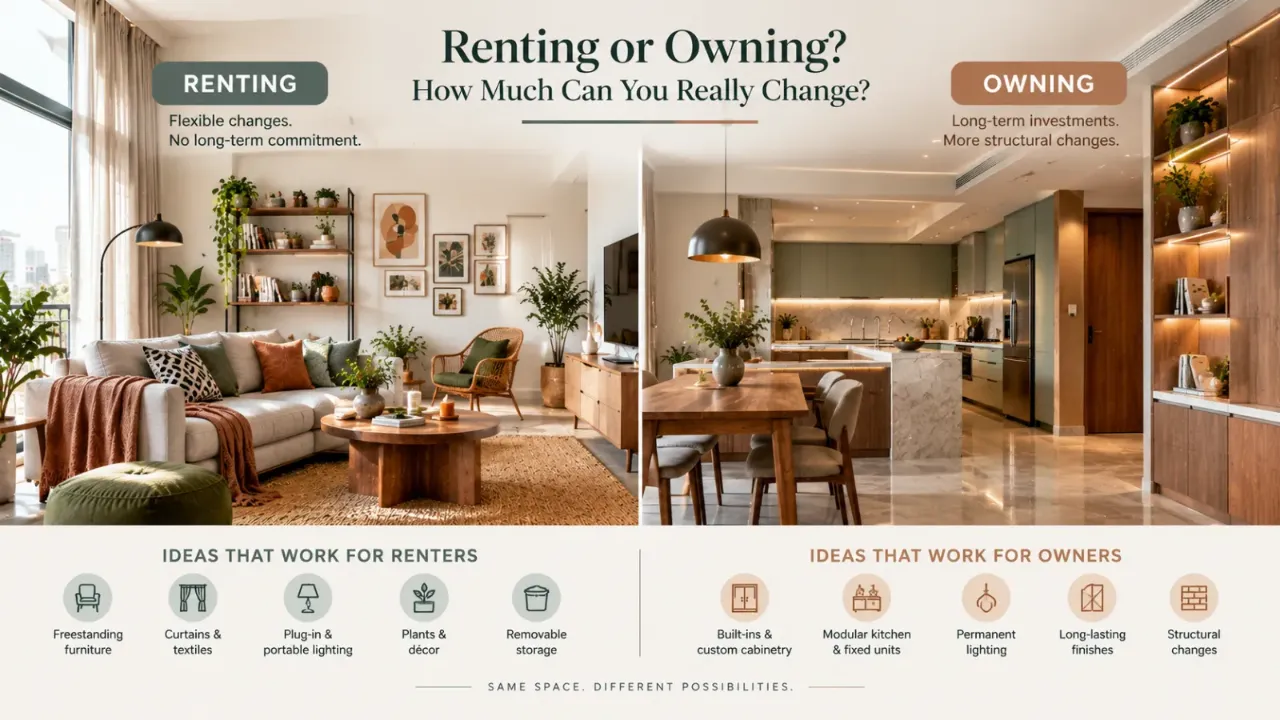
Renting or Owning? How Much Can You Really Change?
The same room can present two completely different design opportunities depending on one thing: do you own it or rent it? In an owned home, you can usually think long term and consider permanent improvements. A rented flat is different. The home may be yours to live in, but the property itself belongs to someone else. That changes where your design freedom comes from.
A rented home offers plenty of freedom through furniture, lighting, rugs, curtains, artwork, plants and other reversible styling choices, while an owned home gives you greater scope for permanent changes such as built-ins, flooring, kitchen work, bathroom upgrades and infrastructure changes. The smartest strategy depends on what you can change, how long you plan to stay and whether the investment can travel with you.
- Design Freedom Is Not All or Nothing
- The Four Levels of Interior Change
- What Renters Can Change More Easily
- The Existing Floor Is Not the End of the World
- The Same Principle Applies to Kitchen Cabinets
- Lighting Is One of the Biggest Rental Design Tools
- What Owners Can Do Differently
- Where Renters Should Be More Strategic With Money
- Build a Rental Around Portable Design Assets
- Owned Homes Can Think in Terms of Infrastructure
- How to Make a Rental Feel Less Temporary
- The Best Design Strategy Depends on How Long You Will Stay
- The Real Difference: Temporary, Reversible and Permanent
- Final Thought
- FAQ
Design Freedom Is Not All or Nothing
It is easy to think of interiors in two categories: owners can do whatever they want, while renters cannot change anything. Both ideas are too simplistic.
Design decisions exist on a spectrum. Some changes are completely temporary. Some are easy to reverse. Some need permission. Some are technically possible but financially difficult to justify. And some are permanent investments that make more sense when you own the property.
Understanding this difference can help you spend money more intelligently.
It is not simply, “Can I change this?” Ask instead, “Should I invest in changing this?”
The Four Levels of Interior Change
Rugs, curtains, cushions, artwork, mirrors, freestanding furniture, decorative objects, plants and lamps can dramatically change a room without altering the property itself.
Removable wallpaper, temporary hooks, peel-and-stick surfaces, freestanding storage and certain non-permanent lighting solutions can offer more customisation while remaining easier to undo.
Painting, changing fixtures, installing certain lighting, drilling extensively or modifying cabinetry may require the property owner's approval.
Kitchen renovations, bathroom redesigns, built-in wardrobes, flooring replacement, electrical planning, plumbing changes and internal layout adjustments are more relevant to long-term owners.
For a rental, check the lease and obtain permission where required before making changes that affect the property.
What Renters Can Change More Easily
A rented home can still go through a significant visual transformation without touching its permanent structure.
Start with the things you bring in rather than the things you inherit from the property.
A sofa, chairs or a freestanding cabinet can completely change the character and function of a room.
Large rugs, cushions and throws add colour, softness and visual structure.
Window treatments can change the perceived height, softness and atmosphere of a room.
Artwork, books, plants and meaningful objects create personality without redesigning the property.
Think in Layers
A rental-friendly design can follow this sequence:
This gives you multiple opportunities to personalise the room before considering permanent modifications.
The Existing Floor Is Not the End of the World
Flooring is often one of the biggest frustrations in rented homes. You may dislike the tiles, the laminate may not match your style or the floor may make the room feel dated.
But replacing it may not be practical. Large area rugs can visually cover significant sections of flooring, while furniture can reduce the amount of floor that dominates the room.
The right wall colours, textiles and lighting can also shift attention away from a finish you do not love.
You do not always need to replace the background. Sometimes you need to change what the eye notices first.
The Same Principle Applies to Kitchen Cabinets
A rental kitchen may come with cabinetry that is functional but not particularly attractive. Replacing it may make little financial sense, especially when you may eventually move.
Instead, look at what can change around it: improve the lighting, add a rug where practical, introduce artwork nearby, use removable organisers inside cabinets and bring in a freestanding trolley or storage unit where space allows.
The objective is not to pretend the original kitchen does not exist. It is to make the whole composition feel more intentional.
Lighting Is One of the Biggest Rental Design Tools
Lighting is particularly powerful because it can transform a room without requiring structural work.
A basic rental flat may rely heavily on ceiling lights. Floor lamps, table lamps, plug-in lights and carefully positioned accent lighting can create a more layered atmosphere.
Combine general illumination with floor or table lamps to create a softer evening atmosphere.
Use a dedicated task light so the area feels intentional rather than simply adding another decorative object.
Bedside lighting can introduce warmth and make the room feel more layered.
A lamp on a sideboard or console can draw attention to artwork and styling without changing the architecture.
What Owners Can Do Differently
Ownership changes the calculation because permanent improvements stay with the property.
An owner may decide to create storage around the actual dimensions of the room rather than buying freestanding furniture. Lighting can be planned around furniture layouts. Kitchen workflow can be redesigned. Bathroom storage can be improved. Finishes that no longer suit the home's long-term needs can be replaced.
These decisions affect how the home functions, not just how it looks.
A rental asks, “How can I adapt this space?”
An owned home allows you to ask, “How can I redesign the space?”
Where Renters Should Be More Strategic With Money
One of the biggest mistakes renters make is spending heavily on improvements they may have to leave behind.
Suppose you expect to move within two years. Spending a large amount on a permanent flooring change may not make sense. But investing in a high-quality sofa, rug, artwork or lighting may continue to benefit you in your next home.
Buy the things that can travel with you.
That does not mean buying cheap furniture because the home is temporary. It means investing in pieces whose value survives the address.
Build a Rental Around Portable Design Assets
Think of your furniture and decor as a collection that moves with you.
A good sofa, chair or cabinet can work in several different homes.
A well-chosen rug can define a room even when the underlying flooring changes from home to home.
Art can adapt to different wall arrangements and continue to build a consistent visual identity.
Portable lamps can move between rooms and properties while continuing to shape the atmosphere.
Instead of trying to make every rented flat perfect, build a collection of pieces that gradually becomes part of your own design identity.
Owned Homes Can Think in Terms of Infrastructure
For owners, the opposite strategy often makes sense. Instead of spending disproportionately on portable pieces, some of the budget can go toward things that improve the property itself.
Good storage planning, better lighting infrastructure, well-planned electrical points, thoughtful kitchen layouts, long-lasting materials and useful bathroom improvements can shape how the home functions for years.
These are not simply decoration. They are part of the home's infrastructure.
Don't Confuse Permanent With Better
A built-in wardrobe is not automatically better than a freestanding one. A renovated kitchen is not automatically better than a well-organised existing kitchen. A painted wall is not automatically better than a beautifully styled neutral wall.
The right choice depends on the problem you are trying to solve.
Sometimes a reversible solution does the job perfectly. Sometimes the problem is important enough to justify a permanent change.
Design freedom should be measured by usefulness, not by how dramatic the change is.
How to Make a Rental Feel Less Temporary
Because the home is temporary, people sometimes treat it like a waiting room. They postpone personalising it, buy random furniture, avoid hanging art and never fully unpack.
The result is a home that feels temporary because it has been designed temporarily.
Even a rented flat can benefit from a clear visual identity.
Choose a palette, select furniture intentionally, use textiles, display meaningful objects, create proper lighting and organise storage. Temporary ownership does not have to mean temporary living.
How Owners Can Avoid Over-Personalising
Owners face the opposite risk. Because the home belongs to them, they may be tempted to customise every corner around one specific preference.
Very bold finishes, highly specialised storage, unusual built-ins and permanent features designed around one current lifestyle can all work beautifully, but the more permanent the decision, the more carefully it should be considered.
A home should reflect you, but it should also remain adaptable to the future version of you.
A Room-by-Room Comparison
Renters can create major visual changes through furniture, rugs, curtains, lighting and art. Owners can additionally consider built-ins, electrical changes and permanent finishes.
Renters can focus on furniture, textiles, lighting and portable storage. Owners have greater scope for wardrobes, wall treatments and integrated storage.
Renters usually work around existing cabinetry and finishes, while owners can rethink storage, lighting, surfaces and workflow.
Renters generally benefit from accessories, organisation and non-permanent styling. Owners can consider larger changes to fixtures, storage, finishes and layout.
A Simple Freedom Test Before You Spend
1. Is it permanent?
Will it remain with the property?
2. Does it need permission?
Could it affect walls, plumbing, electrical systems, cabinetry or other fixed elements?
3. Can I take it with me?
Would the investment still be useful in another home?
4. Does it solve a real problem?
Is the change improving function, comfort or atmosphere?
This simple test can stop you from spending heavily on the wrong kind of improvement.
Your Lease Should Influence Your Design Strategy
For a rental, the lease is part of the design brief.
Do not assume that a change is allowed simply because it seems minor. Look at the rules around painting, drilling, fixtures, alterations, installations and restoration.
When something requires approval, confirm it before beginning the work and keep important permissions in writing.
The Best Design Strategy Depends on How Long You Will Stay
Time changes the equation.
Focus on removable styling, lighting, furniture, textiles and pieces you can easily take with you
You may decide that selected improvements are worth discussing with the landlord if they significantly improve daily life.
Long-term functionality can justify greater investment in storage, infrastructure, layouts and permanent finishes.
Future flexibility, durability and changing household needs become increasingly important design considerations.
Instead of asking only, “Do I rent or own?”, also ask, “How long am I planning to live here?”
The Real Difference: Temporary, Reversible and Permanent
| Type of Change | Typical Examples | Best Design Approach |
|---|---|---|
| Temporary | Furniture, rugs, art, curtains, lamps | Great for renters and easy to move between homes |
| Reversible | Removable wallpaper, temporary fittings, freestanding storage | Useful where a renter wants more personalisation without major permanence |
| Permission-Based | Painting, fixtures, drilling, selected installations | Check the lease and obtain approval before proceeding |
| Permanent | Built-ins, flooring, major kitchen or bathroom work | More suited to long-term ownership and property-specific investment |
Knowing which category a decision belongs to helps you decide where your money, time and effort should go.
Make the Most of the Space You Have
Whether you rent or own, thoughtful design starts with understanding the room, your lifestyle and the changes that will make the biggest difference.
Final Thought
A rented flat is not a place where design stops. And owning a home is not a licence to renovate everything.
The smartest approach is to match the scale of your design investment to the level of control you have over the property.
Renters can build beautiful homes through furniture, lighting, textiles, artwork and thoughtful styling. Owners can go further into infrastructure, built-ins and permanent improvements.
Both can create spaces that feel considered, comfortable and personal.
Because good interior design is not simply about how much you are allowed to change.
It is about knowing what is worth changing in the first place.
FAQ
Yes. Furniture, rugs, curtains, lighting, artwork, plants, textiles and portable storage can create a strong visual identity without major permanent changes.
No. Good-quality portable furniture can be a particularly useful investment because it can move with you to future homes.
Owners generally have more control over permanent changes, but building rules, approvals, technical constraints and other property-specific requirements can still apply.
Changes affecting walls, flooring, electrical systems, plumbing, cabinetry, doors or other fixed elements should be checked against the lease and approved where required.
It can be. Focus on improvements you can enjoy now and take with you later, rather than spending heavily on changes that are tied permanently to the property.
Turn this idea into a plan for your home
Visualise your space, understand the likely budget, or find a professional who can bring the idea to life.