

Porur Home Renovation: Plan Debris Collection and Removal Before Work Starts
Plan renovation debris handling before dismantling begins. For a Porur property, confirm the current authorised collection arrangements, site storage and contractor responsibilities using Greater Chennai Corporation guidance. Separate removal from ordinary household waste, keep the building’s access arrangements clear and obtain a written scope instead of assuming that demolition labour includes disposal.
Start with your Porur property
Porur projects should confirm the authority and arrangements applicable to the actual address. Greater Chennai Corporation publishes construction-and-demolition waste guidance, while building management controls additional site logistics within the property. Check both before work starts. This guide is a planning checklist, not a substitute for current official requirements or professional advice on a particular waste stream.
Identify material before removal
Ask the contractor to describe what will be dismantled, what is retained and which materials need separate assessment or handling. Do not treat every item removed from a home as ordinary mixed rubble. Potentially hazardous, electrical or other separately managed material needs the appropriate authorised route. Avoid breaking or handling an uncertain material to identify it yourself. Define who assesses and classifies the proposed waste and who confirms the collection requirements before the first removal activity.
Agree site storage and the building route
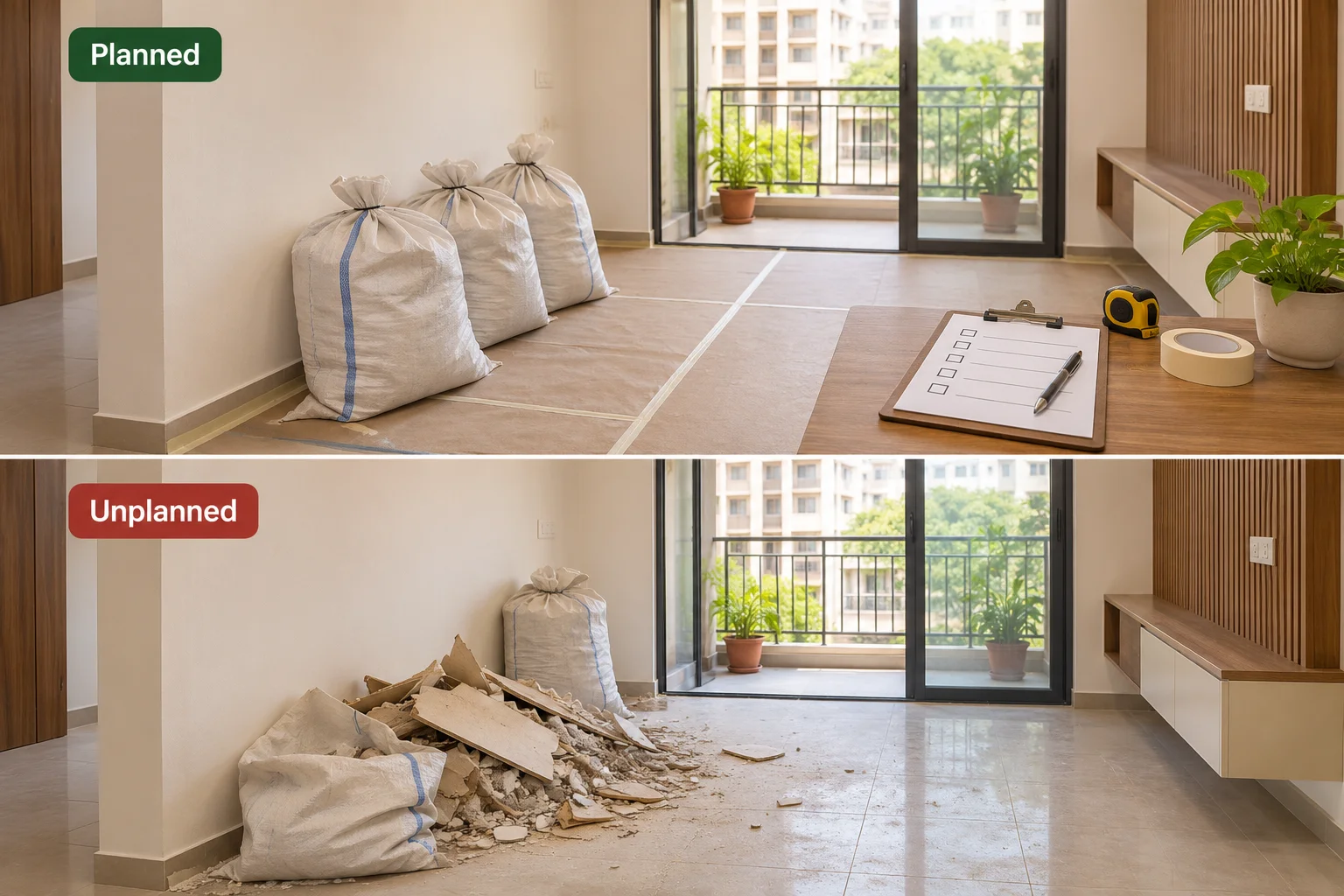
The Corporation’s published guidance addresses proper on-site management and removal; confirm the current details for the project. Do not assume a pavement, road edge or common escape route can be used for private debris storage. Coordinate a suitable assessed temporary location, protection and collection sequence with the contractor and building management. The material quantity and storage load need appropriate review rather than piling bags in an unassessed corner because it is out of sight.
Book the authorised process
Use the relevant current municipal information and authorised providers where required. Confirm how quantities are estimated, how collection is requested and who pays applicable charges. Avoid publishing or relying on an old flat tariff without checking the current service. Record the provider and the agreed destination or documentation requirements. A promise that a labourer will take material away does not explain whether the proposed handling and disposal route is appropriate.
Price and document the work
Separate dismantling, sorting where required, handling within the site, transport, authorised fees and final cleaning. Agree what records the contractor supplies and how additional quantities are approved. Keep ordinary household waste arrangements distinct from the renovation scope. Review the site after collection and check that retained finishes and shared access are restored as agreed. Responsibility should be explicit in the contract rather than discovered when full sacks remain after the workers leave.
A practical example to test the decision
A homeowner assumes a bathroom-removal quotation includes debris disposal. The contractor has priced only dismantling and bagging. Before work starts, they clarify classification, suitable temporary storage, building access and the current authorised removal process. The revised quote identifies handling, transport, charges and records, avoiding an undefined pile of material at handover.
Step-by-step planning checklist
- List retained and removed elements with the contractor.
- Confirm current municipal and building requirements for the address.
- Have storage, quantities and special handling assessed as appropriate.
- Book the required authorised removal route and assign responsibility.
- Collect agreed records and inspect the cleared site and access route.
What to put in the quotation
- Dismantling and handling scope, including any separately assessed materials.
- Suitable site storage and route protection.
- Collection provider, transport, applicable charges and responsibilities.
- Quantity changes, documentation, final cleaning and making good.
Planning budget and scope
| Scope | Planning allowance or pricing method |
|---|---|
| Estimate and planning | Agree who assesses the material and quantity |
| Handling and transport | Itemise the project-specific service |
| Official or authorised charges | Verify current applicable charges before booking |
Use a current project quotation and official service information. No universal Porur per-bag rate is assumed here. Material type, quantity, access and authorised handling can change the cost; compare a complete removal scope rather than demolition labour alone.
Preparation and project timing
Arrange collection and site logistics before dismantling. Coordinate agreed work and vehicle times with management and the provider. Plan staged removal where appropriately assessed, and do not leave booking until the last day of an otherwise finished renovation.
Before you approve the proposal
Ask one named person to coordinate the sequence across trades. If a second contractor removes joinery while another removes tiles, the handling responsibility should still be clear. Review changes before extra material is generated and update the collection plan accordingly. A tidy end photograph is useful, but the more important record is what was removed, who handled it and which authorised process was followed for the actual material.
Prepare a clearer brief with WallsToWonder
Collect photographs, measurements and the choices you want to compare. Use Design My Room to explore a visual direction, then have the relevant professional check the measured layout, product requirements and work scope. Account access and current tool allowances apply; a visual concept is not a costed construction drawing.
Organise the scope with the interior cost planning tool and explore interior companies serving Chennai. Confirm service availability for Porur directly and ask the firm to explain deliverables, site involvement and exclusions.
For related planning, read Questions to Ask a Decor Vendor Before Paying an Advance.
Frequently asked questions
Is renovation debris household waste?
Do not assume the ordinary household collection accepts it. Confirm the appropriate current authorised process.
Can bags stay on the pavement temporarily?
Do not assume public or shared access is available for storage. Follow applicable official and building requirements.
Does demolition labour include disposal?
Only if the written scope says so. Identify handling, transport and applicable charges separately.
Should I use a quoted old tariff?
Verify current official or authorised charges and the actual project scope.
What should I keep after collection?
The agreed provider details, quantity or service records, receipts and completion documentation required for the project.
Further reference: Greater Chennai Corporation C&D waste guidance.
Turn this idea into a plan for your home
Visualise your space, understand the likely budget, or find a professional who can bring the idea to life.