
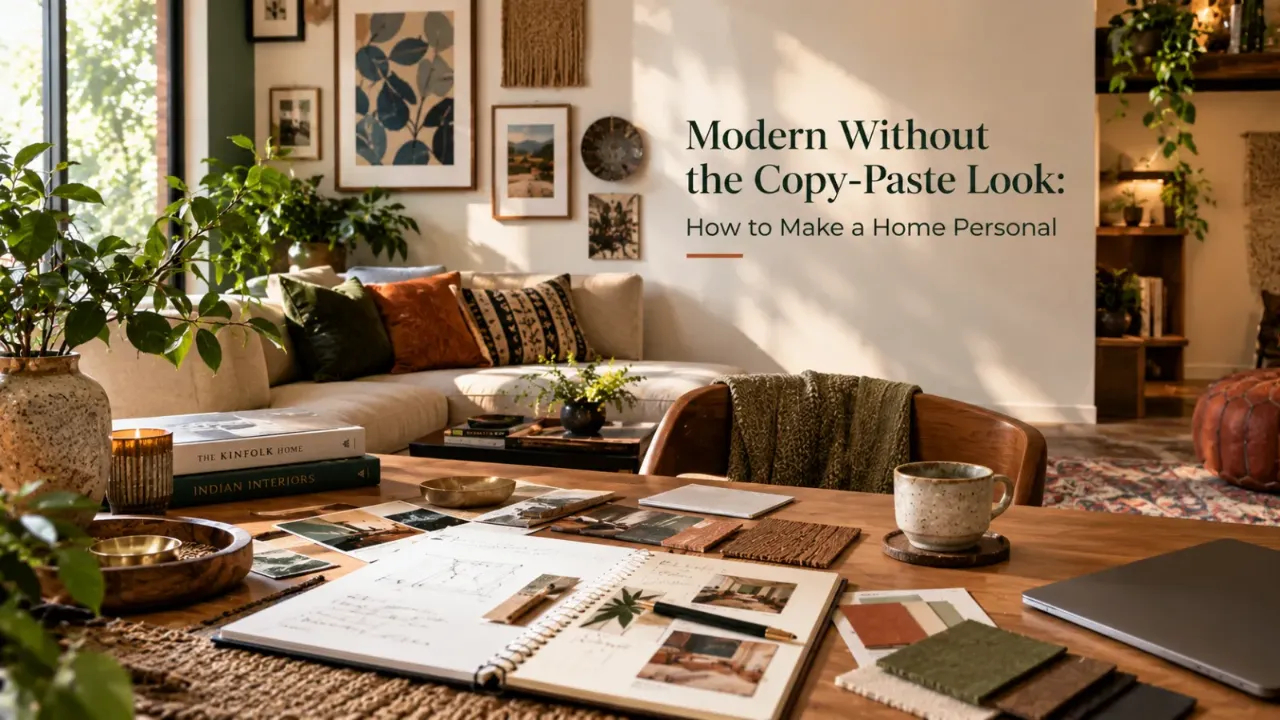
Modern Without the Copy-Paste Look: How to Make a Home Personal
There is a reason many modern homes look beautiful but somehow feel familiar. The same neutral sofa, the same coffee table, the same oversized artwork and the same beige-and-white palette can create a polished room that still does not feel like your home. Modern interior design is often associated with clean lines, restrained colours and uncluttered spaces. Those qualities create a strong foundation, but they can also make a room feel generic when every decision comes from the same visual template.
A modern interior feels personal when its clean design foundation is combined with choices that reflect the people living there. Meaningful objects, artwork, colour, texture, materials, routines and collected pieces can give a contemporary home identity without making it cluttered or visually chaotic.
- Modern Design Needs a Personal Layer
- Start With How You Live
- Choose Fewer Things, But Make Them More Meaningful
- Let Art Tell Your Story
- Use Colour as a Personal Signature
- Bring in Materials That Feel Real
- Mix Old and New
- Let Your Home Show Where You Have Been
- Personalisation Can Come From Everyday Objects
- Do Not Make Every Room Look Identical
- Give the Unexpected a Place
- Avoid the Showroom Checklist
- A Simple Personalisation Framework
- Final Thought
- FAQ
Modern Design Needs a Personal Layer
Think of modern design as the structure of a room. The architecture, furniture, palette, lighting and proportions establish the visual language. Your personal layer comes from everything that tells the story of who actually lives there.
It could be a collection of books, a piece of art bought while travelling, a chair inherited from family, a colour you have always loved, photographs, ceramics made by a local artist, a rug chosen because it reminds you of somewhere meaningful or simply the way you arrange everyday objects.
The goal is not to make a modern home less designed. It is to make the design feel more connected to the person living in it.
Start With How You Live, Not What Is Trending
One of the easiest ways to create a generic interior is to begin with inspiration images. You see a beautiful room online and try to reproduce the same combination of furniture, finishes and accessories.
The problem is that the room was designed for someone else. Instead, start with your routines.
- What do I actually use every day?
- What do I collect?
- Where do people naturally sit?
- Do I read in the living room?
- Do guests gather around the dining table or around the sofa?
- Do I prefer warm colours or cooler tones?
- Do I like visible objects around me or hidden storage?
- Do I work from home?
- Do I entertain often?
These questions may not sound like traditional design questions, but they can shape a much more personal interior.
A home feels individual when its design responds to real behaviour.
Choose Fewer Things, But Make Them More Meaningful
Personalisation does not mean filling every surface. A modern interior often works better when meaningful objects are given enough space to be noticed.
Instead of displaying ten decorative pieces because a shelf looks empty, choose two or three that actually matter.
Choose something connected to your taste, memories or interests rather than simply filling a blank wall.
Use pieces gathered over time rather than making every accessory look as though it came from the same collection.
A family object can introduce history and emotional depth into an otherwise contemporary room.
Books, ceramics or objects that genuinely form part of your life can make a room feel naturally lived in.
Personal does not mean more. It means more intentional.
Let Art Tell Your Story
Art is one of the easiest ways to stop a modern interior from feeling generic. It does not need to match the sofa perfectly.
While visual harmony matters, interesting artwork can also introduce contrast, emotion, memory, culture, texture or simply a point of view.
A modern neutral room with one expressive artwork can feel far more personal than a perfectly coordinated room where every object has been selected from the same visual language.
What Can Count as Art?
It does not always have to be a conventional painting. Photography, textile art, sketches, prints, sculptures, handmade pieces, family photographs, vintage finds and framed travel memories can all become part of the room's visual identity.
Use Colour as a Personal Signature
Modern interiors often rely on neutral backgrounds because they create a clean, timeless base. That does not mean the entire home needs to stay neutral.
A personal colour can become a signature. Perhaps it is deep green, muted blue, terracotta, burgundy, mustard, olive or even a particular shade of purple.
You do not need to paint every wall in it. Use it selectively through upholstery, cushions, art, curtains, books, ceramics or a single statement piece.
Keep the neutral palette as the foundation, then introduce one or two colours that genuinely feel like you.
Bring in Materials That Feel Real
A room can look modern without using only perfectly smooth, manufactured finishes. Natural materials often introduce warmth and individuality.
Think about wood grain, stone variation, woven fibres, brushed metal, linen, cane, handmade ceramics or textured plaster finishes.
These materials are interesting partly because they are not perfectly uniform. Their small variations make the room feel less manufactured.
Modern design gives you clean lines. Natural materials give those lines character.
Mix Old and New
A modern home does not need every piece to be new. Introducing something older can make the entire room feel more personal.
A contemporary sofa next to an inherited side table can work beautifully. A modern dining space can include an older wooden chair. A sleek bedroom can have a vintage mirror.
These combinations create layers and prevent the space from feeling as though everything was purchased during the same shopping trip.
Let Your Home Show Where You Have Been
Travel often leaves behind objects. The mistake is putting them away because they do not perfectly match the interior.
A bowl from another city, a textile from a trip, a photograph from a memorable place or a small sculpture bought on holiday can become part of the visual identity of your home.
The key is presentation. Group related objects, give special pieces breathing room and let them sit alongside modern furniture rather than competing with it.
Personalisation Can Come From Everyday Objects
Some of the most personal details in a home are not decorative at all.
A well-used reading chair and a stack of favourite books can say more about a person than generic decor.
A dedicated tray or small beverage corner can reflect the routines that matter to you.
A record player, speaker setup or carefully displayed collection can become part of the room's identity.
A desk, materials or objects connected to your work can make a room feel naturally lived in.
The most personal interiors often contain clues about daily life.
Do Not Make Every Room Look Identical
Whole-home consistency is useful, but consistency does not mean repetition.
A better approach is to create a common thread. Perhaps the same wood tone appears throughout the home, the metal finishes relate to one another or the wall colours share a similar undertone.
Then allow each room to have its own personality.
The living room might be more expressive. The bedroom might be softer. The study might be darker and moodier. The dining area could introduce a stronger colour.
A cohesive home should feel connected, not duplicated.
Give the Unexpected a Place
One of the best ways to prevent a modern room from becoming generic is to include one element that does not look predictable.
It could be a brightly coloured chair in an otherwise neutral room, a dramatic sculpture, an unusual lamp, a bold patterned cushion, a vintage cabinet, a large plant, a textured wall or an object with strong personal meaning.
The unexpected element gives the room character. Without it, a perfectly polished room can sometimes feel too safe.
Avoid the “Showroom Checklist”
A generic modern interior often happens when design decisions are made as a checklist: sofa, coffee table, rug, artwork, plants, pendant and cushions.
Everything is technically there, but nothing feels connected.
Instead of asking whether you have included every expected element, ask whether each element contributes something.
- Does it serve a function?
- Does it add character?
- Does it create contrast?
- Does it make the room more comfortable?
- Does it have meaning?
- Does it improve the visual balance?
If the answer is no, you may not need it.
A Simple Personalisation Framework
When your modern interior feels too generic, work through five layers:
Design around how you actually use the room rather than how the room is expected to look.
Bring in photographs, inherited pieces, travel objects or anything connected to your story.
Use wood, stone, textiles and other tactile materials to add depth and warmth.
Introduce colours you genuinely like instead of relying entirely on trend-driven palettes.
Add one or two unexpected elements that make the room recognisably yours.
This approach prevents personalisation from becoming random decoration.
What to Do When Your Modern Home Already Feels Generic
You do not always need to redesign the entire room. Start by identifying the pieces that feel interchangeable.
Is the artwork generic? Does the room rely too heavily on matching furniture? Are all the surfaces too similar? Is there no personal object in sight? Does the palette reflect you, or simply what looked good in an inspiration image?
Then make a few targeted changes.
Replace one generic artwork with something meaningful. Introduce one material with more texture. Swap one predictable accessory for something collected. Add one colour that has personal significance. Move a meaningful object from storage into the room.
Sometimes the identity of a space can change dramatically without changing its entire design.
The Goal Is Not to Make the Room Unusual
A personal interior does not need to be eccentric. It does not need unusual furniture everywhere. It does not need bold colours or dramatic styling.
Personal can be subtle.
A room can remain calm, modern and sophisticated while still feeling unmistakably connected to the people who live there.
The goal is not to make visitors say, “What a unique room.”
The goal is to make them say:
Make Your Space Feel More Like You
A strong interior starts with understanding your space, your preferences and the way you live. Explore new possibilities for your own room and discover design directions that feel more personal.
Final Thought
The most successful modern interiors are not the ones that perfectly reproduce a trend.
They are the ones that use modern design as a framework for personal expression.
Keep the clean lines. Keep the thoughtful proportions. Keep the uncluttered foundation. Then add the things a catalogue cannot know about you.
Your memories. Your routines. Your favourite colours. Your books. Your artwork. Your collected objects. Your imperfections.
Because a modern home becomes truly memorable when it stops looking like an example of modern design and starts looking like your version of it.
FAQ
Focus on meaningful pieces rather than more pieces. A few photographs, artworks, books, collected objects or inherited items can add personality without making the space visually busy.
No. Personalisation can come through muted colours, materials, artwork, furniture, lighting and objects with emotional meaning.
Yes. Mixing older or inherited pieces with contemporary furniture can add contrast, history and character.
Look for repetition and a lack of personal clues. If the room could easily belong to anyone, it may need more meaningful objects, stronger material variation or details connected to your lifestyle.
Not necessarily. The rooms should feel connected, but each space can have a slightly different mood while sharing common materials, colours or design principles.
Turn this idea into a plan for your home
Visualise your space, understand the likely budget, or find a professional who can bring the idea to life.