
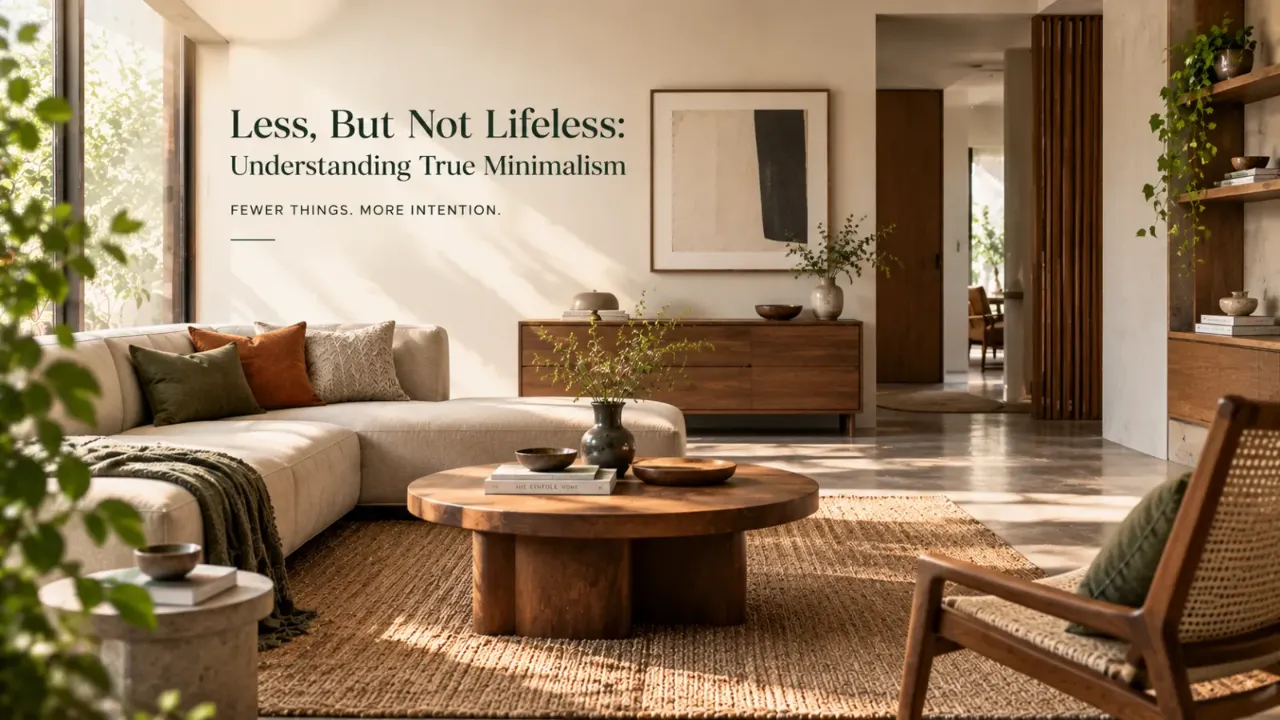
Less, But Not Lifeless: Understanding True Minimalism
There is a particular kind of room that looks beautiful in photographs but feels strangely uncomfortable in real life. The furniture is limited, the colours are restrained, the surfaces are clear and there is plenty of visible floor space. At first glance, it looks minimalist. But sometimes a room is not minimalist at all. It is simply empty. That distinction matters because good minimalism is not about having less for the sake of having less. It is about making deliberate choices so that every element has a reason to exist.
A minimalist room feels complete because its furniture, proportions, lighting, materials and decorative elements have been intentionally edited. An empty room simply has fewer elements, often without enough function, balance, warmth or personality to make the space feel finished.
- Minimalism Is a Design Decision
- The Five Tests of a Thoughtfully Minimal Room
- Minimalist vs Empty
- Why Texture Matters
- Colour Does Not Have to Mean Clutter
- Lighting Can Make or Break Minimalism
- Minimalism in Different Rooms
- When Minimal Becomes Too Bare
- How to Create Minimalism Without Emptiness
- Final Thought
- FAQ
Minimalism Is a Design Decision, Not a Furniture Count
The easiest mistake is to define minimalism by numbers. One sofa, one coffee table, one artwork and almost no accessories do not automatically create a minimalist interior.
Minimalism begins with intention. The question is not, “How little can I put in this room?” The better question is, “What does this room actually need?”
A minimalist living room may have only a few major pieces, but those pieces are carefully selected for scale, function, comfort and visual balance. An empty room usually has fewer elements because something has not been added yet, not because the designer deliberately decided it was unnecessary.
Minimalism removes excess. It does not remove usability.
The Five Tests of a Thoughtfully Minimal Room
A simple way to understand the difference is to examine five things: function, proportion, visual balance, comfort and personality.
Every important activity in the room should still work. A minimalist living room should still allow people to sit comfortably, place a cup down, move around easily and use the space naturally.
A room can contain very little furniture and still feel complete when the pieces are correctly scaled to the space.
Minimalist spaces still need something to anchor the eye, whether that is artwork, lighting, architecture, material or furniture.
A minimalist room should still feel inviting. Soft upholstery, rugs, curtains and layered lighting can create comfort without visual clutter.
A minimalist home can still reveal who lives there. The difference is that personal elements are selected rather than displayed indiscriminately.
Minimalist vs Empty: What Changes the Feeling?
Two rooms can contain almost the same number of objects and feel completely different. The difference lies in the intention behind the arrangement.
| Minimalist Interior | Empty Interior |
|---|---|
| Furniture is chosen intentionally | Furniture may simply be missing |
| Open space feels deliberate | Open space can feel accidental |
| The room still supports daily activities | Important functions may be missing |
| Materials create visual interest | Surfaces may feel flat |
| Lighting adds atmosphere | Lighting may feel purely functional |
| A few objects create personality | There may be little personal connection |
| Proportions feel balanced | Furniture may feel undersized |
| The room feels calm and complete | The room may feel unfinished |
The important point is that empty space itself is not the problem. The real question is whether that emptiness has purpose.
Why Texture Matters More in Minimalist Interiors
When a room contains lots of furniture and decoration, visual interest comes naturally from variety. A minimalist room does not have that advantage, which is why texture becomes so important.
A room with an ivory sofa, pale walls, a smooth floor and plain curtains may technically look minimal, but without variation it can quickly feel lifeless.
Woven rugs, matte finishes, natural wood, soft upholstery, stone, linen, textured cushions and sculptural objects can all create depth without making the space feel busy.
Colour restraint + material variation + controlled detail = visual richness
You can keep the palette extremely simple while still creating a room that feels layered. This is particularly useful when designing neutral interiors.
Colour Does Not Have to Mean Clutter
Minimalist rooms do not have to be completely white, beige or grey. Minimalism can use colour very effectively when the palette is controlled.
For example, warm white walls, muted olive upholstery, natural walnut and soft brass accents can still feel minimalist because the colours work together instead of competing with one another.
What creates visual chaos is usually not colour itself, but too many competing colours without a clear relationship.
Lighting Can Make or Break Minimalism
Lighting becomes even more important when there are fewer decorative elements. A room with minimal furniture but harsh, flat lighting can feel unfinished very quickly.
Provides overall illumination and establishes the basic mood of the room.
Supports activities such as reading, cooking, working or getting ready.
Highlights artwork, architecture, materials or specific features without adding physical clutter.
A carefully chosen pendant, wall light or sculptural fixture can become a focal point on its own.
Minimalism often works best when lighting is doing some of the visual work that accessories would otherwise do.
The “One More Thing” Test
Stand in the room and ask, “Does anything important feel missing?” Not, “Could I add more decor?” Instead, think about function, comfort and visual completeness.
- Do I need another comfortable seat?
- Does this room have enough light?
- Is there somewhere practical to put everyday objects?
- Does the space have enough warmth?
- Is there a visual focal point?
- Does the furniture feel correctly scaled?
- Does this room look like someone actually lives here?
If several answers are yes, the room may need more design rather than more decoration.
Minimalism in Different Rooms
Living Room
A minimalist living room usually benefits from one strong seating arrangement, a proportionate rug, a coffee table, layered lighting and perhaps one or two carefully chosen visual elements. The goal is to create breathing space without making conversation or everyday use uncomfortable.
Bedroom
A minimalist bedroom should feel restful rather than vacant. The bed naturally becomes the visual anchor. Then consider bedside surfaces, soft lighting, window treatments, useful storage and a restrained material palette.
Dining Room
A dining room can be remarkably minimal. A well-proportioned table, comfortable chairs, a statement light and perhaps one restrained decorative element may be all that is needed. The important thing is that the room still feels ready to host people.
Entryway
This is a space where minimalism can be especially effective. Keep only what supports the way the space is actually used. A console or ledge, a mirror, lighting and a practical place for everyday items may be all that is needed.
When “Minimal” Becomes “Too Bare”
There is no universal object count that tells you when a room has gone too far. Instead, look for warning signs.
Large areas of empty space have little relationship to the furniture arrangement.
Not every wall needs artwork, but blankness should still feel intentional rather than accidental.
Everything has the same flat visual quality, making the room feel one-dimensional.
Your eye does not know where to settle, so the space can feel visually unfinished.
The room photographs beautifully but does not appear to support the habits of the people using it.
When appearance consistently wins over usability, minimalism has gone too far.
How to Create Minimalism Without Creating Emptiness
Start with function. Before buying decor, decide what the room needs to support. Then establish the major furniture pieces, check scale and spacing, create a restrained colour palette and add texture through materials.
Finally, introduce only those decorative elements that contribute something meaningful.
A useful sequence is:
Keep the elements the room genuinely needs. Scale them correctly for the space. Balance their visual weight. Layer colour, texture and lighting. Then edit anything that feels repetitive or unnecessary.
Many people try to create minimalism by removing accessories first. A better approach is to build the room properly and then remove what is unnecessary.
Minimalism Is About Restraint, Not Deprivation
A well-designed minimalist home can actually contain quite a lot. The difference is that everything is doing a job.
A rug can define a seating area. A light fixture can become a focal point. A curtain can soften the architecture. A side table can provide function. A piece of art can add personality. A plant can bring softness. A cabinet can hide visual clutter.
Minimalism is therefore not about owning as little as possible. It is about making the room easier to read.
When every element competes for attention, the room becomes noisy. When nothing contributes anything, the room becomes empty.
The sweet spot lies between the two.
Design a Space That Feels Like You
The best interiors balance function, personality and visual clarity. Start imagining how your own room could look with a more intentional approach to space, colour and styling.
Final Thought
The most successful minimalist interiors do not make you think, “There is hardly anything here.”
They make you think:
That is the real difference between minimalist and empty.
Minimalism gives space a sense of calm through intentional choices. Emptiness simply leaves space without enough purpose.
The goal is not to remove everything. The goal is to remove enough that what remains can actually matter.
FAQ
No. Minimalism is primarily about editing, proportion, material choices and intentional styling. A thoughtful composition can work across very different budgets.
No. Minimalist interiors can use warm neutrals, muted colours, darker tones or carefully controlled colour palettes.
There is no fixed number. The right amount depends on the room, its size, function and visual balance.
It may be lacking texture, warmth, layered lighting, comfortable materials or personal elements. Minimalism still needs depth and atmosphere.
Absolutely. High-quality materials, careful proportions, sophisticated lighting and restraint can create a luxurious feeling without visual excess.
Turn this idea into a plan for your home
Visualise your space, understand the likely budget, or find a professional who can bring the idea to life.