
Foldable Dining Tables for Kengeri Homes: Measure Them Open and Closed
Measure a foldable dining table in its closed, opening and fully seated positions before buying for a Kengeri home. Include chairs pulled out, supporting legs and the route to nearby doors. Choose the mechanism you can operate comfortably, then confirm dimensions, stability, delivery access and the storage needed when the table is folded.
Start with your Kengeri property
For a Kengeri apartment, measure the usable dining corner after accounting for the kitchen opening, balcony door and daily route through the room. Confirm building lift and delivery restrictions before paying for a bulky assembled product. If you rent, a movable table may be easier to take with you, but it still needs a workable everyday position and any assembly required by the supplier.
Compare the folding mechanisms in actual use
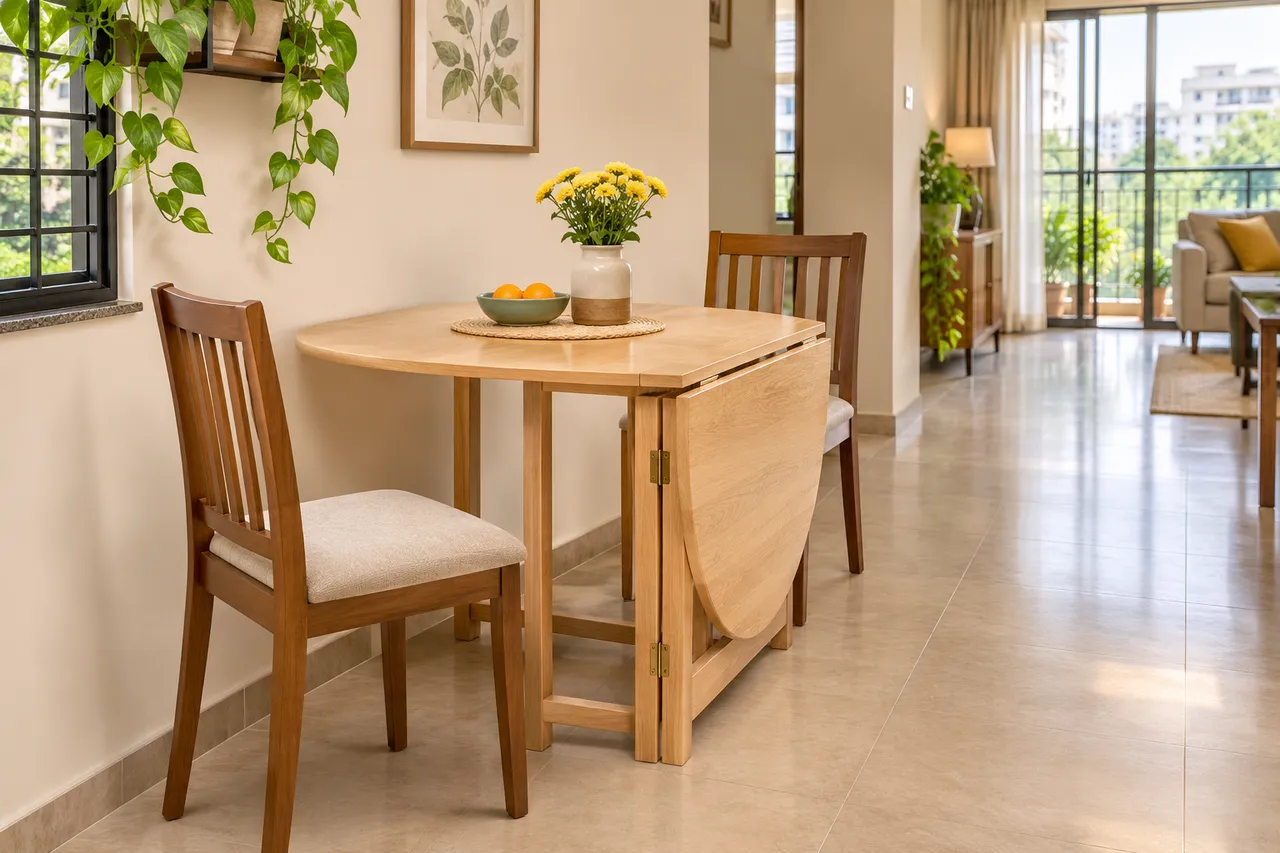
A drop-leaf table changes surface area by raising a side panel; a gateleg design also moves supporting legs. An extending table may store extra leaves inside or elsewhere. Try the exact mechanism, including locks and supports, and ask who can operate it without lifting an awkward weight. A compact closed footprint has little value if chairs, a sideboard or a rug prevent the supports from reaching their working positions.
Make three layouts, not one showroom rectangle
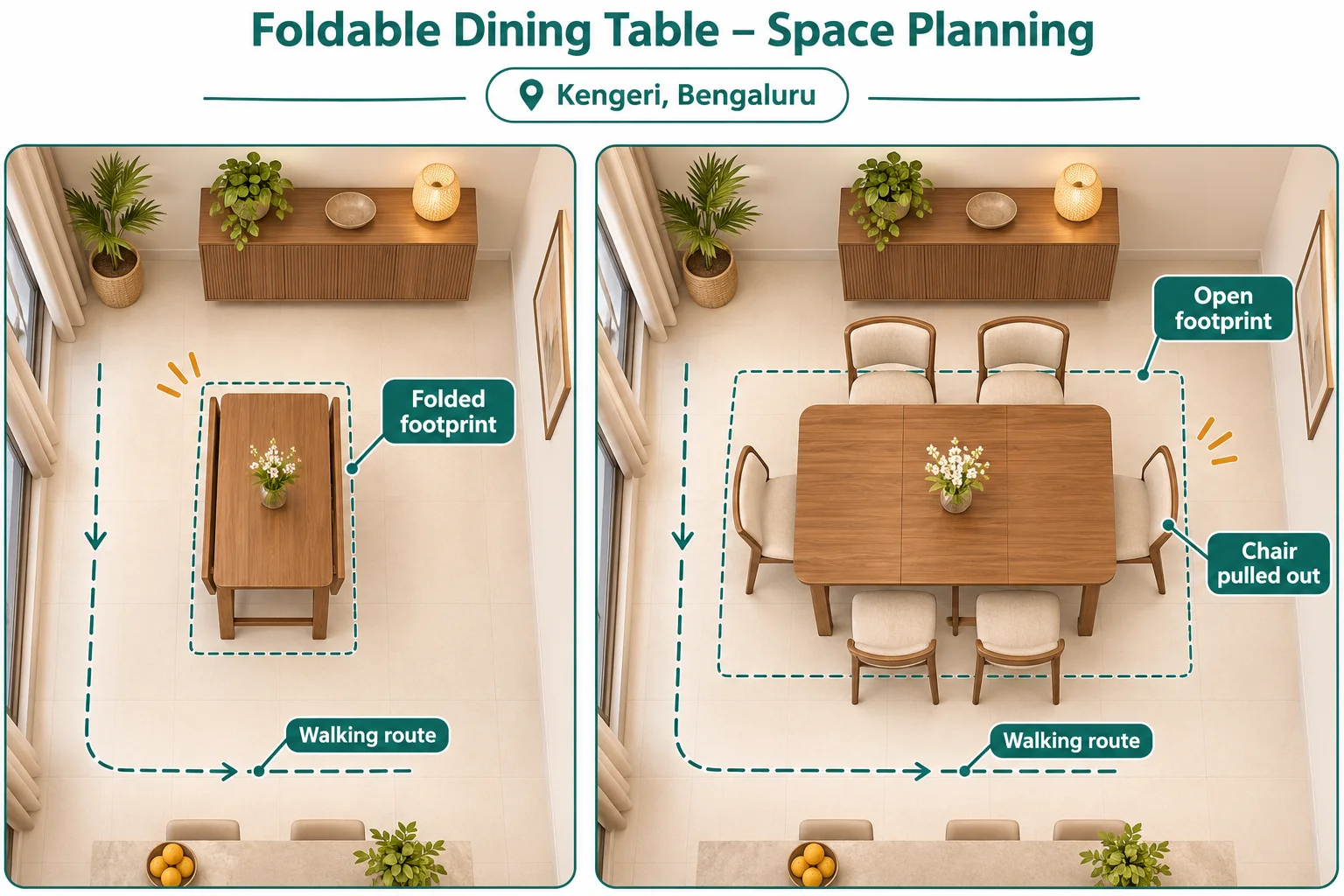
Mark the table folded, fully open and occupied by the usual diners. Pull chairs back as if people are sitting down and stand up from every position. Check access to drawers, a refrigerator or a nearby doorway while the table is in use. For illustration, a hypothetical table growing from 80 by 40 centimetres to 120 by 80 centimetres changes much more than its width: the chairs and walking route also shift. Use your selected model’s actual figures.
Plan where the movable items will go
Identify where spare chairs, table linen and removed leaves will be stored. If a coffee table or bench must move at dinner, give it a sensible destination instead of borrowing a doorway. Compare a simple light chair with a large upholstered chair under the actual table. Seat count should be tested with real place settings and leg positions; an advertised number does not tell you whether your household finds the arrangement comfortable.
Check the product as a delivered system
Ask for overall sizes in every configuration, the weight, permitted loading and assembly guidance. Confirm the finish and cleaning instructions as well as the mechanism warranty. Measure the narrowest delivery turn and check whether the table can be brought in flat-packed. At handover, operate every leaf and support on the intended floor, check rocking and review any adjustment or assembly issue with the supplier before regular use.
A practical example to test the decision
A Kengeri couple eats at a small table most days and hosts two relatives occasionally. A large extending table appears attractive, but its closed position blocks a kitchen drawer. A drop-leaf option fits better once the chairs are assigned a storage position. Another household may need the larger table open every evening; a conventional fixed table could then be simpler. The useful comparison is the routine of the actual occupants, not a promise that folding furniture always saves room.
Step-by-step planning checklist
- Record the dining corner and adjacent openings with a simple floor sketch. Measure at floor and table height where skirting, counters or furniture may alter the available space.
- Shortlist two mechanisms and obtain their complete open and closed dimensions. Confirm how the legs move and whether extra leaves, chairs or accessories need separate storage.
- Tape the footprints on the floor and test both daily and guest meals. Use existing chairs or cardboard seat markers, then test serving and movement from every position.
- Visit a display or request an operation demonstration. Check who can open the table, how supports lock and where fingers or chairs could conflict with moving parts.
- Confirm delivery and assembly, then inspect the completed table in the chosen position. Operate the mechanism and test the seating layout before discarding packaging or agreeing the installation is complete.
What to put in the quotation
- Dimensions and supports in every configuration
- Assembly, mechanism and load instructions
- Spare-leaf and chair storage
- Delivery route and assembly charges
- Finish care, warranty and return conditions
Planning budget and what it includes
| Scope | Planning allowance or pricing method |
|---|---|
| Entry-level folding table planning allowance | ₹8,000–₹18,000 |
| Mid-range drop-leaf or extending table | ₹18,000–₹30,000 |
| Larger or higher-finish extending table | ₹30,000–₹50,000+ |
Allow separately for chairs, delivery and assembly. As a current retail reference checked on 25 November 2026, IKEA’s extending-table range includes examples around ₹18,990–₹24,990, with larger options above that. These examples are not a Kengeri availability promise or a quote for the table pictured. Verify the exact item, price and postcode delivery before ordering. Reference: IKEA extending and drop-leaf table range.
Preparation and project timing
Spend an evening testing the taped layouts and another visit or video call checking the mechanism. Ready-made delivery follows stock and postcode service. Made-to-order tables can take several weeks; confirm the actual drawing, lead time and cancellation terms before paying. A folding mechanism should not be rushed into a custom build without a clear specification.
Use WallsToWonder to prepare a clearer brief
Use Design My Room to compare visual directions for your Kengeri home, then discuss a measured layout and specifications with a professional. Organise the scope using the interior cost planning tool and browse interior companies serving Bengaluru. Confirm service availability and the actual proposal directly.
For related planning, read Built-In Dining Bench for a Ghatkopar Home: Seating, Storage and Access Checks.
Frequently asked questions
Is a folding table best for every small apartment?
No. If it stays open all the time, a fixed table may be simpler. Compare the everyday footprint, guest use, movement and where the chairs will live.
Can four chairs fit because the catalogue says four seats?
Test the exact table with the intended chairs and place settings. Leg positions and chair size affect comfort and access even when the advertised seat count is the same.
What measurements do I need besides the tabletop?
Obtain the height, leg positions, folded depth, open size, moving support footprint, weight and storage requirements for extra leaves. Measure the delivery route too.
Can it be fixed to a rented wall instead?
A wall-mounted drop-leaf product has different fixing and permission requirements. Ask the owner and a suitable installer to assess the wall and product rather than adapting a freestanding design.
What is the final acceptance test?
Operate the complete mechanism on the intended floor, check stable support, test chairs and door access, and record any assembly or finish issue with the supplier.
Editorial review: 25 November 2026. Product examples and planning allowances should be rechecked against the current model, site assessment and written quotation.
Turn this idea into a plan for your home
Visualise your space, understand the likely budget, or find a professional who can bring the idea to life.