

Tall Bookshelves in JP Nagar Homes: Plan Depth, Stability and Everyday Access
Plan a tall bookshelf around your book sizes, the product’s shelf ratings and suitable restraint to the actual wall. In a JP Nagar home, check skirting, switches and circulation before choosing its depth. Keep frequently used books reachable and have the supplier confirm assembly and fixing, rather than treating a tall unit as freestanding decoration.
Start with your JP Nagar property
A JP Nagar flat and an independent house can offer very different wall constructions and access conditions. Identify the intended wall with the owner or building team, especially where the room has concealed services or a lightweight partition. For a rented property, obtain agreement for required restraint before selecting the unit. Delivery and assembly access also deserve a check when a bookshelf is sold as one tall piece.
Measure the collection before the wall
Group large books, ordinary paperbacks, folders and display objects separately. Measure the tallest and deepest items you genuinely want to keep here. A deeper shelf is not automatically better: it can consume room space while encouraging books to disappear behind one another. Compare fixed and adjustable shelf positions against your collection. Make a simple inventory of shelf runs needed and leave a deliberate allowance for new purchases rather than filling every available wall with joinery.
Read the shelf and restraint instructions together
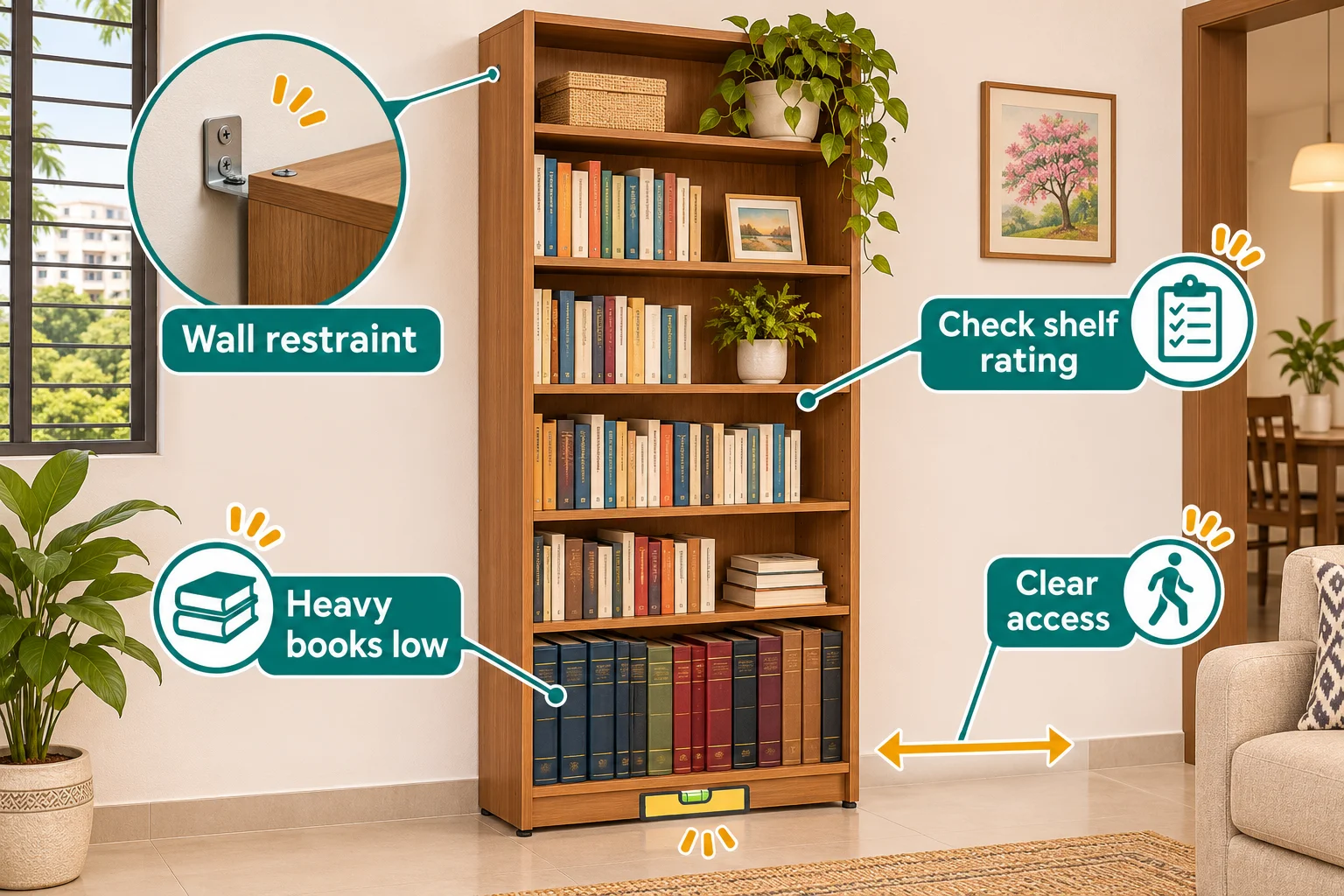
Ask the manufacturer or fabricator for permitted shelf loads, assembly guidance and restraint requirements for the complete unit. A single shelf’s capacity is not a rating for an altered arrangement. IKEA’s BILLY instructions, for example, require the supplied wall attachment to prevent tip-over; fixing suitability still depends on the wall. Have a competent installer select the appropriate method and check for services. Do not assume that placing books low replaces the required restraint. Reference: IKEA BILLY assembly and wall-attachment guidance.
Choose access that works without risky reaching
Put everyday reading and heavier volumes in convenient lower positions, keeping occasional lightweight objects higher where appropriate to the design. Test the lower cabinet doors, if any, beside a chair or study desk. Avoid locating attractive items where someone will be tempted to climb the shelves. If high storage needs a suitable step aid, decide where that aid is kept and who will use it, rather than relying on furniture as a ladder.
Make the detailing easy to maintain
Check whether skirting, an uneven wall or a switchboard changes the installation. Specify how dust can be removed, how adjustable shelves are supported and whether a damaged part can be replaced. A glazed front can reduce exposed dust but adds a door-opening requirement and hardware to maintain. For custom joinery, ask for material thickness, shelf support and construction details to be designed for the actual span and load rather than copying a photograph.
A practical example to test the decision
A JP Nagar family plans a wall of deep shelves for a mostly paperback collection. Measuring the books reveals that shallower storage would work and preserve chair movement beside the unit. Their large art books need only one separate bay. They choose a product with published ratings and arrange suitable fixing before loading it. The result comes from matching storage to the collection; it does not establish a universal shelf depth, span or wall fixing.
Step-by-step planning checklist
- Inventory books and objects by size and weight category. Mark the items used weekly and identify what can be stored elsewhere, donated or kept behind a closed front.
- Measure the proposed position, skirting, nearby doors and the walking route. Ask the owner or building team what is known about the wall and concealed services.
- Obtain the complete unit instructions, shelf ratings and restraint details. For custom work, ask the fabricator to state the intended loads, shelf supports and fixing approach in the proposal.
- Tape the cabinet depth on the floor and test a chair, desk or door beside it. Assign frequently used shelves and check access for the people who will actually use the room.
- Have the unit assembled and restrained appropriately. Inspect doors, shelf supports and any movement with the installer, then keep the instructions and load limits with the purchase record.
What to put in the quotation
- Book-size schedule and shelf arrangement
- Manufacturer ratings or custom load assumptions
- Materials, spans and shelf supports
- Wall restraint and substrate assessment
- Assembly, replacement parts and finish care
Planning budget and what it includes
| Scope | Planning allowance or pricing method |
|---|---|
| Basic ready-made bookcase allowance | ₹5,000–₹15,000 |
| Larger modular arrangement | ₹15,000–₹35,000 |
| Custom wall unit | ₹30,000–₹70,000+ |
These are editorial planning ranges for furniture, not JP Nagar supplier quotations. Allow separately for delivery, suitable fixing, site making good and any closed fronts or lighting. A wall-length custom unit needs a measured drawing and construction specification. Compare the same shelf quantities and load expectations across offers instead of only a per-square-foot headline.
Preparation and project timing
Use a day to inventory and mock up the depth. Ready-made delivery depends on stock and assembly appointments. Custom units may need three to six weeks after approval, with timing affected by materials, finish and fixing assessment. Do not load the unit before the agreed installation and restraint are complete.
Use WallsToWonder to prepare a clearer brief
Use Design My Room to compare visual directions for your JP Nagar home, then discuss a measured layout and specifications with a professional. Organise the scope using the interior cost planning tool and browse interior companies serving Bengaluru. Confirm service availability and the actual proposal directly.
For related planning, read When the Wardrobe Becomes the Dressing Room: Bedroom Layouts That Work.
Frequently asked questions
Can a tall bookcase stand without fixing?
Follow the instructions for the exact product and installation. If restraint is required, arrange suitable fixing before use. A heavy lower shelf does not cancel the manufacturer’s requirement.
How deep should a bookshelf be?
Measure the collection and compare the usable shelf depth of the shortlisted unit. Include larger books and folders separately rather than applying one depth to every bay.
Is a partition wall suitable?
Have the installer assess the actual construction, fixing system and services. Obtain owner permission where needed; the room’s appearance does not identify the wall’s capacity.
Should I put the heaviest books at the bottom?
That is useful arrangement planning, but every shelf and the complete installation must remain within the product or fabricator’s specification. It is not a substitute for required restraint.
What should be checked after assembly?
Confirm shelf supports, fasteners, restraint, door movement and floor contact with the installer. Keep the load guidance and instructions accessible for future rearrangement.
Editorial review: 25 November 2026. Product examples and planning allowances should be rechecked against the current model, site assessment and written quotation.
Turn this idea into a plan for your home
Visualise your space, understand the likely budget, or find a professional who can bring the idea to life.