
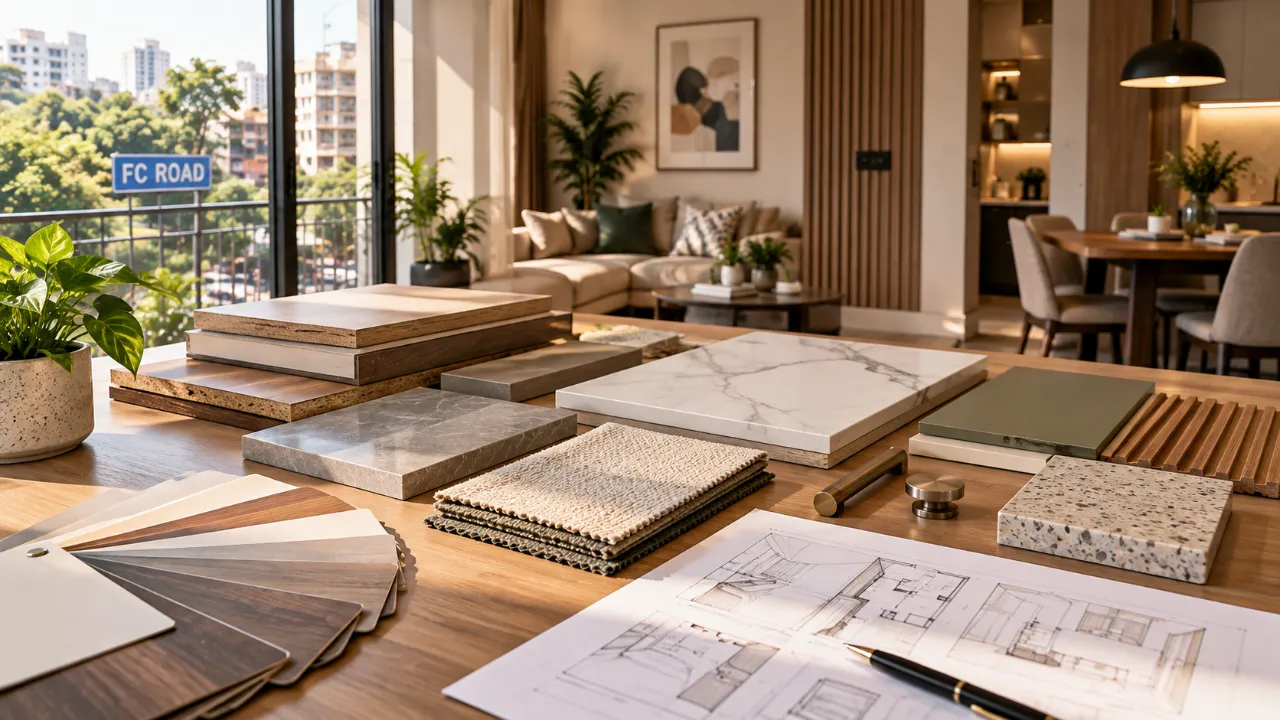
Choosing Interior Materials on FC Road: A Practical Room-by-Room Guide
A compact flat near FC Road can place very different demands on cabinetry: a frequently used kitchen, a wardrobe beside an external wall, a study niche that doubles as storage, or a rented home where repairability matters more than a fully built-in look. The right material is therefore a room decision, not a brand decision.
This interior materials guide for FC Road, Pune explains where plywood, HDHMR, laminates, acrylic, veneer, edge bands and hardware make practical sense. For designers and companies serving FC Road, Shivajinagar, Deccan Gymkhana, Model Colony and Erandwane, compare portfolios through the FC Road interior designer directory, but use the material logic below to test any proposal.
A hypothetical FC Road home, and the brief behind the specification
Illustrative scenario, not a real client: imagine a two-bedroom apartment used by a couple, one parent who visits regularly and a school-age child. The brief includes a moderate-size modular kitchen, two wardrobes, a study ledge, a TV unit and a compact pooja cabinet. The family cooks daily, wants easy cleaning, and expects the home to remain usable during Pune’s monsoon months. The building, floor level and exact exposure are deliberately unspecified; those details would need a site inspection.
The constraints are familiar in urban Pune homes: limited storage depth, several trades working in sequence, existing electrical points that cannot all be moved, and a need to control dust and rework. The family also wants a calm wood-and-neutral palette without making every surface expensive.
Rejected option one: use one premium plywood grade and a high-gloss finish everywhere. This simplifies the conversation, but spends money on rooms that do not need the same moisture or load performance. Glossy surfaces also make fingerprints and scratches more visible in frequently handled zones.
Rejected option two: use a low-cost board and a decorative laminate throughout. This may look acceptable at handover, yet weak edge protection, unsuitable fastener holding and poor coordination around sinks can create avoidable maintenance problems. The issue is not that every economical board fails; it is that its application and detailing must be defined.
Final decision logic: use moisture-suitable, well-sealed cabinetry construction where water and heavy use are likely; reserve higher-specification plywood for demanding shutters, long spans or areas where screw holding matters; use HDHMR selectively for dry, painted or laminate-finished furniture; and keep the finish schedule room-specific. This is the useful lesson: a mixed specification can be more rational than a single-material package.
What belongs inside each room?
| Area | Substrate direction | Finish and edge decision | Execution check |
|---|---|---|---|
| Kitchen | Choose a moisture-conscious core for sink, dishwasher and plumbing-adjacent units. Plywood may suit heavy shutters and long-term screw retention; HDHMR can work in selected dry carcasses when properly sealed. | Laminate is practical for high-touch shutters. Use sealed edges, especially at the bottom and near cut-outs. Acrylic needs more care around fingerprints and scratches. | Confirm sink cut-out sealing, plinth material, ventilation gaps and access to traps before fabrication. |
| Wardrobes | Plywood or HDHMR can both be appropriate depending on span, shutter weight, finish and budget. Avoid choosing only by thickness. | Textured laminate hides handling better than very glossy finishes. Edge band thickness and adhesion matter on exposed verticals and bottoms. | Check hinge count, shelf span, back panel fixing and whether the wardrobe meets an uneven wall. |
| Study and TV unit | HDHMR is often useful for painted or laminate-finished dry furniture with moderate spans. Plywood may be justified for floating shelves or heavier loads. | Matte laminate or paint can reduce glare on a work surface. Use a durable edge on desk fronts and cable openings. | Coordinate sockets, router ventilation, cable routes and service access before closing the back panel. |
| Pooja and foyer | Use a stable board suited to the proposed finish; avoid leaving raw cut edges around lamps, drawers or cleaning zones. | Veneer gives natural variation but needs a clear finish and sample approval. Laminate is simpler to clean and reproduce. | Keep heat, electrical points and storage clear of one another; confirm the exact shelf and shutter proportions. |
For a balcony, utility or any zone exposed to rain splash, do not treat an interior board as automatically suitable. First understand whether the unit is truly protected from water, then specify sealed edges, appropriate hardware and a replaceable or accessible service detail. Outdoor exposure is a separate specification problem, not simply a request for “waterproof plywood”.
Plywood, HDHMR and the finish layer are different decisions
Plywood: useful when construction performance earns its cost
Plywood is often considered for kitchens, wardrobes, heavy shelves and components that need dependable screw holding. Its value depends on grade, thickness, core quality, joining method, edge treatment and the conditions around it. Ask for the proposed grade and application in the quotation rather than accepting “premium plywood” as a complete description.
HDHMR: precise when kept in the right zone
HDHMR can be a practical option for dry-area shutters, routed profiles, painted panels and selected carcasses. Its suitability depends on the manufacturer’s product specification, support, fixing and sealing. It should not be specified casually beside an unprotected sink or plumbing joint simply because the board appears dense.
Laminates, veneer, acrylic and paint
Laminate is usually the most straightforward finish to compare: ask about thickness, texture, matching interiors and edge banding. Veneer requires agreement on grain direction, shade variation and clear-coat maintenance. Acrylic can create a reflective appearance but needs a realistic cleaning routine. Painted finishes demand sample approval, substrate preparation and an understanding that touch-ups may not disappear completely.
Edge banding deserves its own line item. Check whether exposed edges receive PVC or ABS banding, the thickness, colour matching, machine application and treatment at corners. A beautiful shutter with a weak or mismatched edge can look unfinished and admit dirt or moisture at vulnerable points.
Hardware and coordination decide how materials age
Material selection is incomplete without hinges, drawer channels, lift-ups, handles and fasteners. A heavy shutter needs hardware rated for its size and use. Tall wardrobes need a conversation about hinge quantity and adjustment. Kitchen drawers require clear internal dimensions after the hardware is installed, not just a generous-looking elevation.
On site, the sequence matters. Wall dampness, flooring level, skirting, electrical conduits and appliance dimensions should be checked before final carcass fabrication. In monsoon conditions, store boards off the floor and protect cut components from wet work. Seal sink cut-outs and inspect the wall behind base units before closing them. These are coordination controls, not decorative upgrades.
Two tools for checking scope before you compare designers
Interior cost estimator
Use it to structure an early budget conversation by rooms and scope. Treat the result as planning guidance, then validate it against site conditions, quantities, specifications and taxes.
Quotation checker
Use it to spot unclear descriptions, missing quantities or inconsistent inclusions. It cannot replace a technical review of board grades, hardware schedules or site measurements.
Before contacting a designer, browse interior design ideas for finish combinations, read relevant project and expert stories, and use Design my room or the style finder to clarify preferences. The AI interior assistant can help turn room needs into questions, but a designer still needs to verify the site.
How to compare designers serving FC Road
Look beyond rendered images. Ask each designer or company to show a room-wise scope, material schedule, finish samples, hardware make or performance description, edge-band detail and exclusions. A useful comparison keeps the same questions across proposals. Services may include space planning, drawings, electrical and false-ceiling coordination, modular furniture design, finish selection, procurement, installation supervision and snag correction. Not every provider includes every service.
Pricing will move with the number of rooms, storage volume, board and finish specification, hardware, civil or electrical changes, ceiling work, appliances, site access, demolition, transport and the level of project management. A low total may simply omit painting, dismantling, handles, internal accessories, countertop work, GST or post-installation corrections. Use the local FC Road listing to create a comparison set, not as a substitute for checking individual scope.
Quotation lines that deserve a pause
- Board descriptions that say only “plywood” or “HDHMR” without grade, thickness, location and finish.
- “As per design” used in place of quantities, dimensions, hardware or edge details.
- No distinction between visible surfaces, internal shutters, backs, fillers and skirting.
- Unclear treatment of sink cut-outs, wall irregularities, electrical alterations and protection during installation.
- Advance terms that do not identify drawing approval, material approval, manufacturing stage, installation stage and cancellation or change-order treatment.
Before paying an advance, ask who measures the site, who approves shop drawings, when material samples are signed off, who handles damage, how variations are priced, what access or storage the homeowner must provide, and when the final snag list is closed. Keep approvals in writing. If a company resists identifying materials or exclusions, delay the commitment rather than relying on verbal assurances.
A small decision framework for your next material meeting
Take one room at a time. Mark water exposure, load, visibility, touch frequency and repair access. Then ask four questions: what is the substrate, what protects its edges, what finish suits the cleaning routine, and what hardware carries the movement? Finally, request one physical sample showing the board, finish and edge together. A finish sample alone cannot reveal how the complete assembly has been built.
For broader local research, the WallsToWonder posts library can help you compare planning topics, while the FC Road directory remains a practical starting point for designers and companies serving nearby homes. The same approach applies across FC Road, Shivajinagar, Deccan Gymkhana, Model Colony and Erandwane: compare the written specification, not just the visual promise.
Use the directory with a sharper brief
Before requesting proposals, prepare a room list, a preferred finish direction, a realistic maintenance tolerance and the questions above. Then revisit the FC Road interior companies and designers listing and compare responses on scope, material clarity, coordination and accountability.
Frequently asked questions
Is plywood always better than HDHMR for a Pune home?
No. The correct choice depends on moisture exposure, load, span, fixing, finish and detailing. Plywood may be justified in demanding applications; HDHMR can suit selected dry-area furniture.
Can laminate make a lower-cost board suitable for the kitchen?
Laminate protects the surface, but it does not make every substrate appropriate for water-prone construction. Sink areas, cut-outs, edges and plumbing access still need specific treatment.
What should an interior quotation mention about materials?
It should identify substrate, grade or product description, thickness, room or component, finish, edge banding, hardware, quantities, exclusions and applicable taxes or charges.
How can I compare two designers offering different totals?
Convert both proposals into the same room-wise scope. Compare storage quantity, board and finish specifications, hardware, civil work, services, installation, taxes, exclusions and warranty or snag responsibilities.
Should I pay an advance before seeing material samples?
Ask for the agreement, scope, payment milestones and sample-approval process first. A reasonable advance structure should make the deliverables and variation process clear before work begins.
Turn this idea into a plan for your home
Visualise your space, understand the likely budget, or find a professional who can bring the idea to life.