
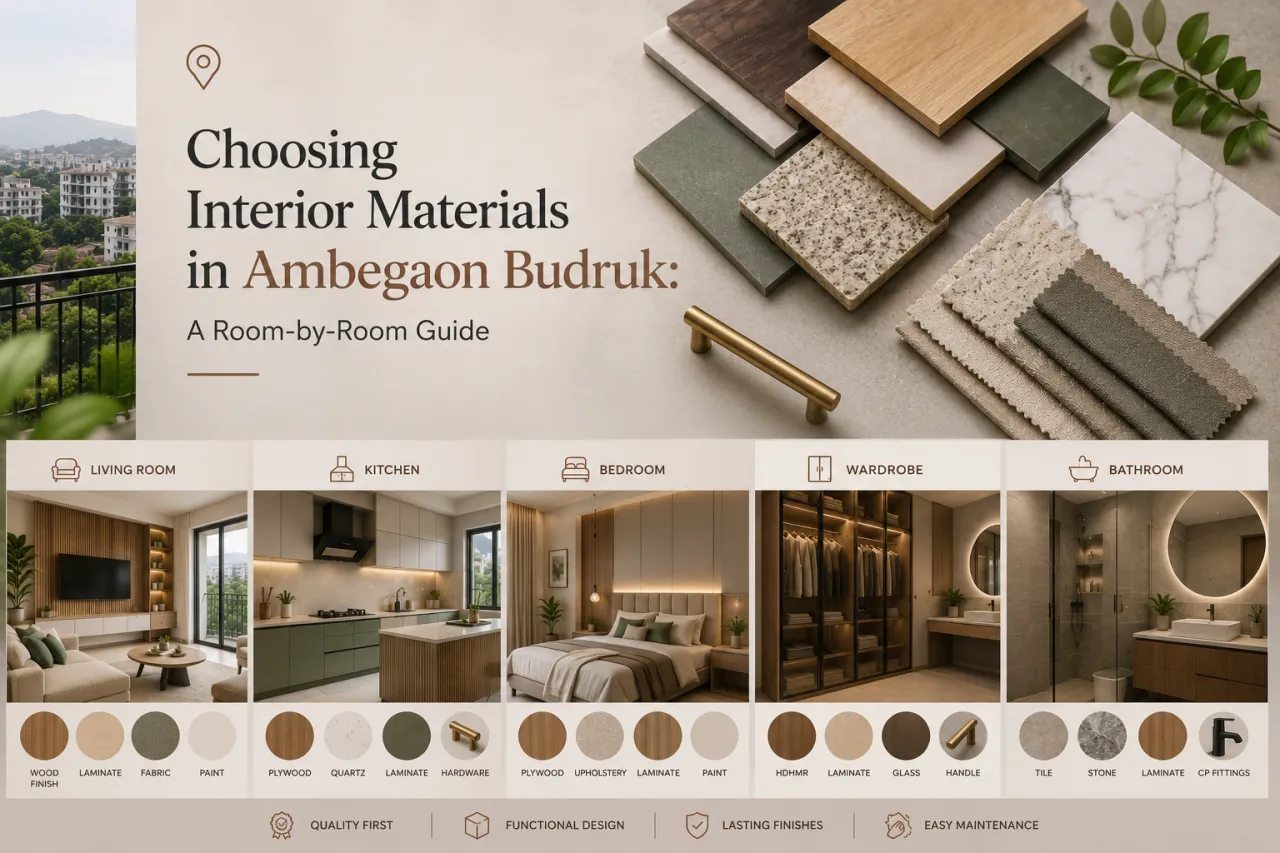
Choosing Interior Materials in Ambegaon Budruk: A Room-by-Room Guide
The most expensive material mistake is rarely choosing the wrong colour. It is using a material in a place where its moisture exposure, edge treatment or hardware cannot cope with daily use. In an Ambegaon Budruk flat, a kitchen shutter, bedroom wardrobe and TV unit may all look similar on a drawing, but they do not face the same demands.
This guide is for homeowners comparing designers and companies serving Ambegaon Budruk, as well as nearby Narhe, Katraj, Dhayari and Bibwewadi. You can browse the Ambegaon Budruk interior designer directory while using the material decisions below to ask sharper questions. The aim is not to declare one substrate universally best; it is to match the board, finish, hardware and edge band to the room.
Start with the room, not the board name
Plywood, HDHMR and other engineered boards are substrates. Laminates, acrylic, veneer and paint are finishes. Hinges, channels, baskets and handles are hardware. Edge banding protects the exposed board edge and completes the visual detail. A quotation that names only “premium material” leaves too much unresolved.
For most homes, the sensible comparison is a matrix of durability, moisture tolerance, maintenance, coordination effort, flexibility and cost exposure. Cost exposure means more than the board rate: a material can require specialised finishing, extra detailing or replacement hardware later. Ask the designer to specify each layer separately.
| Option | Where it makes sense | Advantages | Watch-outs |
|---|---|---|---|
| Moisture-resistant plywood | Kitchen carcasses, sink-adjacent units, utility and demanding storage | Good screw-holding and repair flexibility when properly specified | Quality grades vary; exposed edges, sealing and installation still matter |
| HDHMR | Dry-room shutters, wardrobes, TV units and selected internal panels | Dense, smooth surface suitable for many painted or laminated applications | Not a substitute for waterproof detailing; heavy panels need suitable hardware |
| Laminate | High-contact shutters, shelves and work surfaces | Broad choice, relatively practical maintenance and consistent appearance | Joints, corners and edge bands become visible if workmanship is weak |
| Veneer or painted finish | Feature shutters, living spaces and coordinated furniture | Can create a warmer or more tailored appearance | May need more careful cleaning and tighter colour coordination |
This is a decision aid, not a product guarantee. Ask for the exact grade, thickness, test documentation where relevant and installation specification.
The kitchen is where material shortcuts become visible first
Carcass and sink zone
A moisture-resistant plywood carcass is a cautious choice for the sink base, adjacent plumbing zones and utility storage. The board alone cannot prevent damage: cut-outs should be sealed, the back should not trap a leak against the wall, and the cabinet should allow access to plumbing. HDHMR may work for selected dry sections, but it should not be treated as waterproof simply because it is dense.
Shutters, edges and hardware
Laminate is often practical for high-touch kitchen shutters because it is easy to wipe and can be replaced without rebuilding every carcass. Postformed or carefully edge-banded details reduce exposed seams. Specify hinge brand or performance standard, soft-close requirement, drawer load expectation and the treatment of cut edges. A low-cost board paired with weak channels can create more frustration than a sensible material upgrade.
Glossy finishes show fingerprints and reflections; textured or matte laminates may be more forgiving for everyday use. Neither is automatically superior. The relevant question is whether the finish suits the cleaning habits, cooking pattern and available ventilation of the household.
Bedrooms reward consistency, but not over-specification
Wardrobes usually face less direct moisture than a kitchen, so the matrix changes. HDHMR or a well-specified plywood substrate can be suitable for dry bedroom storage, depending on the design, shutter weight and finish. Laminate on the outside gives predictable maintenance; a painted finish can coordinate with walls but deserves a clear repair and touch-up plan.
Pay particular attention to long shutters, lofts and tall units. Ask how the designer will prevent bowing, what thickness is being used, and whether hinges are selected for the finished shutter weight. Edge band colour should be checked against the laminate rather than accepted as an afterthought. For internal shelves, the practical choice may differ from the visible shutter because abrasion, dust and load are different concerns.
Living areas need a finish hierarchy
A living room TV unit, crockery cabinet or foyer console does not need every visible surface to carry the highest-cost finish. Use the finish hierarchy as a coordination tool: reserve veneer, fluted detailing, paint or a premium laminate for the surfaces people see and touch, then use a durable, simpler finish on internal or less exposed portions.
Hardware should support the visual language. Push-to-open mechanisms can keep a clean front, but they need correct alignment and may be less convenient for every cabinet. Handles are easier to operate and replace, though their position affects the composition. In a pooja or foyer unit, discuss heat, dust, ventilation and cleaning access before approving decorative details.
Storage, renovation and the difficult corners
Storage around balconies, washing machines, plumbing shafts and external-facing walls needs a separate moisture conversation. Pune monsoon conditions can expose weaknesses in leaks, condensation, wet footwear and poorly sealed openings; this is a reason to detail the location carefully, not a reason to label every board “waterproof.” Keep vulnerable board edges away from standing water, include ventilation where appropriate, and confirm how a damaged panel can be removed.
Renovation adds another decision criterion: reversibility. In an occupied home, a modular unit with accessible screws and replaceable panels may be more sensible than a heavily bonded construction. Existing walls may not be square, and old tile, skirting or electrical points can alter dimensions. The designer should record site measurements, services and any assumptions before material quantities are finalised.
Use the quotation to test the designer’s thinking
Designers serving Ambegaon Budruk may offer different combinations of design consultation, site measurement, 3D views, modular execution, civil work, electrical changes, false ceiling, soft furnishings and project coordination. Compare scope before comparing totals. A company that includes installation, transport and finishing protection may not be directly comparable with a quotation that lists only cabinets.
Ask for a room-wise schedule with substrate, thickness, finish code or sample, edge band, hardware, internal accessories, quantity basis and exclusions. Clarify whether dismantling, wall repair, plumbing modification, painting, appliance panels, skirting and waste removal are included. The quotation should also explain approval changes, measurement variation, warranty terms, delivery responsibility and the payment stages.
Check the budget before committing
Use the interior design cost estimator to organise an early budget discussion. Treat the result as a planning aid; the final amount depends on site conditions, specification and scope.

Interrogate the fine print
Before an advance, run the document through the interior quotation checker as an additional review. Then confirm important points directly with the designer.
Questions worth asking before the advance
- Which substrate is proposed in every room, and where does the specification change?
- What exactly does “moisture-resistant” mean in this quotation, and how are sink cut-outs, edges and plumbing access treated?
- Which laminate, paint, veneer or acrylic finish is included, and can the approved sample be attached to the order?
- What are the hinge, drawer-channel and lift-up hardware make, load expectation and replacement process?
- Which work is outsourced, who checks measurements, and who owns responsibility for damage or rework?
- What is excluded, what triggers a variation, and what happens if an item is discontinued or substituted?
- What are the payment milestones, handover conditions, cleaning responsibility and warranty exclusions?
Red flags include one material being specified for every room without explanation, vague labels such as “premium plywood,” no finish samples, a quotation that combines board and hardware into one unexplained line, pressure to pay before scope approval, and refusal to record exclusions. A polished 3D view cannot compensate for missing construction details.
Make the comparison easier before you meet anyone
Save reference images in WallsToWonder design ideas, browse relevant project and expert stories, and note which surfaces you actually want to copy: colour, handle style, storage layout or material. You can also explore Design my room, Find my style and the AI interior assistant to organise preferences before a consultation. These tools do not replace a site measurement or material sample.
When two proposals reach different totals, mark the differences room by room. Is one using plywood where the other uses HDHMR? Are drawer channels, edge bands, loft shutters, electrical work or installation protection missing? This comparison is more useful than asking which designer is “cheaper.” For more local options, return to the Ambegaon Budruk directory and carry the same material brief to each conversation. Further reading is available in WallsToWonder posts.
Frequently asked questions
Is plywood always better than HDHMR?
No. Plywood can be a sensible choice in demanding or moisture-exposed areas, while HDHMR may suit selected dry-room shutters and panels. The correct choice depends on location, detailing, load and finish.
Can HDHMR be used below the kitchen sink?
It should not be selected on the assumption that it is waterproof. Ask how the sink zone, plumbing access, cut edges and leak protection are detailed, and compare the proposal with a moisture-suitable plywood option.
Which finish is easiest to maintain in a Pune home?
Maintenance depends on texture, colour, household use and cleaning products. A well-installed laminate is often practical for high-contact areas, but matte, gloss, painted and veneer finishes each need different care.
What should a material quotation include?
It should identify the substrate, thickness, finish, edge band, hardware, quantities or measurement basis, room location, inclusions, exclusions, variation rules, payment stages and warranty terms.
How can I compare interior designers in Ambegaon Budruk fairly?
Give each designer the same room list and functional brief, then compare drawings, material schedules, hardware, services, exclusions, supervision and payment conditions—not only the headline amount.
Turn this idea into a plan for your home
Visualise your space, understand the likely budget, or find a professional who can bring the idea to life.