
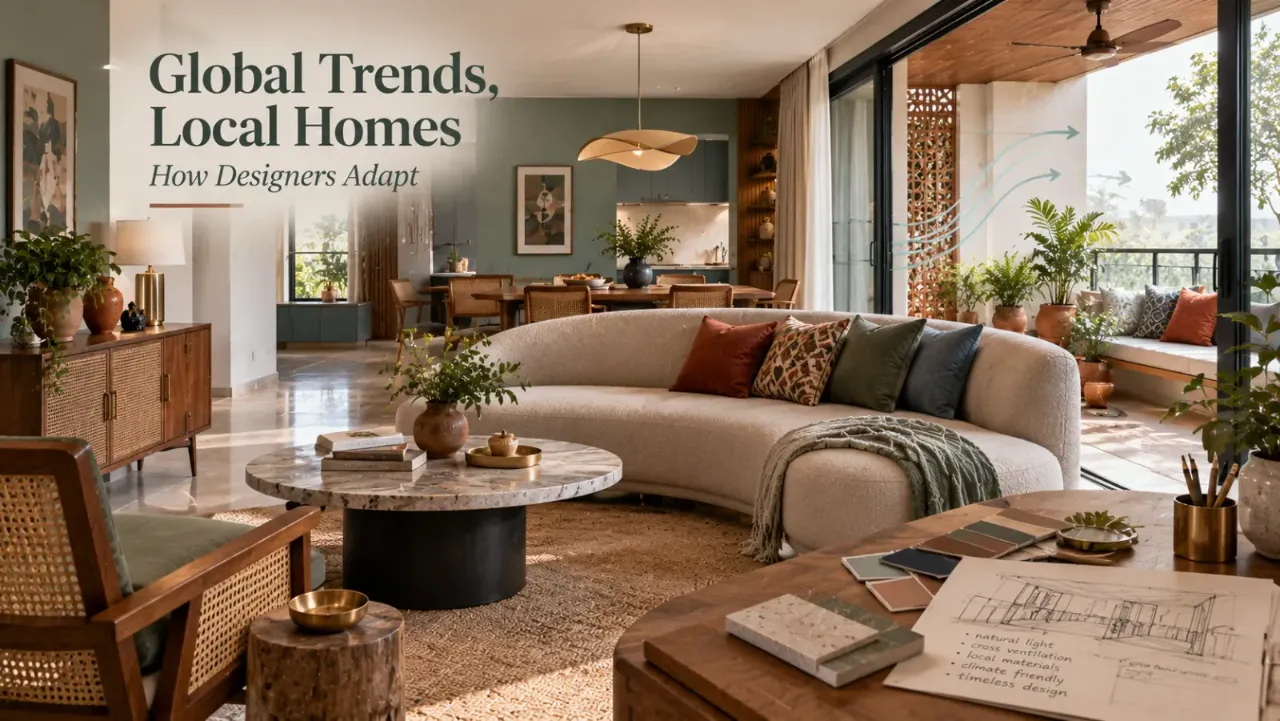
Global Trends, Local Homes: How Designers Adapt
Scroll through international interior-design content and it is easy to fall in love with a look. A warm minimalist kitchen from Copenhagen. A dramatic stone bathroom from Milan. A calm Japandi bedroom. A colourful Mediterranean living room. The images are beautiful. Then you try to recreate one at home and something feels off.
Global Trends Are References, Not Instructions
Interior trends travel quickly. A design idea that appears in a European apartment today may be influencing homes in Mumbai, Pune, Bengaluru or Jaipur soon after.
But a trend does not arrive with a complete set of instructions for every location.
It arrives as an idea.
Maybe it is:
- Softer natural colours
- Sculptural furniture
- Concealed storage
- A more tactile material palette
- Open shelving
- Larger kitchen islands
- Indoor-outdoor living
- Statement lighting
- Warmer minimalism
- Layered textures
The designer then has to decide how much of that idea belongs in the actual home.
That is the first act of adaptation.
Climate Changes the Design
A photograph from a different climate can make a material or layout look effortless. Living with it is another matter.
Heat, humidity, monsoon exposure, dust, sunlight and ventilation can all affect how a home performs.
A designer working locally is more likely to think about those conditions during specification.
A pale textured wall may look beautiful, but is the finish practical for the level of dust and daily cleaning?
A particular fabric may photograph beautifully, but is it easy to maintain?
A heavily glazed space may feel bright, but does the room need more solar control?
An imported design reference cannot answer those questions.
The local designer has to.
This is why climate is not a small technical adjustment at the end. It can influence the material, colour, opening, shading and maintenance decisions from the beginning.
The Kitchen Is Where “Global” Often Meets Reality
One of the clearest examples is the kitchen.
A beautifully minimal kitchen from another country may rely on very different cooking habits.
A regional designer has to think about what actually happens in the client's kitchen.
How many vessels are used?
How often is frying done?
Where does the pressure cooker go?
How much pantry storage is needed?
Does the family use large containers?
Are appliances kept permanently on the counter?
How much prep space is required?
Does the homeowner prefer concealed storage or quick access?
A global trend can still influence the look.
The layout, storage logic and internal planning may need to be completely local.
The result might look minimalist from the outside while being highly practical inside.
That is not compromising the design. That is designing intelligently.
Family Structure Changes the Floor Plan
A room designed for one person does not behave like a room designed for a multigenerational family.
Daily routines, privacy requirements, guest patterns and shared spaces can all differ.
A global trend might promote a completely open living arrangement.
But a local client may need:
- A flexible guest area
- More privacy
- A prayer space
- Storage for multiple family members
- A dining arrangement that supports frequent gatherings
- Adaptable sleeping arrangements
- A place for household work
A regional designer reads the lifestyle before drawing the room.
The trend becomes a layer rather than the entire design.
Cultural Habits Become Design Inputs
Culture does not have to appear as an obvious decorative theme.
It can influence the way a home works.
Consider something as simple as where shoes are removed, where guests sit, how food is served, how festivals change the use of a room or whether certain objects need a dedicated place.
These are not styling details. They affect planning.
A designer who understands the local context can incorporate those habits without turning the home into a themed interior.
This is where adaptation becomes subtle.
The space feels contemporary. But it still feels like it belongs to the people living there.
The Pooja Space Is a Good Example
A global design reference may show a completely open living room with no dedicated spiritual space.
That does not automatically mean the same planning approach is right for every client.
For one homeowner, a pooja room may be essential. For another, a compact integrated shrine may be enough. Someone else may want the space visually quiet and easily accessible without making it the focal point of the room.
The designer does not need to reject the global aesthetic.
They can adapt the planning.
That might mean integrating a niche, screen, cabinet or small dedicated zone into an otherwise contemporary interior.
The idea stays modern. The home stays personal.
Local Materials Can Change the Look for the Better
Global trends often arrive through a material vocabulary.
Stone. Timber. Rattan. Linen. Metal. Terrazzo. Textured plaster. Ceramic.
But using the exact material seen in an international reference is not always necessary.
A regional designer can look for materials that create the same visual effect using options that are easier to source, more appropriate locally or better suited to the project's budget.
That might mean:
- Choosing a locally available stone with a similar character
- Using a regional craft technique
- Selecting a different wood species
- Reproducing a visual texture with another finish
- Adapting a material because of maintenance requirements
The result may look different from the original reference. But the design intention can remain intact.
Local Craft Can Make a Global Trend Feel Original
This is where adaptation gets really interesting.
Imagine a globally popular neutral interior.
Instead of copying it exactly, a regional designer introduces a locally made textile, handcrafted furniture, regional artwork or a traditional pattern in a restrained way.
Suddenly, the room has a different identity.
The global language creates the foundation. The local element makes it yours.
This is often more successful than filling a contemporary room with decorative objects simply to make it “Indian” or “regional.”
Good cultural integration is usually more thoughtful than that.
Budget Changes the Interpretation
This is one of the biggest reasons trends cannot simply be copied.
An international reference may contain custom furniture, rare stone, specialised lighting, imported hardware or bespoke finishes.
A local client may have a completely different budget.
The designer's challenge is to identify what creates the visual impact.
Is it the colour? The proportion? The lighting? The material contrast? The shape? The texture?
Once that is identified, the designer can recreate the effect using a different combination of materials and products.
That is design translation. Not cheap imitation.
A Good Designer Knows What to Spend On
Not every part of a trend deserves equal investment.
Suppose the inspiration is a warm, sophisticated living room.
The designer might decide that the important elements are:
- Good lighting
- Comfortable proportions
- One strong material
- A restrained palette
- A statement piece
Instead of spending heavily on every surface, the budget can be concentrated where the visual impact is highest.
This is especially useful for clients who want a premium look without an unlimited budget.
Furniture Size Has to Follow the Room
A photograph can make a piece of furniture look perfectly proportioned. But photographs remove context.
A sectional sofa that looks beautiful in a large international residence can overwhelm a compact apartment.
A wide kitchen island may look impressive but leave insufficient circulation.
A dramatic dining table may not fit the room's actual movement patterns.
A regional designer understands that furniture has to be scaled to the architecture around it.
Imported Styles Often Need Maintenance Edits
This is an area where design photographs can be misleading.
A space may appear effortless because you are looking at it on the day the photograph was taken.
Real homes accumulate:
- Dust
- Fingerprints
- Cooking residue
- Children's belongings
- Everyday clutter
- Cleaning requirements
- Wear
Some design decisions are much more forgiving than others.
A regional designer can often identify where a visually impressive choice will create unnecessary maintenance.
That may lead to a different finish, a different storage strategy or a slightly altered material palette.
The room may be less dramatic on a mood board. It may be much better to live with.
Open Shelving Is a Perfect Example
Open shelving has been embraced in many global interiors.
It can look light, airy and beautifully styled.
But it also means everything stays visible.
A designer working with a family that needs significant storage may decide that open shelving should be used selectively rather than throughout the room.
Perhaps one display niche is enough.
The rest can remain concealed.
The trend survives. The clutter problem does not.
Lighting Needs a Local Interpretation Too
Lighting trends also travel quickly.
Linear lighting. Wall washers. Pendant clusters. Cove lighting. Decorative sconces. Minimal ceiling lighting.
But the same lighting strategy can behave differently depending on the room, ceiling height, daylight and daily use.
A designer has to consider what the light is actually doing.
Is it task lighting? Ambient lighting? Accent lighting? Decorative lighting?
Does the room still work when only one layer is switched on?
A beautiful international lighting reference is useful. The local room still needs its own lighting logic.
Local Work Habits Matter in Home Offices
Global interiors often show beautiful compact workspaces.
But a local client may work longer hours, use multiple monitors, manage paperwork or switch between professional and household tasks.
That can change:
- Desk dimensions
- Cable management
- Storage
- Seating
- Lighting
- Background treatment
- Privacy
- Power requirements
Again, the inspiration remains useful. The final design is adapted to how the person actually works.
Regional Designers Also Adapt to Availability
A design idea only becomes a real interior when someone can source and install it.
This makes availability part of design.
A material that is easy to obtain in one city may be difficult or expensive elsewhere.
The same can apply to:
- Specialist hardware
- Custom furniture
- Craftsmen
- Stone
- Fabrics
- Fixtures
- Repair services
A good designer understands the supply chain well enough to know when a beautiful specification is sensible and when it is going to create unnecessary delays or maintenance issues.
That is a very unglamorous part of design. It is also extremely valuable.
“Local” Does Not Mean Traditional
Adapting a global trend to a local client does not mean adding traditional motifs everywhere.
A contemporary regional home can still be:
- Minimalist
- Modern
- Industrial
- Japandi-inspired
- Warm contemporary
- Luxury
- Eclectic
Local adaptation may be almost invisible.
It might exist in the storage planning, materials, kitchen layout, proportions, climate response or way rooms connect.
The home does not have to announce its regional identity. It simply has to function within it.
The Best Designers Translate, They Don't Copy
This is perhaps the most important point.
A designer should be able to look at an inspiration image and identify the underlying design idea.
Maybe the client loves:
The Calmness
Rather than the exact furniture, the client may want the sense of quiet and visual simplicity.
The Material Contrast
The appeal may be the balance between wood, stone, metal or fabric rather than the exact materials shown.
The Openness
The client may love the feeling of openness without actually needing a completely open floor plan.
The Warmth
The feeling may come from colour, lighting and texture rather than one specific palette.
Once you understand what someone actually likes, you can reinterpret it much more intelligently.
Here's What the Translation Process Looks Like
1. Find the Idea
Identify what the client actually loves about the global reference: colour, proportion, material, mood, lighting or layout.
2. Read the Home
Look at the room's size, orientation, climate, architecture, existing furniture and circulation.
3. Read the Lifestyle
Understand cooking, storage, family routines, entertaining, work, maintenance and personal preferences.
4. Adapt the Specification
Choose materials, finishes, furniture and details that deliver the same design intention in a practical way.
5. Edit Again
Remove anything that looks impressive but does not improve the way the homeowner will actually live.
That final edit is often the difference between a trend-led interior and a well-designed home.
Why This Matters More Than Following Trends
Trends change. Homes don't need to change every time Instagram does.
A strong regional designer can borrow from what is current without making the interior feel temporary.
That might mean using a trendy colour in a replaceable element rather than permanent cabinetry.
It might mean choosing timeless materials and using trend-led styling around them.
It might mean taking inspiration from a global style while changing the actual layout completely.
The goal is not to prove that the home is “on trend.”
The goal is to create a home that still feels right after the trend has moved on.
The Difference Between Trend-Led and Trend-Informed
These sound similar. They are not.
“This is popular right now, so let's use it.”
A trend-informed home:
“This idea is interesting. Does it make sense for this person and this home?”
The second question is much more useful.
Because design is not a competition to recreate the internet. It is a process of making a particular space work better for particular people.
What Homeowners Can Learn From Regional Designers
When you save an inspiration image, don't ask:
Ask:
Then separate the image into:
- Colour
- Material
- Lighting
- Furniture
- Proportion
- Layout
- Mood
- Styling
You may discover that you only love two of those elements.
That makes the project much easier.
It also gives your designer something far more useful than a folder of unrelated Pinterest images.
The Bottom Line
Global design trends can be incredibly useful.
They introduce new ideas, materials, layouts, colours and ways of thinking about space.
But the best regional designers do not copy them literally.
They adapt them.
They account for the climate. They understand the lifestyle. They work within the budget. They think about materials and availability. They respect cultural habits. They scale furniture to the actual room. They consider maintenance.
“This looks beautiful, but it won't work here.”
That sentence is not a rejection of global design. It is what makes the design local.
The most successful interior may therefore have an international influence without looking imported at all.
It feels current.
It feels personal.
And most importantly, it feels like home.
Bring Inspiration Into Your Own Space
Inspiration is much easier to evaluate when you can see how an idea interacts with your actual room. You can use Walls to Wonder's Design My Room tool to explore different design directions around your existing space.
When you are ready to move from inspiration to execution, the Walls to Wonder designer directory can help you explore interior professionals across different locations and specialisations.
Final Thought
The best design is rarely about choosing between global and local.
It is about knowing what to take from each.
Global trends can provide the spark.
Local knowledge makes the idea livable.
And when those two come together properly, the result does not feel copied from somewhere else.
It feels like it was always meant for that home.
Frequently Asked Questions
How do regional designers use global interior trends?
They identify the underlying idea behind a trend and then adapt the materials, layouts, colours, furniture, detailing and specifications to suit the client's home, lifestyle, climate and budget.
Does local interior design mean using traditional styles?
No. A regional designer can create a completely modern or contemporary interior while still adapting the design to local habits, architecture, materials and practical needs.
Why can't homeowners simply copy interiors from international design websites?
Because the reference home may have a different climate, room size, construction system, cooking habits, family structure, product availability and maintenance requirements.
How does climate influence interior design?
Climate can influence material selection, finishes, ventilation, shading, fabrics, furniture choices and maintenance requirements. A design that works well in one environmental context may need adjustments in another.
Can global trends work in Indian homes?
Yes. Global ideas can work very well when they are adapted to the home's proportions, climate, lifestyle, cooking habits, storage needs, cultural preferences and budget rather than copied literally.
How can I make a global design trend feel local?
Start with the part of the trend you genuinely like, then combine it with locally appropriate materials, furniture, craftsmanship, colours or planning decisions. The local influence does not need to be overt or decorative.
Should I show inspiration images to my interior designer?
Yes, but explain what you like about each image. Saying “I love the lighting and warmth” is usually more useful than simply asking for an exact copy of the room.
Is following global trends a bad idea?
Not at all. Trends are useful sources of inspiration. The problem starts when a trend is treated as a fixed formula instead of being evaluated against the actual home and the people who will live in it.
What makes a good regional interior designer?
A strong regional designer can balance aesthetics with practical knowledge of local lifestyles, materials, climate, sourcing, execution, budget and the client's individual preferences.
Turn this idea into a plan for your home
Visualise your space, understand the likely budget, or find a professional who can bring the idea to life.