

Choosing Bathroom Fittings That Last Beyond the Warranty
Bathroom fittings are among the most frequently used components in a home. A basin tap may be opened dozens of times a day, a shower mixer must regulate water consistently, and a flush system needs to work reliably every time. When a fitting starts leaking, becomes difficult to operate or develops a deteriorating finish, replacing it can involve more than buying a new product. Plumbing work, labour and sometimes tile repairs may also be required.
That is why bathroom fittings deserve attention during home interior design and renovation. The cheapest option may not offer the best value over time, but the most expensive fitting is not automatically the most durable either.
Several factors determine how long a fitting performs well: its internal components, material and finish, water quality, installation, availability of replacement parts and the manufacturer's warranty and service support.
The best bathroom fitting is one that suits your water conditions, daily use and budget—and can be serviced when something eventually wears out.

Here is a practical guide to common bathroom fittings, brands worth comparing in India, and what to check before you buy.
1. Know the Common Bathroom Fittings Before You Shop
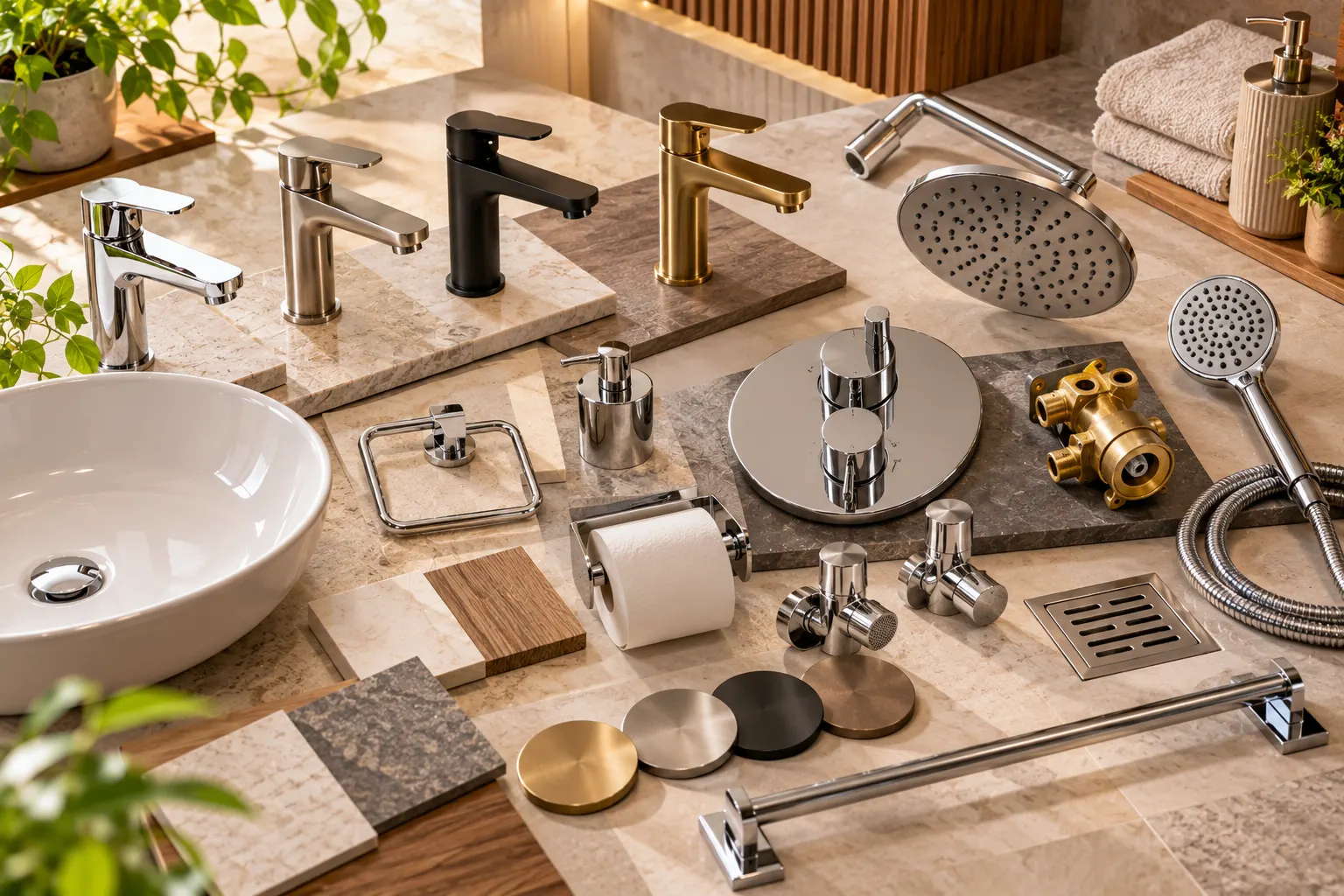
Before comparing brands, identify which fittings your bathroom actually needs. A typical bathroom may include the following components.
Basin taps and mixer taps
A basin tap controls water flow at the washbasin. A mixer tap combines hot and cold water, where both supplies are available, through a single spout or control arrangement.
Look at the operating mechanism, body material, finish, cartridge availability and suitability for your basin. The tap must also suit the number and position of the basin's mounting holes.
Wall mixers and shower mixers
These fittings regulate water going to a shower or bathing outlet. Depending on the arrangement, a mixer may control temperature and flow while a diverter directs water to different outlets.
Choose the configuration according to the plumbing layout. Concealed mixers require particularly careful planning because their internal components sit behind the finished wall.
Overhead showers and hand showers
An overhead shower delivers water from above, while a hand shower provides a movable spray for rinsing and cleaning. The useful choice depends on water pressure, cleaning preferences, the bathroom's dimensions and the available plumbing.
A larger showerhead is not necessarily better if the water supply cannot support the desired flow.
Health faucets and bidet sprays
These hand-held sprays are common in Indian bathrooms. Their reliability depends on the spray mechanism, hose and connections, water pressure and how they are used.
Check the manufacturer's instructions for installation and safe use. The hose and small connection components may have different warranty coverage from the main fitting.
Flush systems and concealed cisterns
A flush system includes the mechanism that releases water into the toilet. A concealed cistern is installed behind a wall or access panel, while an exposed cistern remains visible.
Concealed systems can give a clean appearance, but service access matters. Choose a system with a practical maintenance route and confirm that compatible replacement parts will be available.
Angle valves, hoses, drains and accessories
Small components are easy to overlook during bathroom design, yet a faulty valve, flexible hose or drain can cause inconvenience and, in some cases, water damage.
Budget for suitable angle valves, connection hoses, waste fittings, floor drains, towel rails, hooks and other accessories as part of the complete bathroom plan.
2. What Actually Makes a Bathroom Fitting Last?
A brand name alone cannot predict the lifespan of every product in its range. The specific model, material, installation and usage conditions matter.
Body material and construction
Check the product's technical specifications rather than relying on appearance or weight alone. Brass and suitable stainless-steel components are used in bathroom fittings, but quality varies between products and components.
Also consider which parts are made from metal, polymer or other materials, and whether the product is intended for your application. A shiny exterior does not tell you what the internal construction is like.
Cartridge and moving parts
In mixer taps, the cartridge helps control water flow and temperature. The design, build quality, compatibility and availability of replacement cartridges can make a difference to repairability.
Ask whether the cartridge or other commonly serviced components can be replaced independently rather than requiring the entire fitting to be changed.
Surface finish and corrosion resistance
Chrome, brushed finishes, matte black and gold-toned finishes have different appearances and cleaning requirements. Their long-term appearance depends on the finish system, water deposits, cleaning products and handling.
Hard-water deposits can build up around spouts, shower nozzles and joints. Some finishes may also show fingerprints, scratches or mineral marks more readily than others.
Installation quality
A well-made fitting can still leak or perform poorly if it is installed incorrectly. Incorrect alignment, damaged threads, overtightening, unsuitable connections or inadequate testing may create problems.
Follow the installation instructions and use a qualified plumber, especially for concealed mixers, cisterns and other fittings that become difficult to access later.
Water quality and pressure
Mineral deposits can affect aerators, shower nozzles and moving components. Sediment may also interfere with operation. Very high or fluctuating pressure can place additional stress on certain components and connections.
If your home has hard water or irregular pressure, discuss suitable products, filtration where appropriate and pressure control with your plumber. No premium brand is immune to unsuitable water conditions or poor installation.
3. Bathroom Fittings Brands Worth Comparing in India
Jaquar, CERA, Hindware and Kohler are examples of established brands that homeowners may consider when comparing bathroom fittings. They offer different products and ranges, so the right shortlist depends on the particular fitting, budget, service access and finish you want.
The following comparison is a buying guide, not a ranking of which brand lasts longest.
| Brand | What to examine | Before buying |
|---|---|---|
| Jaquar | The selected faucet or shower range, finish, spare parts and service arrangements | Confirm the exact model's warranty, exclusions and current service terms |
| CERA | Faucet, shower and sanitaryware specifications, plus the relevant product warranty | Check that the warranty applies to your particular product and use |
| Hindware | The specific faucet, shower or flush-system category and its individual coverage | Check exclusions for hoses, washers, valves and other components |
| Kohler | The product line, faucet finish, internal mechanism and service requirements | Read the model-specific warranty and check local service availability |
A brand may offer a long warranty for one category but different coverage for another. Finishes, electronic components, accessories, internal mechanisms and residential versus commercial use may also have different terms.
For example, published manufacturer information includes different warranty conditions across the four brands. CERA lists a 15-year residential warranty for faucets on its official warranty page; Hindware lists 12 years for residential faucets on its warranty page; Jaquar advertises warranty and bathroom maintenance support through its customer-care programme; and Kohler's published Indian policy distinguishes faucet coverage by finish and usage category.
These are examples of published terms, not proof that one brand will physically last longer than another. Always check the latest written policy for the exact model and purchase date, including what is covered, which components are excluded and how service is provided.
4. Match the Fitting to the Bathroom, Not Just the Budget
A good fitting should suit the way the bathroom is used. It is often more useful to spend thoughtfully on the components that will be difficult or costly to access later than to upgrade every visible accessory.
For a family bathroom
Prioritise easy operation, reliable mixer controls, suitable shower performance and readily serviceable components. Where several people use the bathroom every day, repairability and cleaning requirements matter.
For a guest bathroom
A straightforward basin tap, dependable flush mechanism and practical shower arrangement may be more valuable than specialised features that guests rarely use.
For a compact bathroom
Confirm dimensions and clearances before choosing wall-mounted, concealed or unusually shaped fittings. A large overhead shower or prominent fitting can be awkward in a small enclosure if the layout has not been planned around it.
For hard-water areas
Ask about cleaning instructions, finish suitability, removable aerators and descaling requirements. Make sure your household can perform the recommended maintenance without damaging the surface.
For concealed fittings
Give extra attention to compatibility, installation drawings, service access and availability of replacement cartridges and internal components. A concealed fitting may look minimal, but its long-term convenience depends on how it can be repaired.
5. Understand the Warranty Before You Pay
A warranty is useful, but it should never be treated as a complete prediction of product life.
Check the following details on the manufacturer's written policy:
- Coverage period: How long does the warranty last for the specific product?
- Covered defects: Does it cover manufacturing defects in material or workmanship?
- Component exclusions: Are hoses, seals, washers, cartridges, batteries or electronic parts covered differently?
- Installation requirements: Must installation be completed by an authorised or qualified professional?
- Maintenance conditions: Which cleaning methods and operating conditions are required?
- Claim process: What invoice, warranty registration or product details must you retain?
- Service availability: Can an authorised service provider or genuine replacement part be accessed from your location?
Keep your invoice, product model number, warranty document and installation details. These can make a future repair or warranty claim easier to manage.
Do not compare warranty durations in isolation. One policy may cover a specific body or finish for longer while treating internal parts, electronic components or accessories differently.
6. Don't Ignore Spare Parts and After-Sales Service
Bathroom fittings eventually need maintenance. A cartridge can wear, a seal may need replacement, a hose may deteriorate or a flush valve may require servicing.
The availability of compatible parts can determine whether a repair is straightforward or whether you need to replace an otherwise serviceable fitting.
Before choosing a model, ask the dealer or manufacturer:
- Are replacement cartridges, seals and valves available for this model?
- Are the parts standard or model-specific?
- Is there authorised service support in your area?
- Can a concealed fitting be serviced through its planned access point?
- Are compatible replacement parts expected to remain available for the product range?
It is especially important to think about spare parts for concealed mixers and in-wall cisterns. Reaching them may require more effort than servicing an exposed tap.
A less complicated fitting with accessible parts may be a sensible choice for a bathroom that needs to remain easy to maintain.
7. Common Buying Mistakes to Avoid
A stylish finish does not reveal the internal mechanism, serviceability or compatibility with your plumbing.
Warranty terms vary by product, finish and component. They are useful comparison points, but not a controlled test of lifespan.
Concealed mixers, wall-mounted taps and cisterns must match the selected installation system and dimensions.
Valves, hoses, seals and flush mechanisms can cause leaks or inconvenience if they are unsuitable or neglected.
Strong acids, abrasives and unapproved cleaners may damage finishes and seals. Follow the manufacturer's cleaning guidance.
A product is harder to maintain if authorised support and compatible spare parts are difficult to obtain.
8. How to Maintain Bathroom Fittings for Longer Use
Even a well-chosen fitting needs reasonable care. A few simple habits can help preserve performance and appearance.
- Clean regularly with suitable products. Use a soft cloth and cleaners permitted by the manufacturer. Avoid abrasive pads or strong chemicals unless the product instructions explicitly allow them.
- Remove mineral deposits appropriately. Follow the manufacturer's descaling method for shower nozzles, aerators and other affected components.
- Investigate drips early. A dripping tap or recurring leak should be checked rather than ignored until the surrounding surface is damaged.
- Avoid forcing stiff controls. Resistance can indicate mineral deposits, a worn component or another problem that needs attention.
- Check hoses and accessible connections. Look for visible damage, corrosion or leakage, and arrange replacement where necessary.
- Test concealed installations before closing the wall. Have a qualified installer check connections and operation before completing tiles or access panels.
- Retain product details. Keep the invoice, model number, warranty and installation information for future maintenance.
The aim is not to eliminate every possible repair. It is to make routine maintenance manageable and avoid preventable damage.
9. A Practical Bathroom Fittings Buying Checklist
Before finalising your bathroom fittings, confirm each of these points:
- The fitting suits the basin, shower, toilet or plumbing arrangement.
- Its material, finish and operating mechanism are clearly specified.
- The selected model is suitable for your water pressure and conditions.
- You understand the warranty and the components it excludes.
- Compatible replacement parts and authorised service are available.
- Concealed components have a planned route for maintenance.
- Installation requirements and testing responsibilities are clear.
- The total budget includes fittings, valves, hoses, accessories, installation and applicable taxes.
This checklist is useful whether you are renovating a single bathroom or coordinating fittings across an entire home.
Plan Your Bathroom Upgrade With Walls to Wonder
A bathroom that looks cohesive starts with selecting compatible fittings, finishes and layouts before installation begins.
Use the Walls to Wonder Interior Design Cost Estimator to explore bathroom-related interior costs as part of your wider project budget. You can also browse the Walls to Wonder designers directory for professional support with bathroom planning, finishes and renovation coordination.
Confirm the final product specifications, installation requirements and warranty terms with the supplier before placing your order.
Final Thought
There is no single bathroom fittings brand that can be guaranteed to last the longest in every home. Product quality, water conditions, installation, maintenance and access to genuine spare parts all influence the outcome.
Jaquar, CERA, Hindware and Kohler are sensible brands to include in a comparison, but the final decision should be based on the individual model and its written terms—not only its name, price or headline warranty.
Choose fittings that are well specified, suitable for your bathroom and practical to service. That is a better long-term strategy than paying more for features you do not need.
Frequently Asked Questions
1. Which bathroom fittings brands are worth comparing in India?
Jaquar, CERA, Hindware and Kohler are options to consider. Compare the specific product range, internal components, warranty, service availability and replacement parts before deciding. No brand name alone guarantees the longest life.
2. Are expensive bathroom fittings always more durable?
No. Price can reflect design, finish, features and brand positioning, but it does not establish the lifespan of every model. Compare specifications, repairability, warranty exclusions and suitability for your water conditions.
3. What should I look for in a durable bathroom tap?
Check the body material, internal cartridge, finish specifications, compatible replacement parts, installation requirements and warranty. Also consider your water quality, pressure and the manufacturer's cleaning instructions.
4. Are concealed shower mixers and cisterns worth buying?
They can create a clean, uncluttered appearance, but installation planning and service access are essential. Confirm compatibility, access-panel arrangements and spare-part availability before choosing a concealed system.
5. Does a long warranty mean the bathroom fitting will last that many years without problems?
No. A warranty describes the manufacturer's defined coverage and conditions, not a guarantee that the fitting will need no maintenance or never fail. Check which components are covered, what is excluded and how claims are handled.
Turn this idea into a plan for your home
Visualise your space, understand the likely budget, or find a professional who can bring the idea to life.