
How Much Contingency Should You Keep for Home Interiors?
You have finalised the design, compared quotations, selected materials and decided how much you can spend on your home interiors. The budget looks comfortable—until an unexpected plumbing issue appears, an electrical point needs to be shifted or the actual measurements differ from the original estimate.
These situations are more common than homeowners expect. Interior projects involve several trades, suppliers, measurements and on-site decisions. Even with good planning, not every expense can be predicted before work begins.
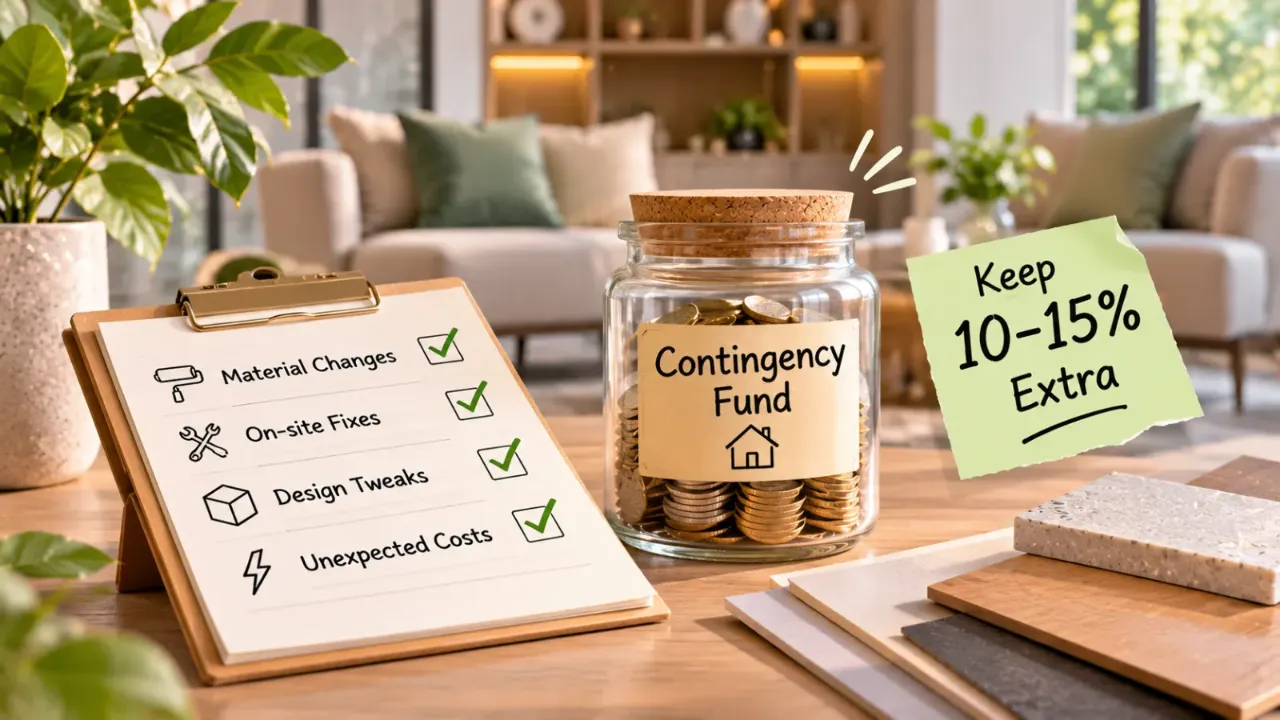
This is why a contingency fund matters. It is a separate amount reserved for genuine unexpected costs, helping you complete the project without borrowing money, compromising essential work or making rushed decisions.
But how much should you keep aside? The answer depends on whether you are furnishing a newly handed-over flat, renovating an older home or carrying out major structural and service-related work.
1. What Is a Contingency Fund in Interior Design?
A contingency fund is an amount kept aside to cover unforeseen expenses that arise during an interior project.
It is not an additional shopping budget or money meant for upgrades you decide to make halfway through the work. It is a financial safety buffer for situations that could not reasonably be identified or priced accurately at the planning stage.
For example, you may discover:
- Dampness behind an existing wardrobe
- Damaged plumbing after removing old bathroom fittings
- Outdated wiring that needs replacement
- Uneven flooring requiring additional preparation
- Additional carpentry work due to actual site measurements
- Material damage during transportation or installation
- Extra labour because of unexpected site conditions
A contingency fund gives you room to address such issues without disrupting the entire project budget.
2. How Much Contingency Should You Keep?
There is no single percentage that works for every home. The right amount depends on the property's condition, the type of work and how much uncertainty remains.
For Indian home interior planning, the following ranges provide a practical starting point:
| Type of project | Suggested contingency |
|---|---|
| New flat with clear specifications and minimal site work | 5–10% |
| Standard full-home interior project | 10–12% |
| Partial renovation or kitchen and bathroom upgrades | 10–15% |
| Older home with uncertain plumbing or electrical conditions | 15–20% |
| Extensive renovation with concealed or structural work | 15–20% or more, depending on site risk |
These are planning recommendations, not mandatory industry rates. A new apartment with completed services and a detailed scope may need a smaller reserve. An older property where walls, flooring and plumbing will be opened up may need considerably more.
The important principle is simple: the less you know about the actual site conditions, the more financial protection you should plan for.
3. Calculate Your Contingency With a Simple Example
Suppose your estimated interior project cost is ₹10 lakh before contingency.
If you keep a 10% reserve, the calculation is:
- Estimated project cost: ₹10,00,000
- Contingency percentage: 10%
- Contingency amount: ₹1,00,000
- Total planned budget: ₹11,00,000
At 15%, the calculation becomes:
- Estimated project cost: ₹10,00,000
- Contingency percentage: 15%
- Contingency amount: ₹1,50,000
- Total planned budget: ₹11,50,000
What if ₹10 lakh is your maximum available budget?
This is an important distinction. If ₹10 lakh is the maximum amount you can spend, you should not plan ₹10 lakh of work and then try to find additional money when something goes wrong.
Instead, reserve the contingency first.
| Total available budget | Reserve percentage | Amount available for planned work |
|---|---|---|
| ₹10 lakh | 10% | Approximately ₹9.09 lakh |
| ₹10 lakh | 12% | Approximately ₹8.93 lakh |
| ₹10 lakh | 15% | Approximately ₹8.70 lakh |
This calculation treats the contingency as a percentage of the total available budget. It is a useful way to work backwards when your spending limit cannot increase.
4. Why Interior Projects Go Over Budget
Unexpected costs usually arise from a combination of incomplete information, site conditions and decisions made during execution.
Hidden plumbing and electrical issues
Existing pipes, wiring and connections are not always visible during the initial inspection. Once old cabinets, tiles or false ceilings are removed, defects may become apparent.
Replacing damaged wiring or repairing a concealed leak can add work that was not included in the original interior estimate.
Incorrect or incomplete measurements
Early estimates may be based on approximate dimensions. Actual site measurements can reveal uneven walls, floor-level differences, columns or other obstructions that affect furniture dimensions and material quantities.
Material price and availability changes
A selected laminate, hardware fitting or decorative surface may become unavailable or take longer to arrive. A replacement product may cost more, particularly when it has to be sourced from another supplier.
Design changes during execution
A decision to increase wardrobe storage, add another drawer unit or change a finish may appear small. But several such changes can increase material, labour and installation costs.
Labour and timeline extensions
Delays caused by material shortages, site access, coordination problems or additional work can increase labour and supervision expenses.
The best contingency plan accounts for genuine uncertainty while reducing avoidable changes through better preparation.
5. Which Expenses Should Your Contingency Cover?
A contingency reserve should be used for unexpected project-related expenses, not for every additional purchase.
| Expense | Should contingency cover it? |
|---|---|
| Hidden plumbing damage discovered during renovation | Yes |
| Unplanned electrical repair required for safety | Yes |
| Additional surface preparation after removing old finishes | Yes |
| Unexpected material wastage beyond the allowance | Possibly, if justified |
| Additional labour due to unforeseen site conditions | Yes |
| A more expensive laminate chosen for appearance | No, this is an upgrade |
| Adding another wardrobe after work begins | No, this is a scope change |
| Buying a new sofa or decorative lighting | No, unless already part of the planned scope |
| Replacing a selected product because you changed your mind | No |
This distinction is important. If you use your contingency for optional upgrades, you may have no reserve left when a genuine problem appears.
6. New Home vs Renovation: Why the Reserve Should Differ
A newly handed-over flat and an older property do not carry the same level of uncertainty.
New homes
A new apartment may already have completed electrical wiring, plumbing connections, flooring and basic finishes. If these are in good condition and the interior work is clearly specified, many site-related uncertainties are reduced.
A reserve of around 5–10% can be a reasonable starting point for a straightforward project.
However, new homes are not automatically free from problems. Incorrect dimensions, incomplete handover work, damaged finishes and changes to electrical points can still create additional costs.
Older homes
Renovations are more difficult to estimate because parts of the property remain hidden until work starts.
You may discover:
- Corroded or leaking pipes
- Old or unsuitable electrical wiring
- Dampness behind wall finishes
- Damaged plaster or uneven floors
- Weak fixing surfaces
- Deteriorated waterproofing
A reserve of 15–20% may be more appropriate for an older home, particularly when several concealed services are being replaced.
For extensive renovation or structural work, the amount should be assessed with the relevant professionals after a site inspection. A percentage alone cannot replace a proper risk assessment.
7. How to Reduce the Chances of Using Your Contingency
The purpose of contingency is to protect you when something genuinely unexpected happens. Good planning can reduce how often you need to use it.
Get a detailed Bill of Quantities
A detailed BOQ should specify the work, quantities, materials, finishes, dimensions and rates. Avoid accepting a quotation that describes everything as a single package without explaining what is included.
Complete a proper site inspection
Before finalising the budget, inspect existing plumbing, electrical points, walls, floors, ceiling conditions and access arrangements.
For renovation projects, ask the relevant professionals to identify areas that may need further investigation.
Finalise materials before procurement
Decide on plywood, laminates, hardware, countertops, paint and other finishes before ordering begins. Keep product names, specifications and approved alternatives in writing.
Confirm what the quotation excludes
Check whether civil work, debris removal, transportation, GST, appliances, loose furniture and additional electrical or plumbing work are included.
Approve drawings before execution
Finalise furniture dimensions, storage requirements, electrical provisions and ceiling layouts before fabrication or installation. Changes made later can be more expensive.
Record every change
Any additional work should be documented with its reason, cost and approval. This helps distinguish genuine unforeseen expenses from optional changes.
8. Keep Your Contingency Separate From Your Main Budget
A contingency fund only works if it remains available when you need it.
Keep it separate from the amount allocated to planned work. It can be tracked in a separate bank balance or a clearly identified budget category.
Use a simple record for every withdrawal:
| Detail | Example |
|---|---|
| Original contingency | ₹1,00,000 |
| Unexpected issue | Concealed pipe repair |
| Approved additional cost | ₹18,000 |
| Remaining contingency | ₹82,000 |
| Supporting record | Contractor estimate and invoice |
Before approving an expense, ask:
- Was this expense included in the original quotation?
- Could it reasonably have been identified before work began?
- Is it necessary to complete the project safely or properly?
- Has the contractor provided a clear cost breakdown?
- Is there a more economical solution without compromising quality?
If the expense is simply an optional improvement, fund it separately rather than taking money from the reserve.
9. What Happens If You Do Not Use the Contingency?
A contingency fund is not money that must be spent.
If the project is completed without unexpected expenses, the unused amount remains yours. You can use it for curtains, loose furniture, appliances, decorative accessories or simply retain it as savings.
In fact, a well-planned project may finish with most of its contingency untouched. That is a positive outcome, not a reason to spend the money at the last moment.
10. A Practical Contingency Planning Checklist
Before starting your interior project, check the following:
- Estimate the project cost using a detailed scope of work.
- Decide whether the property is new, partially renovated or undergoing a full renovation.
- Assess existing plumbing, wiring, flooring and wall conditions.
- Choose a contingency percentage based on the actual level of uncertainty.
- Keep the reserve separate from the planned execution budget.
- Confirm material specifications and quantities.
- Record all exclusions in the contractor's quotation.
- Get approval before any additional work begins.
- Track every contingency expense with a bill or written estimate.
- Retain any unused amount after project completion.
Closing Thoughts
A contingency fund is not an indication that your interior project is poorly planned. It is a sign that you understand how real-world execution works.
For a straightforward new-home fit-out, 5–10% can provide a useful starting buffer. For most renovations, 10–15% is a more cautious allowance, while older properties and extensive work may require 15–20% or more.
The most important step is to calculate the reserve before committing your full budget. Keep it separate, use it only for genuine unexpected expenses and document every additional cost.
A good interior budget does not just tell you what you can build. It also prepares you for what you could not predict.
Explore More with Walls to Wonder
Planning your interiors becomes easier when you understand the costs before work begins. Explore Walls to Wonder's AI tools to estimate expenses, review quotations and visualise your design decisions.
- Whole Home Visualizer
- Design My Room
- Interior Design Cost Estimate
- Interior Quotation Checker
- Rate My Room Design
- Interior Style Finder
Visit Walls to Wonder for more ideas and inspiration for your home.
Get a personalised estimate for your home
Choose your rooms, materials and preferences to understand a practical interior budget before you commit.