
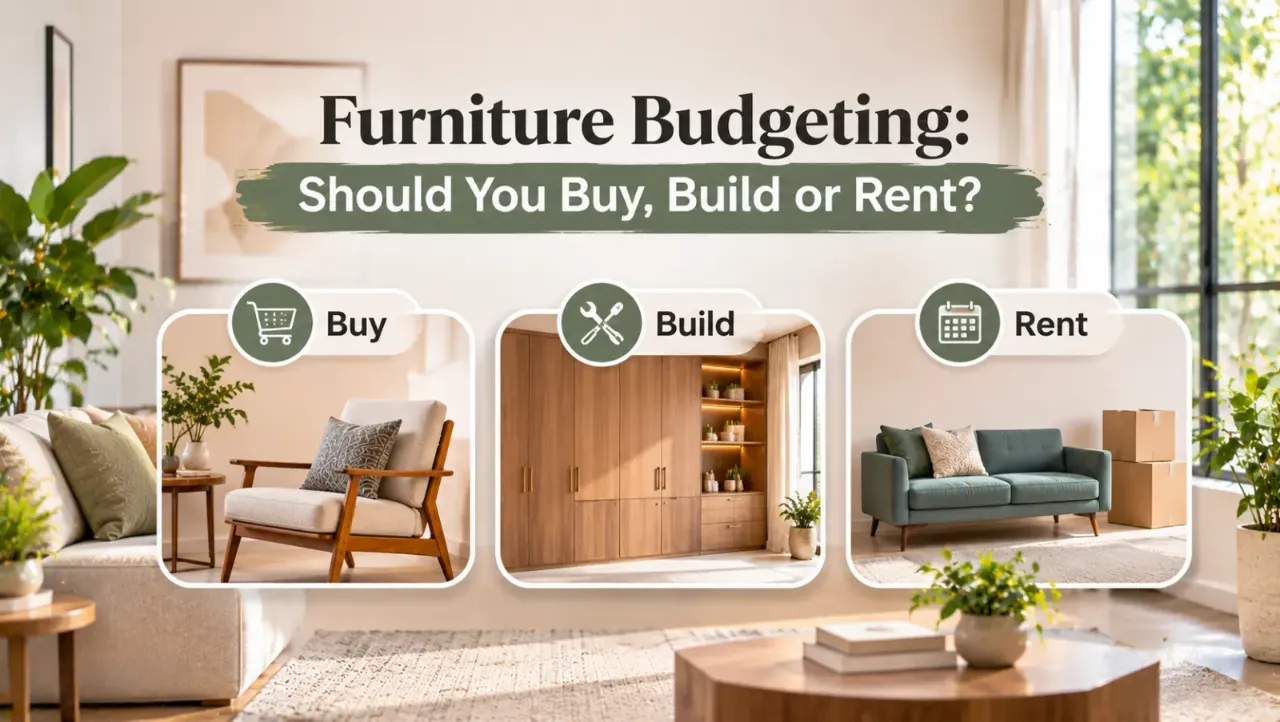
Furniture Budgeting: Should You Buy, Build or Rent?
Furnishing a home involves more than selecting furniture that looks good. Every decision, from choosing a sofa and dining table to planning wardrobes and storage units, affects your overall interior budget. But one question often creates confusion: should you purchase ready-made furniture, get it custom-built or rent it?
Each option has its own financial advantages and limitations. Buying furniture may involve a higher initial expense but can provide long-term ownership. Custom-built furniture offers greater control over dimensions, materials and design, while renting can reduce upfront costs and make furnishing a temporary home easier.
The right choice depends on how long you plan to use the furniture, your available budget, the size of your home and your lifestyle requirements.
For Indian homeowners, where moving arrangements, rental housing, family requirements and space constraints can vary considerably, understanding these differences is particularly important.
Here is how to compare buying, building and renting furniture before making a decision.
1. Understand the Three Furniture Options
Before comparing costs, it is important to understand what each option involves.
- Buying ready-made furniture: You purchase furniture that has already been manufactured and is available through furniture stores, showrooms or online retailers. It is generally suitable when you need standard furniture without waiting for custom production.
- Building custom furniture: You hire a carpenter, furniture manufacturer or interior design professional to create furniture according to your room dimensions, preferred materials and design requirements. It allows greater control over the final product.
- Renting furniture: You pay a recurring amount to use furniture for an agreed period instead of purchasing it outright. Depending on the provider, rental plans may include delivery, installation, maintenance and collection.
None of these options is automatically the cheapest. The actual cost depends on the furniture category, quality, usage period and additional expenses involved.
2. Buying Ready-Made Furniture: When Does It Make Sense?
Buying ready-made furniture is often the simplest option when you want to furnish a home without managing a custom manufacturing process.
You can compare different designs, materials, dimensions and prices before making a purchase. Many retailers also offer delivery, installation and warranty support.
Advantages of buying furniture include:
- Immediate availability: Standard furniture may be available for delivery without waiting for custom manufacturing.
- Price comparison: You can compare products from different brands and retailers.
- Variety: Ready-made furniture comes in different styles, materials, sizes and finishes.
- Ownership: Once purchased, the furniture belongs to you and can be used, moved or resold.
- Warranty options: Many products include manufacturer warranties, depending on the retailer and product category.
However, buying ready-made furniture also has certain limitations:
- Standard dimensions may not fit every room.
- Customisation options can be limited.
- Some products may require additional assembly.
- Lower-priced options may use less durable materials or hardware.
- Moving large furniture between homes can be inconvenient.
Buying is generally suitable when you expect to use the furniture for several years and can find products that match your space and requirements.
3. Custom-Built Furniture: Is It Worth the Investment?
Custom-built furniture is designed and manufactured according to your specific requirements. It is particularly useful when standard furniture does not fit your room dimensions or storage needs.
For example, an apartment with an unusually shaped bedroom may require a wardrobe designed around an existing column. Similarly, a compact kitchen may benefit from cabinets planned around available wall space and appliances.
Advantages of custom-built furniture include:
- Personalised dimensions: Furniture can be designed to fit the available space.
- Material selection: You can choose between different boards, wood types, laminates, veneers and finishes.
- Storage planning: Internal shelves, drawers and compartments can be designed around your requirements.
- Design consistency: Furniture can be coordinated with the overall interior theme.
- Better use of awkward spaces: Corners, niches and unusual wall dimensions can be utilised more effectively.
However, custom-built furniture also has limitations:
- Initial costs may be higher depending on materials and detailing.
- Manufacturing and installation take time.
- Design changes during execution can increase costs.
- Quality depends heavily on workmanship and supervision.
- Repairs and replacements may require the original manufacturer or a skilled carpenter.
Custom-built furniture is particularly useful for wardrobes, modular kitchens, TV units, study desks and storage systems where dimensions and functionality matter.
However, customisation should solve a genuine requirement. Spending extra on complicated designs or unnecessary detailing does not automatically improve furniture quality.
4. Renting Furniture: A Flexible Option for Temporary Homes
Furniture rental has become an option worth considering for people who live in rented apartments, frequently relocate or do not want to make a large initial investment.
Instead of paying the entire purchase price, you pay a monthly rental amount for the furniture you need.
Advantages of renting furniture include:
- Lower initial expense: You avoid paying the full purchase price upfront.
- Flexibility: Furniture can be returned or exchanged according to the rental agreement.
- Convenience: Some providers arrange delivery, installation and collection.
- Temporary suitability: Useful for people staying in a city for a limited period.
- Reduced relocation burden: You may avoid transporting large furniture items between homes.
However, renting furniture also has limitations:
- Monthly payments continue throughout the rental period.
- You generally do not own the furniture.
- Deposits, delivery fees and other charges may apply.
- Product selection and customisation can be limited.
- Damage, maintenance and early termination conditions depend on the agreement.
Renting can be practical for short-term requirements, but the total rental expense should always be compared with the purchase cost over the same period.
5. Buy, Build or Rent: A Side-by-Side Comparison
The three options differ in terms of ownership, flexibility, initial expenses and long-term value.
| Factor | Buy | Custom-build | Rent |
|---|---|---|---|
| Initial expense | Usually moderate to high | Moderate to high | Usually lower |
| Ownership | Yes | Yes | No |
| Customisation | Limited to available options | High | Usually limited |
| Availability | Depends on stock | Requires manufacturing time | Depends on rental inventory |
| Long-term use | Suitable | Suitable | Can become expensive over time |
| Maintenance | Owner responsibility | Owner responsibility, subject to warranty | Depends on rental agreement |
| Moving homes | Requires transportation | May be difficult for fixed furniture | Return or relocation depends on provider |
| Design flexibility | Moderate | High | Limited |
| Best suited for | Long-term homes | Specific dimensions and storage needs | Temporary living arrangements |
The comparison shows that the cheapest initial option may not necessarily be the most economical over a longer period.
6. Calculate the Actual Cost Before Making a Decision
One of the most common furniture budgeting mistakes is comparing only the purchase price or monthly rental amount.
A better approach is to calculate the total cost of ownership or usage.
For buying furniture, include:
- Purchase price.
- Delivery and installation.
- Assembly charges, if applicable.
- Maintenance and repair expenses.
- Transportation costs if you move.
For custom-built furniture, also include:
- Design and measurement charges, if applicable.
- Material costs.
- Labour and fabrication.
- Hardware and accessories.
- Finishing and installation.
- Additional expenses caused by design changes.
For rented furniture, calculate:
- Monthly rental.
- Security deposit and applicable fees.
- Delivery and installation charges.
- Maintenance or damage charges.
- Relocation or collection fees.
- Early termination charges, if applicable.
A useful starting calculation is:
- Total buying cost: Purchase price + Delivery + Installation + Estimated maintenance.
- Total custom-building cost: Materials + Labour + Hardware + Finishing + Installation.
- Total rental cost: Monthly rental × Number of months + Additional fees.
Security deposits should be considered separately because they may be refundable, depending on the agreement and applicable deductions.
7. A Hypothetical Furniture Cost Comparison
Consider a homeowner who needs a sofa for an apartment and is comparing three options.
The following figures are illustrative assumptions, not actual market quotations. They help explain how the total cost changes with the duration of use.
| Option | Assumed cost |
|---|---|
| Ready-made sofa purchase | ₹35,000 |
| Custom-built sofa | ₹45,000 |
| Sofa rental | ₹2,000 per month |
Based on these assumptions, the rental expense changes as follows:
| Usage period | Rental cost |
|---|---|
| 6 months | ₹12,000 |
| 12 months | ₹24,000 |
| 18 months | ₹36,000 |
| 24 months | ₹48,000 |
| 36 months | ₹72,000 |
At six months, renting has a lower direct cost than purchasing either sofa. At eighteen months, the rental expense exceeds the assumed ready-made purchase price.
However, this does not automatically mean purchasing is better. The comparison should also account for delivery, maintenance, resale value, product condition and the terms of the rental agreement.
For a fair comparison, compare furniture of similar quality, size and functionality.
8. Which Furniture Should You Buy, Build or Rent?
Not every furniture category requires the same approach. Some items are easier to purchase ready-made, while others benefit from custom dimensions or temporary rental arrangements.
| Furniture category | Recommended approach | Reason |
|---|---|---|
| Sofa | Buy or rent | Ready-made choices are widely available; rental suits temporary homes. |
| Wardrobe | Custom-build or buy | Custom sizing helps with specific storage requirements. |
| Modular kitchen | Custom-build | Requires accurate measurements and functional planning. |
| Dining table | Buy | Standard designs are widely available. |
| Study desk | Buy or custom-build | Depends on available space and work requirements. |
| Bed | Buy or custom-build | Long-term use and mattress compatibility matter. |
| Office chair | Buy | Comfort and ergonomic support are important. |
| TV unit | Buy or custom-build | Depends on wall dimensions and storage needs. |
| Temporary guest furniture | Rent | Useful when usage is occasional. |
| Bookshelves | Buy or custom-build | Standard or space-specific storage requirements. |
A mixed approach is often more practical than choosing only one option for the entire home.
For example, you could custom-build the kitchen and wardrobes, purchase the dining table and bed, and rent a sofa if you are living in a temporary apartment.
9. How Long Do You Plan to Use the Furniture?
The expected duration of use is one of the most important factors in furniture budgeting.
- Short-term use: If you expect to stay in a home for a few months or around a year, renting may reduce upfront expenses and relocation difficulties.
- Medium-term use: If you expect to stay for two or three years, compare rental payments against the purchase price, resale value and transportation expenses.
- Long-term use: If you are furnishing your permanent home, buying or custom-building may offer better long-term value, particularly for frequently used furniture.
However, duration alone should not determine the decision. Consider whether the furniture can be transported, reused in another home or sold when your requirements change.
10. Furniture Budgeting Mistakes to Avoid
Even a well-planned interior budget can become difficult to manage when furniture decisions are made without comparing the complete costs.
Watch out for these common mistakes:
- Choosing only by initial price: A cheaper product may require more frequent repairs or replacement.
- Ignoring measurements: Furniture that does not fit properly can create additional modification and replacement expenses.
- Over-customising everything: Custom-built furniture is useful where required, but not every piece needs to be made to order.
- Renting without checking the agreement: Understand deposits, damage policies, maintenance responsibilities and return conditions.
- Ignoring transportation costs: Large furniture items can be expensive to move between cities or homes.
- Overlooking warranties: Check what is covered, for how long and how service requests are handled.
- Buying furniture before finalising the layout: This can result in unsuitable dimensions and unnecessary purchases.
- Not comparing material quality: Two similar-looking products can differ significantly in construction and durability.
The best furniture decision is one that balances price, quality, comfort and practical use.
11. How to Plan Your Furniture Budget More Effectively
Before purchasing, building or renting furniture, prepare a furniture requirement list for each room.
Start by identifying the essential pieces and separating them from optional purchases.
- Living room: Sofa, coffee table, TV unit and selected storage.
- Bedroom: Bed, wardrobe, bedside tables and dressing unit.
- Dining area: Dining table, chairs and storage if required.
- Study: Desk, chair and bookshelf.
Once the list is ready:
- Measure each room and identify the available furniture space.
- Decide which pieces require custom dimensions.
- Compare ready-made products from multiple sellers.
- Obtain detailed quotations for custom-built furniture.
- Compare rental plans, deposits and contract conditions.
- Calculate the total cost for your expected usage period.
- Keep a contingency amount for additional expenses.
If you are planning several rooms together, prioritise essential furniture first. Decorative and additional furniture can be purchased later when the budget allows.
Closing Thoughts
There is no single answer to whether buying, building or renting furniture is better. Each option serves a different purpose, and the right decision depends on your budget, living arrangements, expected usage period and design requirements.
Buying can be suitable for long-term ownership, custom-building offers control over dimensions and storage, while renting provides flexibility when your living arrangements are temporary.
For many Indian homes, combining all three approaches may be the most practical solution. Customise the furniture that needs to fit your space, purchase standard pieces that offer long-term value and rent items that you may not need permanently.
The goal is not simply to spend less on furniture. It is to choose the right furnishing approach so that your money goes towards pieces that genuinely improve the comfort, functionality and usability of your home.
Explore More with Walls to Wonder
Planning a home interior project? Explore Walls to Wonder's AI tools to visualise design ideas, understand costs and make more informed decisions.
- Whole Home Visualizer – Explore design ideas across your home.
- Design My Room – Experiment with different room styles and looks.
- Interior Design Cost Estimate – Get an initial understanding of interior costs.
- Interior Quotation Checker – Review and understand interior quotations.
- Rate My Room Design – Get feedback on your room design.
- Interior Style Finder – Discover an interior style that suits your preferences.
Visit Walls to Wonder for more interior design ideas and inspiration.
Get a personalised estimate for your home
Choose your rooms, materials and preferences to understand a practical interior budget before you commit.