
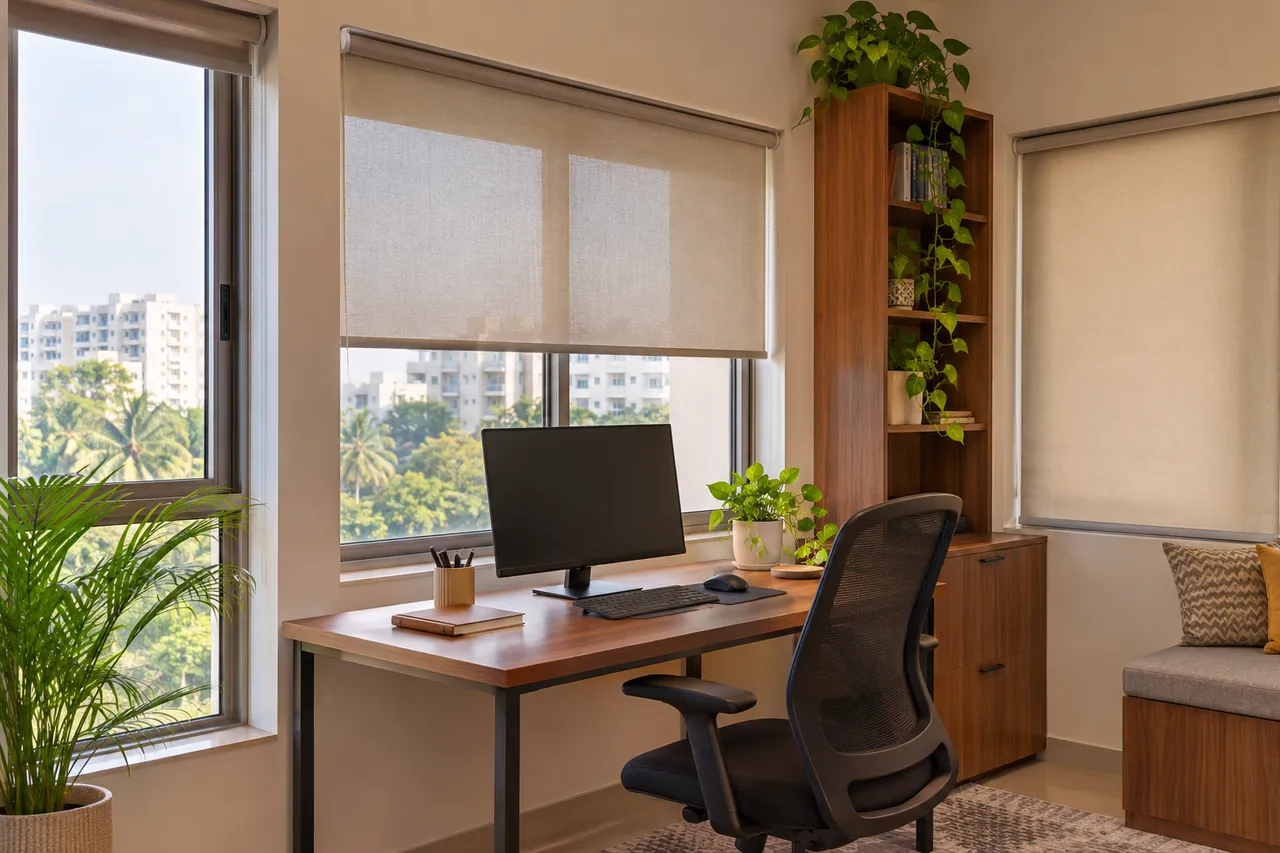
Blinds for Electronic City Home Offices: Test Screen Glare, Privacy and Window Access
Choose home-office blinds after testing light, screen reflections, privacy and window operation during actual working hours. In an Electronic City home, a blackout label or attractive fabric sample does not settle the whole room brief. Compare suitable products with the desk position before fixing hardware or assuming that darker always means better.
Start with your Electronic City property
For an Electronic City workspace, record the window orientation as observed, the desk and monitor positions and the times the room is used. Locality alone does not establish sunlight or privacy conditions. A room used for daytime work and evening household activities may need more than one lighting state. Begin with those tasks rather than choosing a blind from the wall colour.
Observe the room through the working day
Use the ordinary screen and seating position and note reflections, direct light and the view from outside where relevant. Repeat the trial at the times that matter rather than relying on a single midday photograph. Compare a reasonable desk repositioning with a window-treatment change. A blind can alter light entering the room, but it does not replace a considered workstation arrangement or establish a universal level of visual comfort.
Compare actual product functions
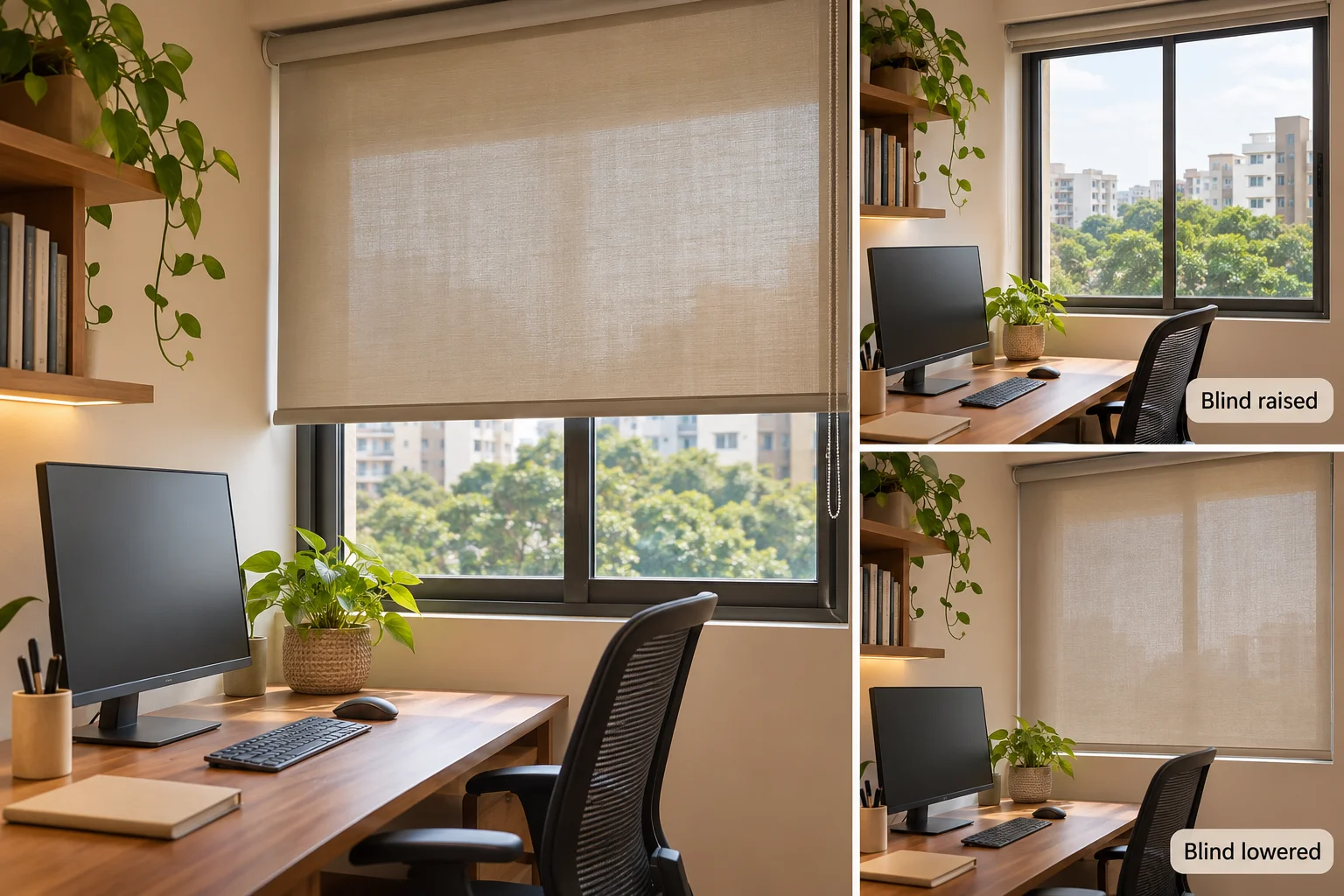
Light-filtering and block-out products serve different aims, and performance depends on the selected product and installation. Ask the supplier to explain the relevant specification and samples. Do not assume the same privacy effect by day and night. A suitable trial or demonstration is more useful than a photograph of a bright room with a partly lowered blind. Keep the household’s need for daylight, view and privacy visible in the comparison instead of optimising only for the darkest screen reflection.
Coordinate the window and controls
Open the window and check handles, cleaning and the blind’s complete travel. Have mounting and the product’s operating arrangement assessed for the actual substrate and setting. Follow relevant product safety and use instructions rather than improvising cords, fixtures or controls. If powered operation or fixed electrical changes are proposed, use the appropriate professionals and compatible products. An attractive pelmet should not make the treatment difficult to service or prevent access to the opening.
Test the finished workspace
Check the agreed arrangement with the monitor, room lights and normal video-call position if used. Confirm how the material is cleaned and how components are replaced. A successful choice supports ordinary work and the room’s other uses, not just one staged image. Retain the selected model, material and installer details. If the desk moves later, revisit light and privacy rather than assuming the window treatment remains equally effective in every furniture layout.
A practical example to test the decision
A user selects block-out fabric to address a monitor reflection. Testing the actual room reveals that desk orientation and a different light-control arrangement could retain more useful daylight. They compare those options before choosing the blind. The result follows the working routine rather than treating maximum darkness as the only goal.
Step-by-step planning checklist
- Record working times and the actual screen position.
- Observe light and privacy in relevant daytime and evening conditions.
- Compare product samples and realistic operating positions.
- Check window movement, cleaning and suitable installation.
- Test the finished room and retain product information.
What to put in the quotation
- Exact material and stated product function.
- Measured opening and compatible mounting.
- Controls, fitting and any separate electrical work.
- Cleaning, service and replacement access.
Planning budget and scope
| Scope | Planning allowance or pricing method |
|---|---|
| Observation and desk rearrangement | ₹0–₹3,000 initial allowance |
| Window treatment | Quote selected fabric, dimensions and fittings |
| Powered or bespoke installation | Separate compatible product and service scope |
The allowance is editorial, not an Electronic City supplier tariff. Compare the complete fitted treatment and specified functions. Fabric area alone may exclude controls, mounting, making good or other work needed for a useful result.
Preparation and project timing
Observe relevant working hours before ordering. Review samples and installation details before fabrication. Schedule a final room check under the conditions in the brief, not only at a convenient installer visit.
Before you approve the proposal
Keep a short record of the conditions each proposed option solves. A product that works well for one afternoon call may be less suitable for early work or evening privacy. This helps the household compare trade-offs without asking a fabric sample to prove the behaviour of the whole room. Revisit the trial whenever a major monitor or desk change alters the view.
Prepare a clearer brief with WallsToWonder
Collect photographs, measurements and the choices you want to compare. Use Design My Room to explore a visual direction, then have the relevant professional check the measured layout, product requirements and work scope. Account access and current tool allowances apply; a visual concept is not a costed construction drawing.
Organise the scope with the interior cost planning tool and explore interior companies serving Bengaluru. Confirm service availability for Electronic City directly and ask the firm to explain deliverables, site involvement and exclusions.
For related planning, read Curtains, Blinds or Sheers: Choosing Window Treatments Room by Room.
Frequently asked questions
Are blackout blinds always best for work?
No. Compare screen use with daylight, privacy and other room activities.
Will a light-filtering fabric give privacy at night?
Confirm the actual product and conditions rather than assuming day and night performance is identical.
Should I move the desk first?
Compare reasonable layout changes with the window-treatment options before fixed work.
Can a blind block window maintenance?
It can if poorly coordinated. Check handles, opening, cleaning and service access.
What should be tested after fitting?
Normal screen use, the agreed light and privacy states, controls and window access.
Further reference: IKEA India blinds and product-function options.
Turn this idea into a plan for your home
Visualise your space, understand the likely budget, or find a professional who can bring the idea to life.