
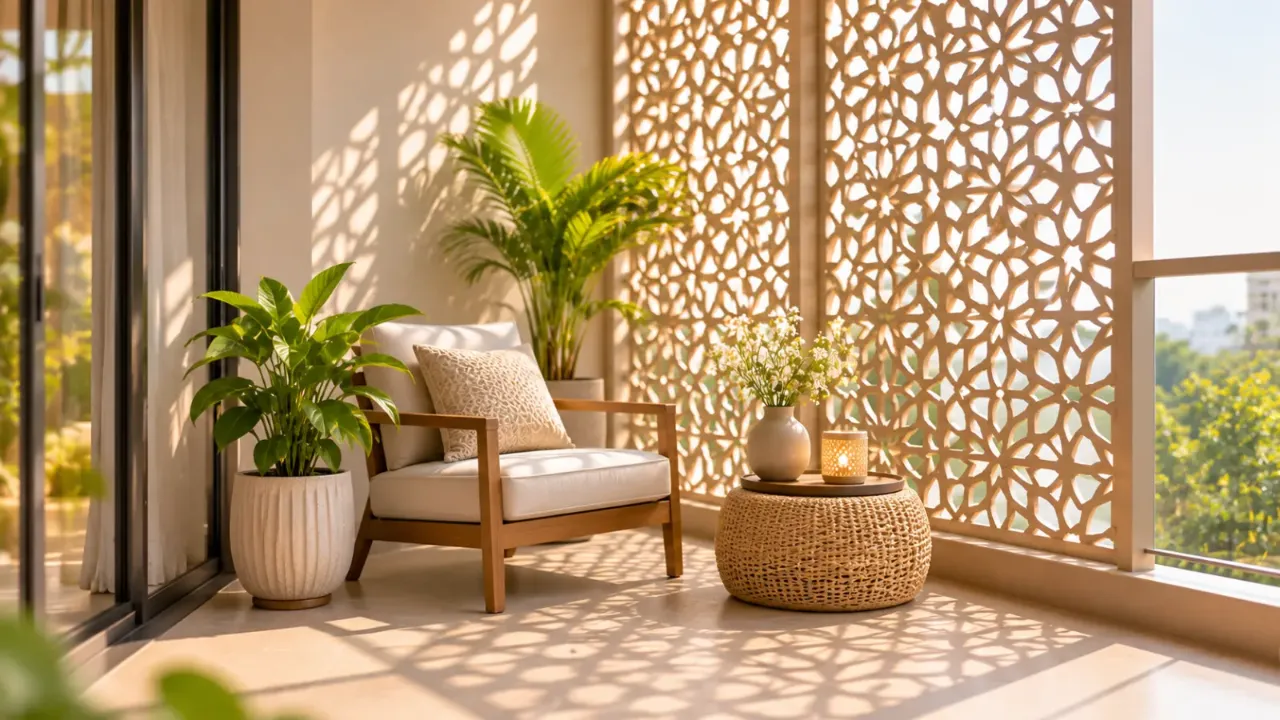
Jaali Screens in Modern Homes: Light, Privacy and Cost
Jaali screens have a long history in Indian architecture. Traditionally used in palaces, courtyards and residential buildings, these perforated screens allowed air and filtered sunlight to enter while reducing direct visibility from outside. Today, the same architectural element is finding a place in modern apartments, independent houses and contemporary interior spaces.
Modern jaali designs are available in wood, metal, stone, concrete, ceramic and engineered materials. They can be used as balcony partitions, entrance screens, room dividers, facade features and decorative panels.
But installing a jaali screen is not simply about choosing an attractive pattern. Its opening size, material, placement and orientation determine how much light enters, how much privacy it provides and how much maintenance it requires.
Before selecting one for your home, understand these important considerations.
1. What Is a Jaali Screen and Why Is It Used?
A jaali is a perforated screen made with repeated openings or cut-out patterns. These openings may be geometric, floral, traditional or completely customised.
Unlike a solid wall, a jaali creates a partially open boundary. It allows some light and air to pass through while breaking direct views between spaces.
In modern homes, jaali screens are used for several purposes:
- Providing partial privacy for balconies and windows.
- Filtering strong sunlight.
- Creating separation between living and dining areas.
- Adding visual interest to entrance spaces.
- Concealing selected service or utility areas.
- Introducing decorative patterns to exterior facades.
The important distinction is that a jaali does not provide the same privacy, security or weather protection as a solid wall. Its performance depends on the pattern, material, viewing angle and installation location.
2. How Jaali Screens Control Natural Light
One of the biggest advantages of a jaali screen is its ability to filter incoming sunlight.
Instead of allowing direct sunlight to enter through a completely open window or balcony, the perforated surface breaks the light into smaller patches. This can create interesting shadow patterns across floors and walls.
However, the result depends on several factors.
Pattern and opening size
A jaali with larger openings generally allows more light to pass through. Smaller openings create a more filtered effect, although the actual result also depends on the screen's thickness and the angle of incoming sunlight.
Screen orientation
A screen facing strong afternoon sunlight may need a different design from one receiving softer morning light. The direction of the sun can change the shadows and the amount of light entering throughout the day.
Distance from windows
A jaali placed directly in front of a window may produce a different lighting effect from one installed farther away. The gap between the screen and the opening also influences how shadows fall.
What to consider: Do not choose a pattern only from a catalogue image. Ask for a sample, mock-up or visualisation that considers the actual orientation and location of the screen.
3. Can Jaali Screens Provide Privacy Without Blocking the View?
Jaali screens are useful when you want to reduce direct visibility without completely closing a space.
For example, a balcony facing a neighbouring apartment may benefit from a screen that interrupts direct sightlines while still allowing daylight and some air movement.
However, privacy is not guaranteed simply because a screen has small openings.
- Opening size: Larger gaps can allow clearer views through the screen.
- Viewing angle: A screen may provide privacy from one direction but not another.
- Height: A low screen may not block views from neighbouring upper floors.
- Lighting conditions: At night, an illuminated interior can make the space more visible from outside.
- Screen placement: A screen placed at the balcony edge may perform differently from one positioned closer to the window.
For bedrooms, bathrooms or other spaces requiring stronger visual privacy, a jaali may need to be combined with curtains, blinds or an appropriate secondary partition.
What to consider: Review the screen from the actual neighbouring viewpoints, not just from inside your home.
4. Choosing the Right Material for Your Jaali
The material affects the appearance, durability, weight, installation method and overall cost of a jaali screen. There is no single best material for every location.
Wooden jaali
Best suited for: Interior partitions, decorative panels and selected covered areas.
Wooden jaali screens bring warmth and a natural appearance to interiors. They can work well as living-dining dividers, pooja room partitions and decorative wall features.
However, the type of wood, finish and exposure conditions matter. Wood used in damp or exposed locations may require additional protection and maintenance.
Metal jaali
Best suited for: Balcony screens, facade features, gates and contemporary partitions.
Metal jaali screens can be fabricated in geometric, floral and customised patterns. They are useful when a relatively slim screen with a distinctive appearance is required.
The choice of metal and protective finish is important, especially in exposed locations. Ask about corrosion protection, coating quality and maintenance requirements.
Concrete or cement jaali
Best suited for: Exterior walls, boundary features and architectural partitions.
Concrete jaali blocks can create a solid architectural feature while retaining openings for filtered light and airflow. They are often considered for exterior applications and boundary walls.
Their weight, support requirements, installation quality and drainage details need attention. The structural design should be checked before installation.
Stone jaali
Best suited for: Premium architectural features and selected facade or courtyard applications.
Stone jaali screens offer a distinctive natural texture and architectural character. They can work particularly well in designs that draw inspiration from traditional Indian architecture.
However, stone selection, carving complexity, thickness, weight and installation can make this option more demanding. Proper support and fixing details are essential.
Ceramic and other engineered panels
Best suited for: Decorative partitions and selected interior or exterior applications, depending on the product.
Ceramic and engineered panels offer additional choices in colour, surface finish and pattern. Their suitability depends on the specific product, its strength, intended application and installation system.
Before selecting them, confirm whether the product is rated for the proposed exposure and whether suitable fixing accessories are available.
5. Where Can You Use Jaali Screens in a Modern Home?
Jaali screens can be introduced in different parts of a house, but their design should match the function of each space.
Balcony
A balcony jaali can reduce direct visibility from neighbouring buildings while adding a decorative layer to the exterior.
Check wind exposure, fixing arrangements, maintenance access and the impact on daylight before installation.
Entrance and foyer
An entrance jaali can create a transition between the main door and living area. It can provide partial screening without making the foyer feel completely enclosed.
Living and dining area
A jaali partition can visually separate the living and dining spaces while maintaining a sense of connection. It is especially useful when a solid partition would make the layout feel smaller.
Pooja space
A patterned screen can define a pooja area within a larger room. The design can be kept subtle or made more decorative, depending on the surrounding interiors.
Staircase and landing
Jaali panels can also be incorporated into staircase enclosures or selected landing partitions. However, when used as a guard or railing, the design must satisfy applicable safety requirements. Decorative openings should not create fall or climbing hazards.
6. How Much Do Jaali Screens Cost?
The cost of a jaali screen depends on its material, size, pattern, fabrication process and installation requirements. A simple standard panel will generally involve a different budget from a customised, intricately patterned screen.
Instead of comparing prices only by material name, understand what the quotation includes.
Major factors affecting the cost
1. Material: Wood, metal, stone, concrete and engineered panels have different material and processing costs.
2. Pattern complexity: Simple geometric patterns may be easier to manufacture than intricate or highly customised designs.
3. Panel dimensions: Larger screens require more material and may need additional supports or multiple connected panels.
4. Thickness and finish: Material thickness, surface treatments, polishing, painting and protective coatings affect the final price.
5. Fabrication method: Hand carving, CNC cutting, laser cutting, moulding and standard block manufacturing involve different production processes.
6. Installation: Labour, framing, supports, brackets, transport, scaffolding and site conditions can contribute significantly to the total cost.
7. Customisation: Special colours, non-standard dimensions, customised motifs and unusual fixing arrangements may increase the overall expense.
What should a jaali quotation include?
- Material type and grade.
- Panel dimensions and thickness.
- Pattern or fabrication specifications.
- Surface finish and protective treatment.
- Frame, brackets and fixing accessories.
- Installation and labour charges.
- Transportation and handling.
- Taxes, if applicable.
- Warranty and maintenance terms, where offered.
What to consider: Ask for an itemised quotation rather than accepting a single amount for the entire installation. Compare quotations with matching dimensions, material specifications and scope of work.
7. What About Maintenance and Durability?
A jaali screen is exposed to dust, pollution and, in exterior locations, rain and sunlight. Its maintenance needs depend on the material and the complexity of its pattern.
- Wood: Check the finish periodically and protect it from moisture, insects and prolonged weather exposure as appropriate for the selected product.
- Metal: Inspect coatings, joints and exposed edges for damage or corrosion.
- Concrete: Check for cracks, surface deterioration and water-related damage.
- Stone: Clean using suitable methods and inspect joints, supports and exposed surfaces.
- Ceramic and engineered panels: Follow the manufacturer's cleaning and maintenance instructions.
Intricate patterns can collect dust in corners and narrow openings. If the screen is installed at a height or in an inaccessible position, cleaning may become difficult.
What to consider: Choose a pattern that can be cleaned easily and ensure there is sufficient access for inspection and maintenance.
8. Common Mistakes to Avoid When Selecting Jaali Screens
A beautiful jaali pattern does not necessarily make a good installation. Avoid these common mistakes:
- Choosing a pattern without considering sunlight: A screen that looks attractive in a product photograph may make an already dark room feel darker.
- Expecting complete privacy: Perforated screens provide varying levels of visual screening, not the same privacy as a solid partition.
- Ignoring the surroundings: A balcony screen should be evaluated against actual neighbouring windows, balconies and viewing angles.
- Selecting a material only for its appearance: The material must be suitable for its location and exposure conditions.
- Overlooking structural support: Heavy screens and large panels require suitable support and fixing arrangements.
- Ignoring maintenance access: Very intricate patterns can be difficult to clean, particularly on upper floors.
- Approving the design without a sample: A physical sample can help you understand the actual material, colour, thickness and finish.
9. How to Choose the Right Jaali for Your Home
Before finalising a jaali screen, start with its purpose rather than the pattern.
If you want to filter sunlight, consider the screen's orientation, opening size and distance from the window. If privacy is the main requirement, examine the viewing angles and decide whether an additional curtain or blind is necessary.
Next, select a material that suits the location, available budget and maintenance expectations. Finally, confirm the dimensions, fixing details, finish and installation scope.
A simple checklist can help:
- Identify the primary purpose: privacy, light filtering, ventilation or decoration.
- Measure the installation area accurately.
- Check the direction of sunlight and neighbouring sightlines.
- Compare material options and their maintenance requirements.
- Review the pattern using a physical sample or mock-up.
- Confirm structural support and fixing details.
- Obtain an itemised quotation.
- Plan for cleaning and future maintenance.
Closing Thoughts
Jaali screens can bring together traditional architectural character and contemporary design. Whether used on a balcony, at an entrance or as an interior partition, they can help create visual separation without completely closing a space.
The right choice depends on more than appearance. Material, pattern, light transmission, privacy, installation and maintenance all deserve attention before you commit to a design.
Plan the screen around the way you use your home, and it can become a functional architectural feature rather than just another decorative element.
Explore More with Walls to Wonder
Planning your home becomes easier when you have the right tools to explore layouts, visualise spaces and understand interior costs. Discover the tools available on Walls to Wonder:
- Whole Home Visualizer – Visualise design possibilities across your home.
- Design My Room – Explore different looks and arrangements for individual rooms.
- Interior Design Cost Estimate – Get an initial understanding of potential interior costs.
- Interior Quotation Checker – Review and understand interior quotations.
- Rate My Room Design – Get feedback on your room design.
- Interior Style Finder – Explore interior styles that match your preferences.
Visit Walls to Wonder to explore more.
Get a personalised estimate for your home
Choose your rooms, materials and preferences to understand a practical interior budget before you commit.