
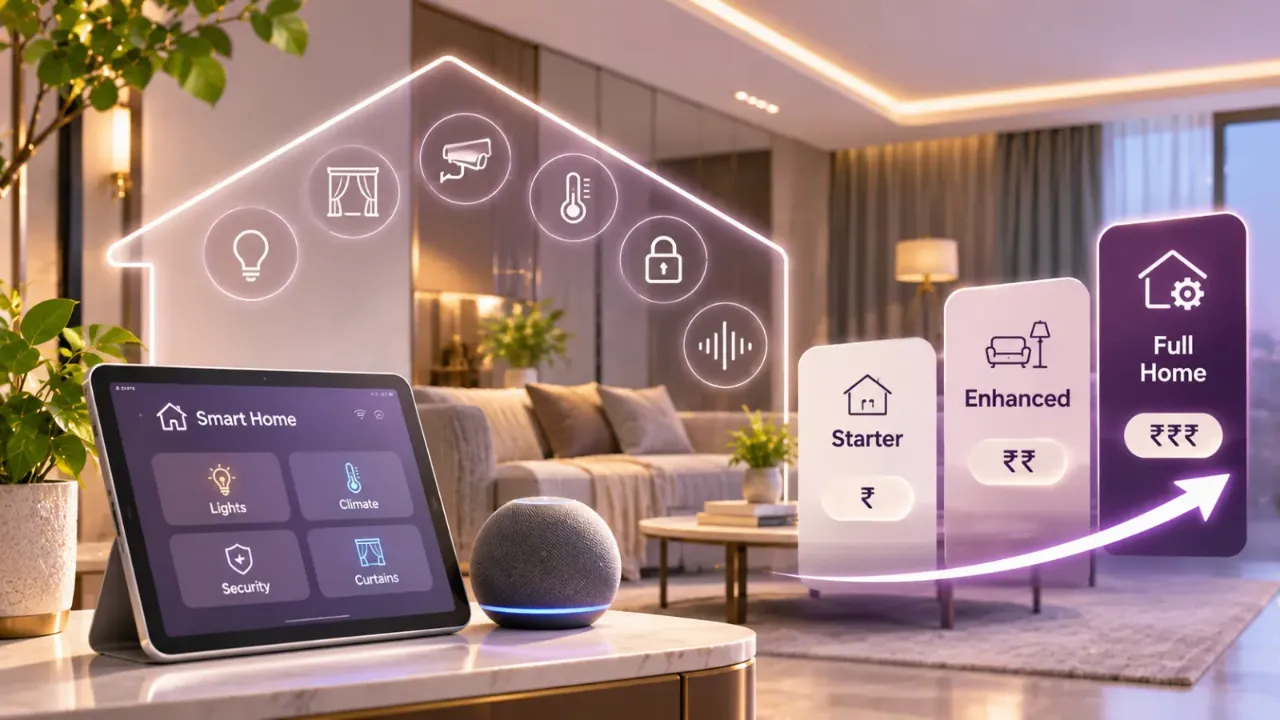
Home Automation Costs in India: Starter to Full
Home automation is no longer limited to luxury villas with voice-controlled lighting and motorised curtains. Today, even a modest apartment can have smart switches, automated geysers, motion sensors and app-controlled appliances. The bigger question is how much you should actually budget for it.
In India, home automation can start at around ₹15,000–₹45,000 for a basic set of useful devices. A more comprehensive setup for a 2BHK or 3BHK can cost ₹60,000–₹2 lakh, while extended wireless and fully wired systems can run into several lakhs.
The difference depends on what you want to automate, the technology you choose, the number of control points and whether the home is under construction or already occupied.
1. What Does Home Automation Actually Include?
Home automation means using connected devices, controllers and sensors to operate different functions of your home with less manual effort.
Depending on the system, you may be able to control:
- Lighting: Switch lights on and off, dim them or create preset lighting scenes.
- Fans and appliances: Control compatible fans, geysers, exhaust fans and selected appliances.
- Curtains and blinds: Open or close motorised curtains using an app, remote or scheduled routine.
- Air conditioning: Control compatible AC units through smart controllers or integrated systems.
- Security: Monitor cameras, smart locks, video doorbells and door or window sensors.
- Safety: Receive alerts from water-leak, gas-leak or smoke detectors.
- Water management: Automate pumps and monitor overhead tank levels.
- Entertainment: Integrate televisions, speakers and other compatible devices.
You do not need to automate every function at once. A home can begin with a few useful devices and expand over time, provided the system is selected with future compatibility in mind.
2. Home Automation Costs in India: An Overview
The easiest way to understand home automation costs is to divide the options into different levels of automation.
The following are indicative planning ranges based on published Indian market pricing around October–November 2026. They are not fixed quotations. Actual costs vary by device count, brand, home size, wiring, installation and system architecture.
| Automation level | What it generally includes | Indicative budget |
|---|---|---|
| Starter | Basic smart switches, selected sensors, geyser or pump control | ₹15,000–₹45,000 |
| Smart-ready provisions | Electrical provisions for future automation in a 3BHK | ₹15,000–₹40,000 |
| Focused automation | Smart lock, curtain motors, lighting scenes, AC control and sensors | ₹60,000–₹2,00,000 |
| Extended wireless | More rooms, lighting circuits, curtains, cameras and additional controls | ₹1.5–₹4 lakh |
| Full wired automation | Central controller, integrated lighting, curtains and other systems | ₹3–₹10 lakh or more |
| Premium integrated systems | Advanced wired lighting, climate, security and entertainment integration | Several lakhs upwards; large projects can exceed ₹15 lakh |
These categories are not directly interchangeable. Smart-ready wiring is a provision for future devices, while a starter package is an actual set of working automation products.
3. Starter Home Automation: What Can You Get for ₹15,000–₹45,000?
A starter setup is ideal if you want to experience smart home technology without investing in a complete system.
Instead of automating every room, begin with functions that solve everyday problems.
A basic package might include:
- A video door phone or smart doorbell.
- Two or three motion sensors.
- A geyser timer or smart switch.
- A water-tank level or pump controller.
- A few smart plugs or bulbs, depending on the selected package.
Illustrative device costs
| Device | Indicative price |
|---|---|
| Smart bulb | ₹500–₹1,500 each |
| Motion sensor | ₹1,000–₹3,500 each |
| Smart switch or retrofit module | ₹1,500–₹4,500 per module |
| Water-tank or pump controller | ₹2,500–₹8,000 |
| Geyser timer or smart switch | ₹1,500–₹4,500 |
| Video door phone | ₹6,000–₹30,000 |
These are indicative device-level ranges, not a package quotation. Some devices may need a compatible hub, additional wiring or installation.
Who should choose this level?
- Homeowners who are new to automation.
- People living in smaller apartments.
- Families who want to automate a few repetitive tasks.
- Homeowners who prefer to expand their system gradually.
4. Mid-Range Home Automation: What Does ₹60,000–₹2 Lakh Get You?
This is where home automation starts becoming a more noticeable part of everyday living.
A focused mid-range setup can cover several rooms and combine convenience with basic security and safety features.
Depending on the number of devices, it may include:
- Smart switches for selected lighting and fan circuits.
- App-based control and preset scenes.
- Motorised curtains in selected rooms.
- Smart door lock.
- AC control through compatible smart controllers.
- Motion and water-leak sensors.
- A hub or gateway for connected devices.
Example: A focused 3BHK setup
Consider a family that wants to automate the living room, bedrooms and a few essential functions.
| Feature | Proposed coverage |
|---|---|
| Lighting | Selected circuits in the living room and bedrooms |
| Curtains | Motorised curtains in the living room and master bedroom |
| Climate | AC control in selected rooms |
| Security | One smart lock and selected sensors |
| Water management | Pump or tank automation |
| Control | Mobile app, selected keypads and routines |
The actual cost will depend on the number of switchboards, curtain tracks, sensors and compatible appliances.
Who should choose this level?
- Families planning long-term use of their home.
- Homeowners who want lighting and appliance control in multiple rooms.
- People who want selected security and convenience features without a complete wired system.
5. Extended Wireless Automation: What Does ₹1.5–₹4 Lakh Include?
An extended wireless system provides broader coverage across the home.
Rather than controlling only a few devices, it can connect most of the important lighting and convenience functions.
A setup at this level may include:
- Smart lighting control across most rooms.
- Multiple scene keypads or smart switch panels.
- More motorised curtains and blinds.
- Smart locks and video doorbells.
- Indoor or outdoor cameras.
- Motion, door and water-leak sensors.
- AC control across multiple rooms.
- Centralised app-based control and automation routines.
The exact configuration matters more than the package name. Two vendors may both describe their offering as a full smart home while providing very different numbers of controlled circuits and devices.
Before accepting a proposal, ask for a room-wise list of every device and function included.
6. Full Wired Home Automation: What Does ₹3–₹10 Lakh or More Mean?
A full wired system is a more integrated approach to automation. It is generally considered when a homeowner is constructing a new property or undertaking a major renovation.
Instead of relying entirely on individual wireless devices, the system uses dedicated wiring and centralised control infrastructure.
Depending on the design, it may integrate:
- Lighting circuits and dimming.
- Scene-based control through wall keypads.
- Motorised curtains and blinds.
- Air conditioning and climate control.
- Security and access systems.
- Selected entertainment and audio systems.
- Centralised monitoring and control.
Systems such as KNX and DALI may be used for different parts of an integrated setup. They are not identical technologies: KNX is a building automation communication standard, while DALI is primarily used for digital lighting control.
A professionally designed wired installation can offer coordinated control and local operation, but it requires more planning, technical design, programming and commissioning.
For large villas and premium projects, budgets can go well beyond ₹10 lakh depending on the number of circuits, control panels, lighting fixtures, brands and integrated systems.
7. Wired vs Wireless Home Automation: Which Costs More?
The technology you choose has a major influence on the total budget.
| Factor | Wireless system | Wired system |
|---|---|---|
| Installation | Often easier in an existing home | Requires planned cabling and infrastructure |
| Initial investment | Usually lower | Usually higher |
| Best suited for | Existing apartments and phased upgrades | New construction and major renovations |
| Expansion | Depends on device and hub compatibility | Depends on system architecture and available infrastructure |
| Internet dependency | Varies by product and configuration | Can support local control without internet |
| Maintenance | Device batteries, connectivity and software updates may be relevant | Controller, wiring and programming support may be required |
| Planning | Can be introduced in stages | Should be planned early in the electrical design |
Wireless does not automatically mean unreliable, and wired does not automatically mean better for every home. The right choice depends on the property, budget, desired functions and expected period of use.
A hybrid approach can also work well: use suitable wired infrastructure for essential functions and wireless devices for features that may change over time.
8. What Factors Affect Home Automation Costs?
Two homes of the same size can have very different automation budgets. The following factors usually make the biggest difference.
Number of rooms and control points
A 3BHK with lighting automation in every room will cost more than one where only the living room, master bedroom and entrance are automated. The number of circuits, switchboards, sensors and keypads is often more important than the total carpet area.
Type of devices and features
Basic smart switches are generally less expensive than premium touch panels. Motorised curtains, smart locks, cameras and multi-room audio can increase the total substantially.
Brand and product range
Different brands offer different levels of design, compatibility, support and functionality. Premium keypads and controllers can cost considerably more than basic smart modules.
New construction vs retrofit
Installing automation during construction allows wiring and electrical provisions to be planned in advance.
In an existing home, additional work may be needed to accommodate modules, change switch boxes, add wiring or modify ceilings and walls. This can increase installation costs.
System integration
A system controlling only lights is simpler than one coordinating lighting, AC, curtains, security, audio and other functions. The more systems you integrate, the more important the controller, programming and commissioning become.
Network and infrastructure
A reliable Wi-Fi network, suitable hub placement, structured cabling and backup power for important equipment can add to the initial investment.
9. Hidden Costs You Should Include in Your Budget
The advertised price of a home automation package may not represent the complete amount you will pay.
Before approving a quotation, check whether it includes:
- Installation and electrician charges.
- Additional wiring and electrical modifications.
- Switch-box replacements or deeper back boxes.
- Hub, gateway or central controller.
- Wi-Fi access points or network upgrades.
- Programming and scene configuration.
- Integration with existing appliances.
- Civil work and false-ceiling modifications.
- Batteries and replacement accessories.
- App subscriptions or cloud storage fees.
- Annual maintenance or technical support.
- GST and other applicable taxes.
For example, a quotation may include motorised curtain motors but exclude the curtain fabric, track modifications or electrical points. Similarly, a smart camera may include local recording but charge separately for cloud storage.
Ask the vendor to separate hardware, installation, programming, civil work, taxes and recurring charges.
10. How to Make Your Home Automation Budget More Efficient
You do not need to automate every appliance to have a useful smart home. A phased approach can help you spend money where it makes the most difference.
Start with everyday functions
Prioritise lights, fans, geysers, entrance security and water-pump control. These are often more useful than adding multiple decorative smart devices.
Automate rooms selectively
Begin with the living room, master bedroom and entrance. Add other bedrooms or utility areas when there is a clear need.
Plan wiring before interiors begin
If your home is under construction, discuss neutral wires, deeper switch boxes, spare conduits, network points and power provisions with the electrician and automation integrator.
These provisions can make future upgrades easier without requiring extensive wall modifications.
Avoid unnecessary premium features
Motorised curtains, premium touch panels and whole-home audio can be attractive, but consider how frequently your family will use them. Choose features based on your routines rather than the number of devices a package offers.
Check compatibility before buying
Make sure your devices can communicate with the selected hub or control platform. Ask whether essential functions continue to work when the internet is unavailable.
11. Questions to Ask a Home Automation Vendor Before Finalising
Before selecting a system, ask the vendor:
- Which devices and circuits are included in the quotation?
- Is the system wired, wireless or hybrid?
- Which functions work without an internet connection?
- Does the system require a hub or central controller?
- Can the devices from different brands work together?
- Are installation, programming and commissioning included?
- Are app access and cloud services free or subscription-based?
- What happens if the internet or Wi-Fi connection stops working?
- What warranty applies to each device and controller?
- Will the configuration and programming details be handed over?
- Can the system be expanded in the future?
- What are the annual maintenance and replacement costs?
Get the answers in writing. A detailed device schedule and scope of work make it easier to compare quotations from different vendors.
12. Which Home Automation Budget Should You Choose?
The right budget depends on your home and how much control you actually need.
| Your requirement | A sensible starting point |
|---|---|
| A few smart devices and basic convenience | Starter setup |
| Lighting, geyser and selected appliance control | Starter to focused setup |
| Smart lighting, curtains, locks and sensors in multiple rooms | Focused or extended wireless |
| Automation across most rooms with multiple integrated systems | Extended or full system |
| New villa with centralised lighting, climate and security control | Professionally designed wired or hybrid system |
For most homeowners, starting with a focused set of useful functions is more practical than trying to automate everything immediately.
If you are building a new home and expect to stay for many years, investing in suitable electrical and network provisions early can keep future options open.
Closing Thoughts
Home automation in India can be as simple as controlling a few lights through your phone or as comprehensive as managing lighting, curtains, climate, security and entertainment through a central system.
The important thing is to choose technology that fits your home, routines and budget. A well-planned starter setup can be more useful than an expensive system filled with features your family rarely uses.
Before investing, compare complete quotations, check offline functionality, understand recurring costs and plan the electrical infrastructure properly. A smart home should make everyday living easier—not make maintenance and technology more complicated.
Explore More with Walls to Wonder
Planning your home interiors? Explore Walls to Wonder's AI-powered tools to visualise your space, estimate interior costs, check quotations and discover your design style.
- Whole Home Visualizer
- Design My Room
- Interior Design Cost Estimate
- Interior Quotation Checker
- Rate My Room Design
- Interior Style Finder
Visit Walls to Wonder to explore more ways to plan your home.
Get a personalised estimate for your home
Choose your rooms, materials and preferences to understand a practical interior budget before you commit.