
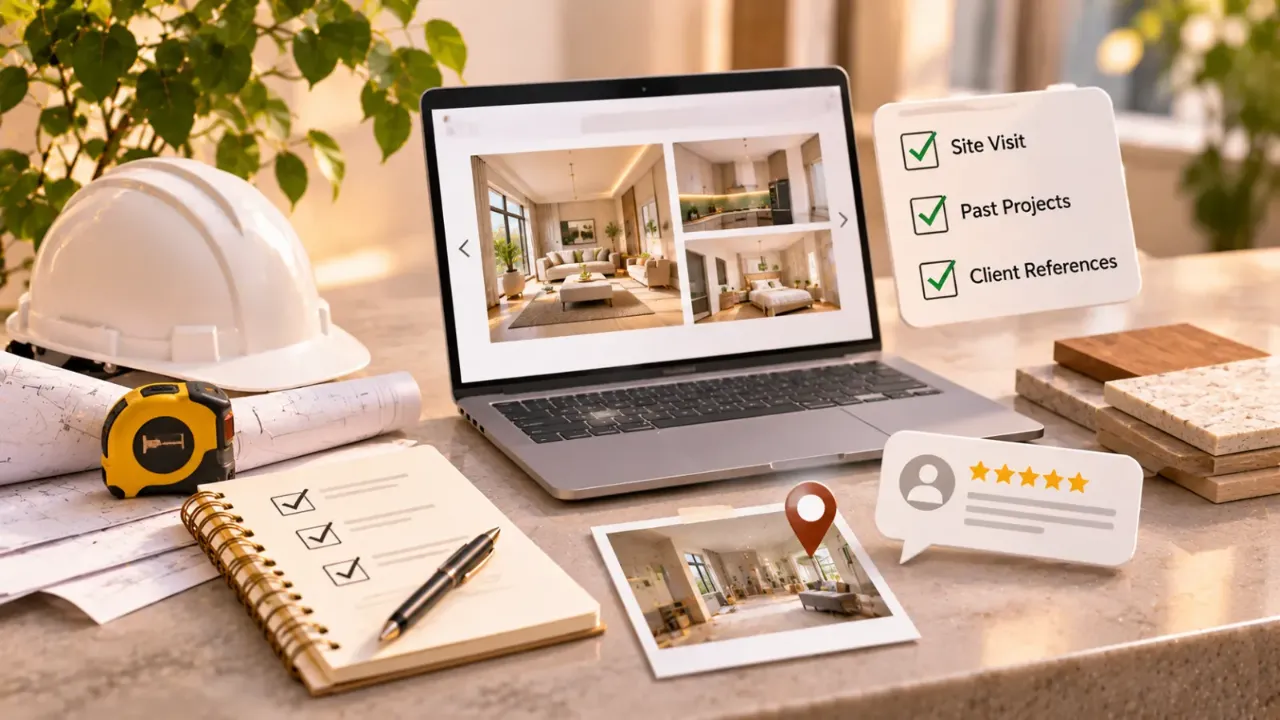
Checking a Designer's Past Work: Site Visits and References
A beautiful portfolio can make an interior designer's work look impressive, but photographs alone cannot tell you how well a project was executed, whether it stayed within budget or how the designer handled problems along the way.
Before hiring someone for your home, take the time to verify their past work. Visit a completed project, observe a site that is still under execution and speak directly with previous clients. These checks can help you understand what working with the designer may actually be like.
1. Look Beyond the Portfolio Photographs
A portfolio is a useful starting point, but it should not be the only basis for your decision. Professional photographs and 3D renders can make almost any design look appealing. What matters is whether the designer can translate those ideas into a functional, well-executed space.
While reviewing a portfolio, check:
- Whether the projects are completed or only conceptual renders.
- Whether the designer has worked on homes similar to yours.
- Whether the layouts suit the size and type of property you have.
- Whether the material finishes and detailing appear consistent.
- Whether the portfolio shows different styles or repeats the same design approach.
- Whether before-and-after photographs are available for renovation projects.
Ask the designer to explain their role in each project. Did they handle only the design, or were they also responsible for procurement, contractor coordination, site supervision and execution?
This distinction matters because a designer's involvement in a project may be very different from the services you are expecting.
2. Ask to See Projects Similar to Yours
A designer may have an impressive portfolio, but not every project demonstrates experience relevant to your requirements.
For example, someone who mainly designs large villas may approach a compact 2BHK apartment differently from a designer who regularly works with smaller urban homes.
Try to see projects that match your:
- Property type: apartment, independent house, villa or renovation.
- Approximate size and room configuration.
- Budget range.
- Design requirements, such as modular kitchens, storage or space-saving furniture.
- Preferred style and material choices.
You do not need an exact match. The purpose is to understand whether the designer has handled similar constraints and can explain how they solved them.
3. Arrange a Visit to a Completed Project
A completed site visit is one of the most useful ways to evaluate a designer's work. It allows you to see the actual space rather than relying entirely on selected photographs.
Request permission to visit a completed project and, where possible, speak with the homeowner.
Finishing and workmanship
- Are laminate edges and joints neatly finished?
- Are shutters aligned properly?
- Do drawers and hinges operate smoothly?
- Are corners, skirting and wall junctions finished cleanly?
- Are there visible gaps, uneven surfaces or signs of poor installation?
Functionality
- Does the furniture work comfortably in everyday use?
- Is there enough clearance around beds, dining tables and wardrobes?
- Are storage units practical and accessible?
- Are switches, sockets and lighting positioned sensibly?
- Does the layout support the homeowner's daily routine?
Material quality
- Do the installed materials appear consistent with the approved specifications?
- Are surfaces showing premature damage or peeling?
- Do hardware components operate as expected?
- Are there signs of moisture damage or poor sealing in kitchens and bathrooms?
A finished home gives you a better understanding of the final result, but remember that one site cannot guarantee how every future project will be executed.
4. Visit a Project That Is Still Under Execution
A completed home shows you the result. A running site shows you something equally important: how the designer and execution team work.
If possible, request a visit to a project that is currently under construction or installation.
Observe:
- Whether working drawings are available on site.
- Whether carpenters and contractors are following the approved drawings.
- Whether materials are stored safely and labelled appropriately.
- Whether the site is reasonably organised and protected.
- Whether the site supervisor is present and understands the work.
- Whether the designer or a designated team member visits the site.
- Whether work appears coordinated across different trades.
You can also ask the homeowner how updates are shared and how issues are resolved.
A busy or unfinished site will naturally look different from a completed home. Do not judge it by appearance alone; focus on organisation, communication, safety and whether the work follows the agreed plan.
5. Speak Directly to Previous Clients
Client references can reveal details that photographs and presentations cannot. Ask the designer to connect you with two or three previous clients, preferably people whose projects are similar to yours.
Contact them directly, with their permission, rather than relying only on testimonials selected for a website or social media page.
Instead of asking only, "Were you happy with the designer?", ask specific questions:
- Was the project completed within the expected timeline?
- Did the final cost remain close to the original quotation?
- Were additional charges explained and approved?
- Did the designer communicate regularly?
- Were material specifications followed?
- How were mistakes or changes handled?
- Was the site supervisor responsive?
- Were defects addressed after handover?
- Would you hire the same designer again?
The answers can help you understand the designer's working style and reliability.
6. Ask About Budget and Timeline Management
A project may look excellent after completion, but the experience of reaching that result matters too.
Ask previous clients whether the designer managed the project responsibly in terms of money and time.
For budget management, find out:
- Whether the original quotation was detailed.
- Whether any major costs were missing from the initial estimate.
- Whether changes were communicated before additional work began.
- Whether the final bill was explained clearly.
For timelines, ask:
- When was the project originally expected to finish?
- Was the handover delayed?
- Were delays communicated in advance?
- Were material procurement and contractor schedules coordinated?
Some changes and delays are normal in interior projects. What matters is whether they were communicated, documented and managed transparently.
7. Find Out Who Actually Worked on the Project
The person presenting the portfolio may not be the person who manages your project.
In some studios, the principal designer handles the initial meetings while junior designers, project managers, contractors or site supervisors take over during execution.
Ask clearly:
- Who prepared the design and drawings?
- Who will be your day-to-day contact?
- Who will coordinate contractors and suppliers?
- Who will supervise the site?
- How frequently will the designer visit?
- Who will handle questions and approvals?
If possible, meet the people who will be directly involved in your project. This helps avoid a situation where your expectations are based on one person but your actual experience involves an entirely different team.
8. Verify That the Portfolio Work Belongs to the Designer
It is reasonable to ask for clarification about the designer's role in the projects they present.
A studio may showcase projects completed in collaboration with architects, contractors, photographers or other design firms. That is not necessarily a problem, but the contribution of each party should be clear.
Ask:
- Was this project designed and executed by your team?
- Did you handle the complete project or only selected rooms?
- Was the work completed by your in-house team or an external contractor?
- Can you show drawings or material specifications from this project?
- Are these photographs of the completed site or 3D visualisations?
For shortlisted projects, compare the photographs with other available evidence, such as approved drawings, project details or a permitted site visit.
Do not assume that every image on a designer's social media account represents work independently completed by that designer.
9. Check Reviews, But Look for Patterns
Online reviews can help you identify recurring experiences, but they should not replace direct verification.
Look beyond the overall star rating. Read what clients are actually saying.
Pay attention to repeated comments about:
- Delayed project completion.
- Unexplained cost increases.
- Poor communication.
- Changes in material quality.
- Incomplete finishing.
- Difficulty getting post-handover support.
One negative review does not automatically mean a designer is unreliable. Similarly, several positive reviews do not prove that every project was successful.
Look for specific, consistent details across different reviews and platforms. Treat anonymous or unverified claims as signals to investigate, not as established facts.
10. Red Flags During Site Visits and Reference Checks
Certain warning signs deserve closer attention before you make a commitment.
| Warning sign | Why it matters |
|---|---|
| Only 3D renders are shown | Actual execution quality remains unverified |
| No completed project can be visited | You have limited opportunity to inspect finished work |
| References are unavailable | Past client experience cannot be checked directly |
| The designer avoids questions about project costs | Budget management may lack transparency |
| The person presenting the work cannot explain their role | Their actual contribution may be unclear |
| The site team does not know the approved drawings | Design and execution may not be properly coordinated |
| Repeated complaints about unresolved defects | After-sales support may be a concern |
| Pressure to decide without verification | You are not being given reasonable time to evaluate the proposal |
One warning sign does not necessarily prove poor work. However, several unexplained warning signs together should make you pause and investigate further.
11. A Practical Checklist Before Hiring
Use this checklist when evaluating a shortlisted interior designer:
- Reviewed completed projects, not only 3D renders.
- Seen projects similar to my property type and requirements.
- Visited at least one completed project.
- Visited a running project, where possible.
- Inspected finishing, materials and furniture functionality.
- Spoken directly to two or three previous clients, with permission.
- Asked about budget changes and project delays.
- Understood how complaints and defects were handled.
- Confirmed who will work on and supervise my project.
- Clarified the designer's role in the portfolio projects.
- Checked online reviews for recurring patterns.
- Compared the designer's working process with the proposed scope and quotation.
Keep your notes from each meeting and site visit. They will help you compare designers based on evidence rather than first impressions.
12. Make Your Final Decision Based on More Than Appearance
After reviewing portfolios, visiting sites and speaking with previous clients, compare the designers on the aspects that will affect your own project.
Consider their design quality, execution experience, communication, budget transparency, site supervision and ability to handle unexpected issues.
A designer whose style looks impressive may not necessarily be the best match for your home. Choose someone who understands your requirements, explains their process clearly and can demonstrate how they have managed similar projects.
Closing Thoughts
Hiring an interior designer is a decision that affects your budget, home and everyday comfort. A portfolio can introduce you to a designer's style, but completed projects, site visits and client references help you understand the quality and experience behind that presentation.
Take the time to verify the work, ask specific questions and speak to people who have already worked with the designer. A little research before signing can help you make a more informed decision and begin your interior project with greater confidence.
Explore More with Walls to Wonder
Planning your home interiors? Explore Walls to Wonder's AI-powered tools to estimate costs, check quotations, discover your style and visualise your space before making decisions.
- Whole Home Visualizer
- Design My Room
- Interior Design Cost Estimate
- Interior Quotation Checker
- Rate My Room Design
- Interior Style Finder
Visit Walls to Wonder to explore more ways to plan your home.
Turn this idea into a plan for your home
Visualise your space, understand the likely budget, or find a professional who can bring the idea to life.